
You might assume AI legal drafting is flawless, but top AI tools exceed human lawyers with 73.3% reliability versus 56.7% for humans. AI transforms how legal professionals and small businesses create documents, yet critical gaps remain. This guide reveals what AI can reliably handle, where it fails dangerously, and how to integrate these tools safely into your workflow without exposing yourself to legal risks.
Table of Contents
- Understanding AI's Capabilities And Limitations In Legal Drafting
- Evaluating AI Reliability And Risks In Legal Document Drafting
- Integrating AI Tools Effectively In Legal Workflows For Small Businesses And Professionals
- Challenges And The Future Outlook For AI In Legal Document Drafting
- Explore AI-Powered Legal Document Drafting Solutions
Key takeaways
| Point | Details |
|---|---|
| AI boosts efficiency but needs oversight | AI accelerates drafting speed dramatically but requires human review to catch errors and ensure compliance. |
| Specialized tools outperform humans | Leading AI drafting platforms show higher first-draft accuracy than human lawyers in contract creation. |
| Performance varies widely | AI models differ significantly in reliability, usability, and integration capabilities with existing workflows. |
| Safety reduces usability | Safety-trained models minimize hallucinations but frequently refuse legitimate legal queries, limiting practical use. |
| Human review remains mandatory | AI-generated documents must undergo thorough legal review to prevent fabricated citations and costly mistakes. |
Understanding AI's capabilities and limitations in legal drafting
Legal document building relies on predefined schemas and AI assistance like JusBuild architecture. These systems assemble draft documents from structured inputs and approved templates, not through creative legal reasoning. The AI analyzes your requirements, selects appropriate clauses from its training data, and generates a first draft that mirrors common legal language patterns.
AI legal document generators operate by matching your inputs to template structures and legal precedents. The process involves natural language processing to understand your needs, retrieval of relevant clauses from vast databases, and assembly into coherent documents. However, these tools cannot replace legal judgment or make strategic decisions about outcomes.
Human oversight remains non-negotiable. You must review every AI-generated document for accuracy, compliance with current laws, and appropriateness for your specific situation. Digital workflows must maintain competence standards, protect client confidentiality, ensure proper supervision, and facilitate clear communication about AI's role.
Best practices for AI drafting workflows:
- Verify all legal citations and statutory references independently
- Cross-check clauses against jurisdiction-specific requirements
- Ensure AI outputs align with client objectives and risk tolerance
- Document your review process for professional liability protection
Pro Tip: Treat AI drafts as sophisticated templates requiring the same level of scrutiny you'd apply to any junior associate's work, not as finished products.
"AI assists legal practitioners in building documents more efficiently, but the architecture requires human validation at every stage to ensure legal soundness and client protection."
Explore legal AI tools overview to understand how different platforms approach document generation and which features matter most for your practice.
Evaluating AI reliability and risks in legal document drafting
Recent benchmarks reveal AI tools achieve 73.3% reliability compared to 56.7% for human lawyers in contract drafting first drafts. This performance gap demonstrates AI's potential, yet wide variation exists among different tools. Some specialized legal AI platforms consistently outperform generalist models, while others produce unreliable outputs that require extensive corrections.

AI hallucinations pose serious legal exposure. These systems can generate fabricated citations and critical errors that lead to financial penalties and legal disputes. A surge in mediation cases involving DIY AI-generated contracts highlights real-world consequences when users skip human review.
| Risk Category | Impact Level | Mitigation Strategy |
|---|---|---|
| Fabricated case citations | High | Verify every citation independently through legal databases |
| Incorrect jurisdictional clauses | High | Cross-reference against current local laws and regulations |
| Ambiguous liability terms | Medium | Review with experienced counsel before finalization |
| Missing critical disclosures | High | Use comprehensive checklists for document completeness |
| Outdated regulatory references | Medium | Confirm compliance with 2026 legal standards |
Safety-trained AI models attempt to reduce hallucinations but create usability problems. These systems refuse many legitimate legal questions to avoid generating incorrect information, forcing users to rephrase requests repeatedly or abandon the tool entirely. The trade-off between accuracy and practicality affects workflow efficiency.
You cannot eliminate AI error risk completely. Human supervision remains essential to protect against legal and financial exposure from automated drafting mistakes. Every document requires qualified review before use in any legal context or business transaction.
Pro Tip: Create a verification checklist specific to your practice area, documenting common AI errors you've encountered to catch patterns faster in future reviews.
Research legal drafting accuracy to access updated benchmarks comparing AI performance across different document types and legal specialties.
Integrating AI tools effectively in legal workflows for small businesses and professionals
Successful AI integration requires alignment with your existing document creation processes. You need tools that fit naturally into how you already work, not systems that force workflow overhauls. Start by identifying repetitive drafting tasks where AI can deliver immediate value without disrupting established procedures.
Integration with Microsoft Word matters significantly, as two-thirds of legal AI products support this platform. This compatibility reduces training time and maintains familiar interfaces for your team. Look for tools offering seamless plugins rather than standalone applications requiring document transfers.
Implementation steps for AI drafting integration:
- Identify high-volume, template-based documents suitable for AI assistance
- Select AI tools offering integration with your current drafting software
- Establish review protocols ensuring human oversight before finalization
- Train staff on AI capabilities, limitations, and verification procedures
- Create client communication guidelines explaining AI's role in your process
- Monitor performance metrics comparing AI-assisted versus traditional drafting
Workflow design should support competence, confidentiality, supervision, and communication requirements. Your protocols must ensure AI-generated drafts receive thorough human review before client delivery. Document your quality control process to demonstrate professional standards compliance.
Balance efficiency gains against competence requirements. AI accelerates initial drafting but should not compress review time below professional standards. Allocate time savings toward deeper analysis and strategic counseling rather than eliminating review steps entirely.
Pro Tip: Pilot AI tools on low-risk documents first, building confidence and refining workflows before expanding to complex or high-stakes matters.
Awareness of AI model trade-offs guides tool selection. Some platforms prioritize speed, others emphasize accuracy, and safety-focused models sacrifice usability to minimize errors. Match tool characteristics to your specific practice needs and risk tolerance.
Key integration considerations:
- Data security and client confidentiality protections
- Version control for AI-generated and human-edited documents
- Audit trails documenting AI use and human review
- Professional liability insurance coverage for AI-assisted work
- Ethical disclosure requirements in your jurisdiction
Discover legal AI workflow integration strategies tailored to different practice sizes and specialties, including implementation timelines and success metrics.
Challenges and the future outlook for AI in legal document drafting
Large language models face fundamental limitations in legal contexts. LLMs produce brittle, arbitrary outputs that make them unsuitable for judicial chambers without significant human oversight. These systems struggle with consistent legal interpretation across similar fact patterns, generating different answers to identical questions based on minor prompt variations.
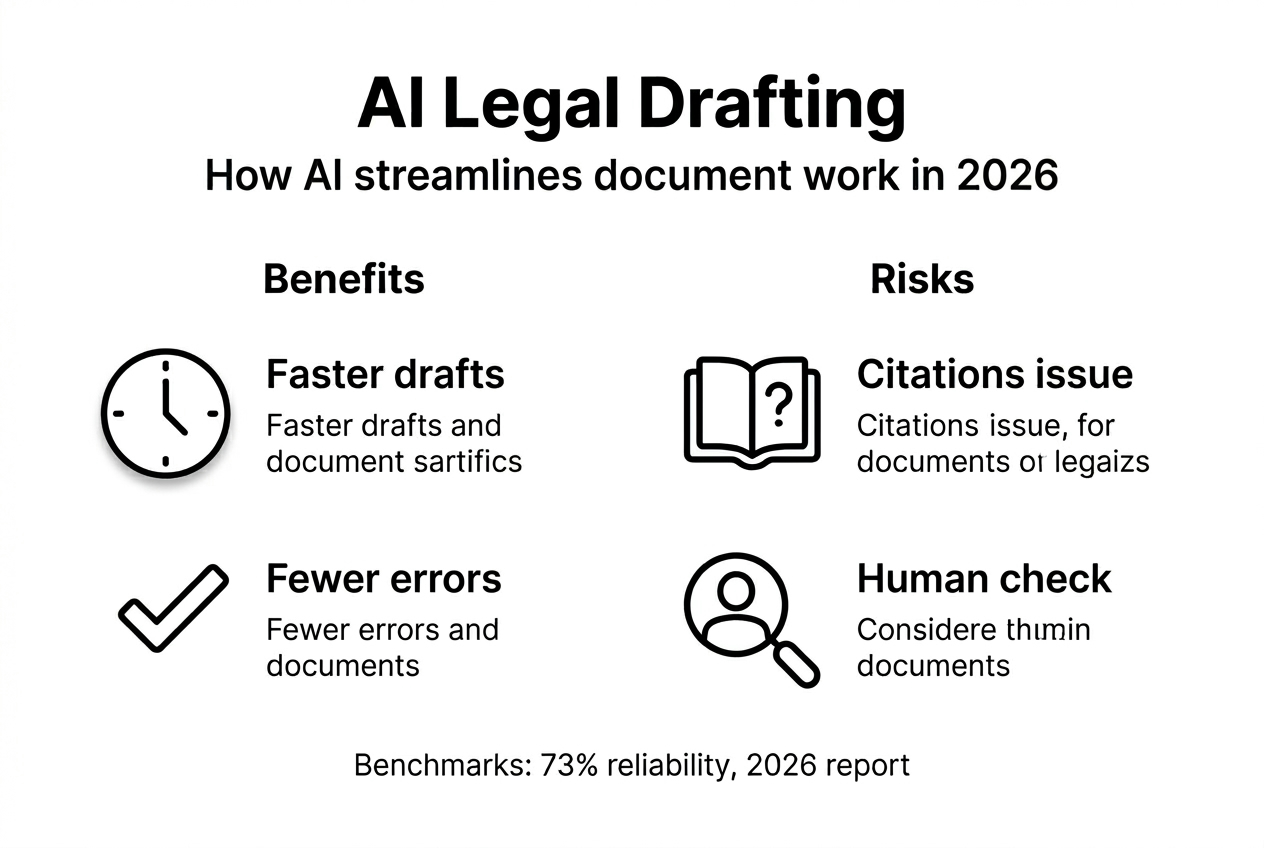
Safety-trained models balance refusal rates against contract scoring accuracy. While these systems reduce hallucinations, they refuse many legitimate legal questions, creating friction in professional workflows. Users must navigate between models that answer too freely with errors and models that refuse too often despite having relevant knowledge.
Ongoing research focuses on improving reliability, usability, and compliance for professional adoption. Developers work on reducing hallucinations without sacrificing practical utility, but current technology remains far from replacing human legal expertise. You must stay informed about AI limitations rather than assuming steady improvement solves all problems.
Current AI limitations in legal drafting:
- Inconsistent application of legal principles across similar scenarios
- Difficulty incorporating recent case law and regulatory changes
- Inability to assess strategic implications of clause choices
- Limited understanding of client-specific risk tolerance and priorities
- Struggles with multi-jurisdictional compliance requirements
Future developments may enhance AI's role but require transparent governance and ethical standards. Professional organizations are developing guidelines for AI use in legal practice, addressing disclosure requirements, liability allocation, and quality assurance protocols. You should monitor these evolving standards to ensure compliance.
"The challenge isn't whether AI can draft documents, it's whether AI can understand the legal nuances, strategic objectives, and ethical obligations that human lawyers navigate instinctively in every matter."
Users cannot fully replace human legal expertise with current AI technology. While AI assists efficiently with routine drafting tasks, strategic decision-making, judgment calls, and client counseling remain distinctly human responsibilities. The foreseeable future involves AI augmentation rather than replacement of legal professionals.
Explore advanced legal AI capabilities to understand emerging technologies and how they might impact your practice over the next few years.
Explore AI-powered legal document drafting solutions
After understanding both AI's potential and pitfalls, consider how specialized tools can enhance your practice safely. BXP Legal AI offers AI-powered draft generation integrated with expert legal oversight, designed specifically for professionals who need efficiency without compromising quality or compliance.
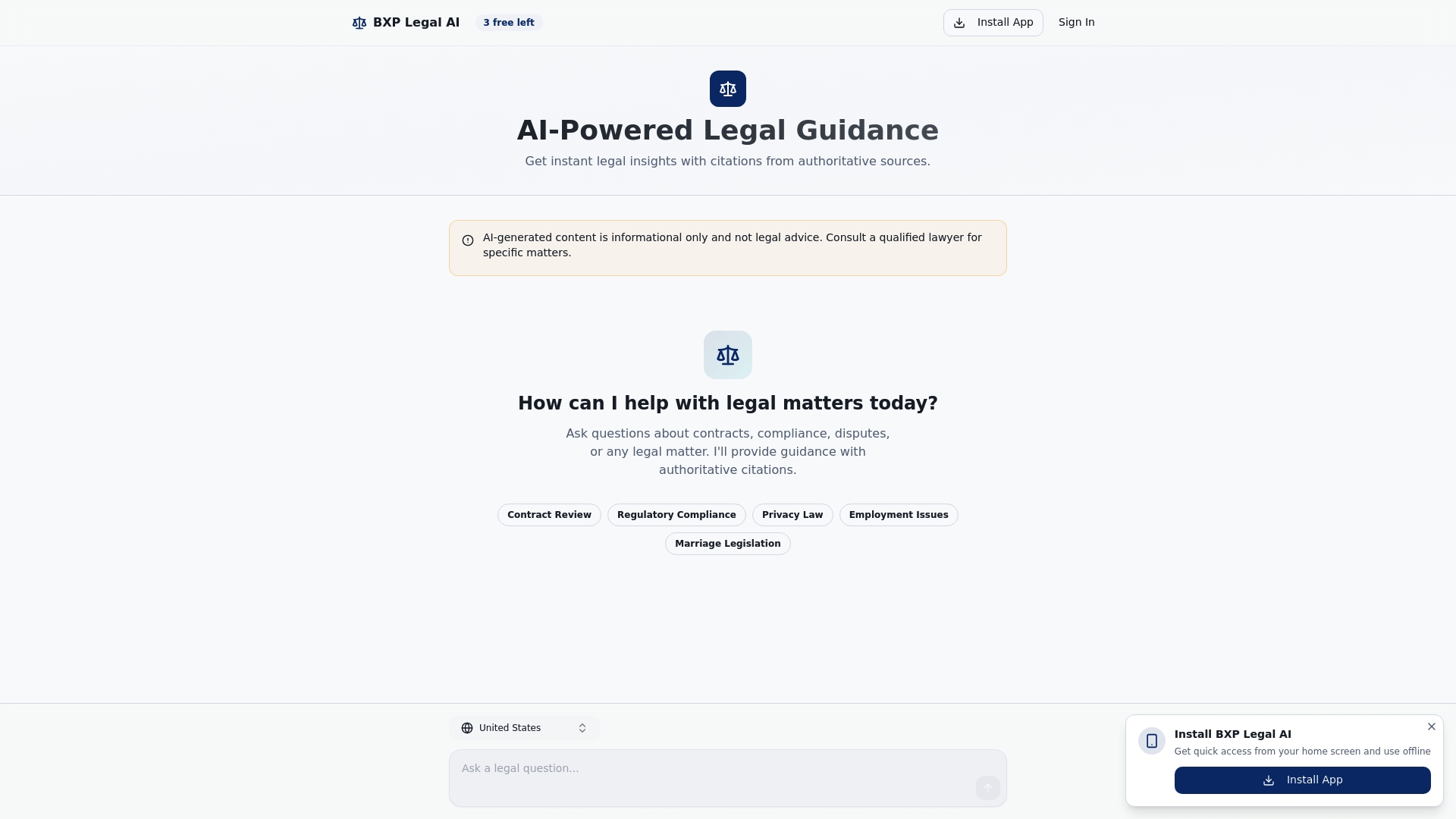
Our solutions streamline document creation while ensuring accuracy through built-in review protocols and compliance checks. Whether you're a solo practitioner handling high-volume matters or a small business managing contracts internally, our platform balances automation with the human judgment legal work demands.
Learn how AI-powered legal guidance can augment your drafting process safely and effectively. Visit BXP Legal AI to explore tools combining AI innovation with legal expertise, helping you work faster without sacrificing the professional standards your clients expect.
FAQ
What types of legal documents can AI assist with drafting?
AI commonly drafts contracts, NDAs, wills, employment agreements, and other template-driven legal documents. These tools work best with standardized document types that follow predictable structures. However, every AI-generated document requires thorough human review to ensure accuracy, compliance with current laws, and appropriateness for your specific circumstances before use.
How reliable are AI-generated legal documents compared to human-drafted ones?
Top AI tools demonstrate 73.3% first-draft reliability versus 56.7% for human lawyers in contract drafting. Performance varies significantly among AI products, with specialized legal platforms typically outperforming generalist models. Despite these promising benchmarks, critical human review remains essential to catch errors, verify citations, and ensure documents meet professional standards and client needs.
What risks should I be aware of when using AI for legal drafting?
AI can produce fabricated legal citations, incorrect jurisdictional clauses, and ambiguous terms that lead to financial penalties or legal disputes if left unchecked. Safety-trained models reduce these errors but frequently refuse legitimate requests, disrupting workflows and limiting practical utility. Always ensure qualified legal professionals review AI-generated documents thoroughly before finalization to mitigate these risks and protect against professional liability exposure.
How can legal professionals and small business owners integrate AI drafting tools into their workflows?
Integration should prioritize compatibility with existing software like Microsoft Word, which two-thirds of legal AI products support. Implement clear review processes ensuring human oversight, establish client communication protocols explaining AI's role, and train staff on verification procedures. Choose AI solutions balancing usability with performance metrics specific to your practice needs, and start with low-risk documents to build confidence before expanding to complex matters.