
Managing contracts across multiple legal systems exposes businesses to complex risks that can drain revenue and trigger costly disputes. Companies lose approximately 9% of annual revenue due to poor contract management, with multi-jurisdictional agreements presenting unique challenges around governing law, enforcement, and regulatory compliance. A structured checklist transforms this complexity into manageable steps, protecting your business from legal pitfalls while ensuring contracts remain enforceable across borders. This guide delivers the essential framework contract managers need to navigate cross-border agreements confidently.
Table of Contents
- Essential criteria for evaluating multi-jurisdictional contracts
- Key checklist items: contract terms and compliance considerations
- Comparing dispute resolution options in multi-jurisdictional agreements
- Decision-making framework: applying the multi-jurisdictional contract checklist
- Explore AI-powered tools to master multi-jurisdictional contracts
- What is a multi-jurisdictional contract checklist?
- Why is governing law important in cross-border contracts?
- How can arbitration clauses reduce legal risks?
- What consequences can arise from non-compliance with foreign regulations?
Key takeaways
| Point | Details |
|---|---|
| Governing law clarity | Specifying which jurisdiction's laws apply prevents costly uncertainty and conflict of law disputes. |
| Compliance verification | Multi-jurisdictional contracts must satisfy local regulations in each territory to remain enforceable. |
| Dispute resolution planning | Arbitration, litigation, and mediation each carry distinct risks requiring careful clause drafting. |
| Enforcement assessment | Understanding how judgments transfer across borders prevents unenforceable contract terms. |
| Systematic risk review | Structured checklists reduce revenue loss by identifying compliance gaps before they become problems. |
Essential criteria for evaluating multi-jurisdictional contracts
Every cross-border contract faces legal risks related to governing law, jurisdiction, and enforcement that can invalidate agreements or make them impossible to enforce. Your checklist must start by verifying which legal system controls the contract interpretation and performance. Without a clear governing law clause, courts apply conflict of law rules that produce unpredictable outcomes, potentially subjecting your business to unfamiliar legal standards.
Jurisdiction clauses determine where disputes get resolved, but many contracts fail to consider whether foreign judgments will be recognized in the counterparty's home country. Some nations refuse to enforce foreign court decisions, making your legal victory worthless. This enforcement gap creates the single biggest practical risk in cross-border agreements.
Mandatory local laws often override your chosen governing law for specific issues. Employment protections, consumer rights, and regulatory compliance requirements typically cannot be contracted around, even with explicit governing law selections. Your checklist must identify which local laws apply regardless of your contractual choices.
Arbitration offers a neutral forum that most countries recognize under international treaties, but poorly drafted arbitration clauses spawn disputes about their own validity and scope. You need to specify the arbitration rules, seat, language, and number of arbitrators to avoid preliminary fights before reaching the actual dispute.
Pro Tip: Always verify that your chosen governing law and dispute forum have reciprocal enforcement treaties with the counterparty's jurisdiction. The Hague Convention and New York Convention provide frameworks, but coverage varies significantly.
Your evaluation criteria should include:
- Explicit governing law designation with fallback provisions
- Jurisdiction clause specifying exclusive or non-exclusive forums
- Enforcement mechanism verification across relevant territories
- Identification of mandatory local law carve-outs
- Clear arbitration procedures if litigation alternatives are unsuitable
These foundational elements prevent the most common failures in multi-jurisdiction legal support scenarios where ambiguity creates expensive litigation about preliminary jurisdictional questions before addressing the actual contract dispute.
Key checklist items: contract terms and compliance considerations
Beyond jurisdictional frameworks, your checklist must verify that contract terms satisfy regulatory requirements in each relevant territory. Non-compliance with foreign regulations triggers fines, contract invalidation, or enforcement barriers that undermine your entire agreement. Regulatory compliance spans multiple legal domains that intersect unpredictably across borders.
Currency and payment terms require special attention in multi-jurisdictional contexts. Exchange rate fluctuations, capital controls, and sanctions programs can make contractually specified payments impossible to execute. Your checklist should confirm payment methods comply with both jurisdictions' banking regulations and include provisions for currency conversion disputes.
Intellectual property rights vary dramatically across legal systems, with some countries offering weak protection or requiring local registration for enforcement. Tax implications of cross-border transactions often surprise businesses that fail to consider withholding requirements, value-added taxes, and transfer pricing rules in each jurisdiction.

Labor and employment laws present particularly rigid mandatory requirements that contracts cannot override. If your agreement involves services performed across borders, you must verify compliance with employment standards, worker classification rules, and social security obligations in each location where work occurs.
Your comprehensive checklist should systematically verify:
- Regulatory compliance in all relevant jurisdictions for contract subject matter
- Currency designation, payment mechanisms, and exchange rate risk allocation
- Intellectual property ownership, registration requirements, and protection levels
- Tax withholding obligations, VAT treatment, and transfer pricing documentation
- Labor law compliance for any cross-border service performance
- Data protection and privacy law requirements for information transfers
- Import/export controls, sanctions screening, and trade compliance
- Termination provisions that satisfy notice requirements in all jurisdictions
- Force majeure clauses addressing jurisdiction-specific legal doctrines
- Warranty and liability limitations that remain enforceable under local law
Pro Tip: Create jurisdiction-specific compliance appendices for contracts spanning more than two legal systems. This modular approach makes updates easier when regulations change and helps ensure nothing gets overlooked during review.
Effective legal document drafting for multi-jurisdictional agreements requires layering general contractual provisions with jurisdiction-specific compliance terms. Generic templates fail because they ignore mandatory local requirements that vary significantly across legal systems.
Comparing dispute resolution options in multi-jurisdictional agreements
Dispute resolution clauses determine how effectively you can enforce contractual rights when conflicts arise. Arbitration requires careful drafting to avoid preliminary disputes about the clause's validity and scope, but offers significant advantages over litigation for cross-border enforcement.
Litigation through national courts creates multiple complications in international contexts. Court judgments often lack reciprocal enforcement, requiring you to re-litigate the entire dispute in the counterparty's home jurisdiction. Forum shopping risks arise when parties race to file in their preferred court first. Language barriers, unfamiliar procedures, and local bias can disadvantage foreign parties significantly.
Arbitration provides a neutral forum with streamlined enforcement under the New York Convention, which 172 countries have adopted. Arbitral awards generally transfer across borders more easily than court judgments. However, arbitration costs can exceed litigation expenses, particularly for smaller disputes. Badly drafted arbitration clauses spawn fights about arbitrability, scope, and procedural rules before reaching the merits.
Mediation offers flexible, relationship-preserving dispute resolution but produces non-binding outcomes unless parties agree to settlement terms. Mediation works best as a preliminary step before binding arbitration or litigation, giving parties a chance to resolve disputes efficiently while preserving fallback enforcement options.
| Dispute Resolution Method | Enforcement Ease | Cost Level | Neutrality | Speed | Best Use Case |
|---|---|---|---|---|---|
| Litigation | Low (reciprocal enforcement limited) | Medium to High | Low (home court advantage) | Slow | Domestic disputes with clear jurisdiction |
| Arbitration | High (New York Convention) | High | High | Medium | Complex international commercial disputes |
| Mediation | N/A (non-binding) | Low | High | Fast | Relationship-preservation priority |
| Hybrid (Med-Arb) | Medium (if arbitration follows) | Medium | High | Medium | Disputes where settlement is possible |
Your checklist should evaluate dispute resolution options based on:
- Enforcement treaty coverage between relevant jurisdictions
- Relative costs of each mechanism for likely dispute values
- Relationship preservation importance
- Need for confidentiality versus public proceedings
- Technical complexity requiring specialized arbitrators
- Speed requirements for dispute resolution
Pro Tip: Consider tiered dispute resolution clauses that require negotiation and mediation before arbitration or litigation. This approach preserves relationships while maintaining enforceable fallback options if settlement fails.
The document comparison process should verify that dispute resolution clauses remain consistent across related agreements. Conflicts between master agreements and specific transaction documents create ambiguity that parties exploit during disputes.
Decision-making framework: applying the multi-jurisdictional contract checklist
Structured contract review checklists serve as essential tools to mitigate risks, ensure compliance, and protect business interests across jurisdictions. Your decision-making framework should prioritize checklist items based on contract-specific risk profiles rather than applying uniform scrutiny to every provision.
Start by categorizing contract risk levels using factors like transaction value, jurisdictional complexity, regulatory sensitivity, and relationship importance. High-risk contracts warrant exhaustive checklist application with legal counsel review, while lower-risk agreements can follow abbreviated protocols focusing on critical compliance items.
Sequential review stages prevent overlooking essential elements. Begin with jurisdictional framework verification, then proceed to substantive term compliance, followed by dispute resolution adequacy, and conclude with execution formality requirements. This systematic approach ensures foundational issues get addressed before investing time in detailed term negotiations.
Risk assessment guides your arbitration versus litigation decision. When enforcement treaties provide strong arbitration support, arbitration clauses offer superior protection. If one jurisdiction lacks New York Convention coverage, litigation clauses specifying a favorable forum may prove more practical despite reciprocal enforcement limitations.
Compliance verification should occur at multiple contract lifecycle stages:
- Initial term sheet negotiation to identify deal-breakers early
- Detailed contract drafting to ensure regulatory satisfaction
- Pre-execution review confirming no regulatory changes occurred
- Periodic post-execution audits for long-term agreements
- Amendment review when terms change or regulations evolve
Leveraging AI tools can automate significant portions of checklist application, particularly for compliance verification across multiple jurisdictions. AI document drafting technology can flag missing clauses, identify inconsistencies, and suggest jurisdiction-specific provisions based on the legal systems involved.
Your decision framework should incorporate these systematic steps:
| Review Stage | Key Activities | Decision Points | Tools/Resources |
|---|---|---|---|
| Risk Assessment | Categorize contract complexity and value | Determine review depth required | Risk matrix, jurisdiction complexity index |
| Jurisdictional Framework | Verify governing law and dispute clauses | Select arbitration vs litigation | Treaty coverage databases |
| Compliance Verification | Check regulatory requirements | Identify mandatory local law issues | Regulatory compliance tools |
| Term Negotiation | Address identified gaps | Prioritize essential protections | Template libraries |
| Execution Review | Confirm formality requirements | Ensure enforceability | Jurisdiction-specific checklists |
This structured approach transforms the overwhelming complexity of multi-jurisdictional contracts into manageable, repeatable processes that protect your business while enabling efficient contract execution.
Explore AI-powered tools to master multi-jurisdictional contracts
Navigating the complexity of cross-border agreements demands tools that streamline compliance verification and contract drafting across legal systems. The BXP Legal AI platform delivers instant guidance on multi-jurisdictional contract requirements, helping you identify governing law issues, compliance gaps, and enforcement risks before they become expensive problems.
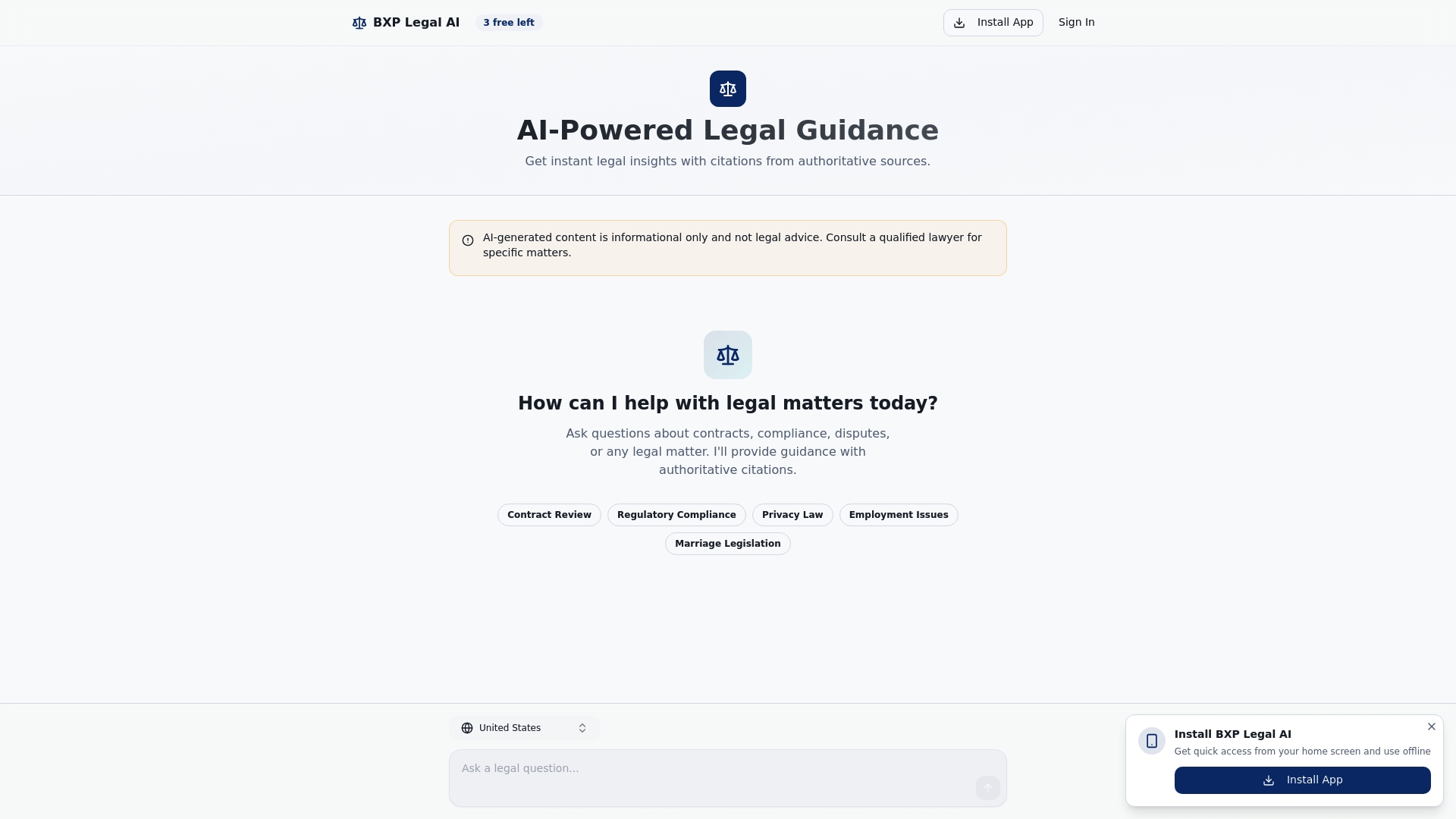
Our AI-powered contract review analyzes agreements against jurisdiction-specific requirements, flagging missing clauses and regulatory compliance issues automatically. Access comprehensive legal templates tailored for cross-border transactions, with built-in provisions addressing common multi-jurisdictional pitfalls. The document comparison features ensure consistency across related agreements, preventing conflicts that create enforcement vulnerabilities. Transform hours of manual checklist application into minutes of AI-assisted review, reducing legal risks while accelerating your contract workflows.
What is a multi-jurisdictional contract checklist?
A multi-jurisdictional contract checklist is a structured tool listing legal and compliance verification steps for agreements spanning multiple legal systems. It systematically addresses governing law selection, jurisdictional clauses, regulatory compliance requirements, dispute resolution mechanisms, and enforcement considerations across relevant territories. The checklist ensures contract managers identify and resolve potential conflicts between different legal systems before execution, reducing revenue loss from unenforceable terms or regulatory violations.
Why is governing law important in cross-border contracts?
Governing law clauses determine which jurisdiction's legal principles interpret and enforce contract terms, providing predictability for both parties. Without explicit governing law designation, courts apply conflict of law rules that produce uncertain outcomes, potentially subjecting your business to unfamiliar legal standards. Mandatory local laws may override chosen governing law for specific issues like employment rights or consumer protections, requiring careful analysis of which provisions remain subject to contractual choice.
How can arbitration clauses reduce legal risks?
Arbitration provides neutral dispute resolution with streamlined international enforcement under the New York Convention, which 172 countries recognize. This treaty framework makes arbitral awards easier to enforce across borders than court judgments, which often require re-litigation in the counterparty's jurisdiction. However, poorly drafted arbitration clauses create preliminary disputes about validity, scope, and procedural rules that delay resolution and increase costs, making precise drafting essential for risk reduction.
What consequences can arise from non-compliance with foreign regulations?
Non-compliance with foreign regulations triggers fines, contract invalidation, and enforcement difficulties that undermine your entire agreement. Regulatory violations can make contracts unenforceable in the non-compliant jurisdiction, eliminating your legal remedies when disputes arise. Intellectual property, labor law, and tax regulation violations carry particularly severe consequences, including criminal liability in some jurisdictions, making systematic compliance verification essential for multi-jurisdictional contracts.