
TL;DR:
- Marriage is a legal contract governed by state law that establishes recognized rights, obligations, and protections. If legal requirements such as capacity, age, consent, and eligibility are unmet, the marriage may be void or voidable, affecting legal rights and recognition. Understanding state, federal, and international laws is essential to ensuring a marriage's validity and safeguarding associated legal benefits.
Most people think a wedding makes a marriage. The flowers, the vows, the officiant, the photos. But what is marriage law, really? It's a body of legal rules that determines whether your union is actually recognized by the state, what rights you gain, what obligations you take on, and what protections you can claim. Get it wrong, and your ceremony could mean nothing in a courtroom. This guide breaks down the marriage law definition, how state and federal rules interact, and what you need to know to protect your legal standing.
Table of Contents
- Understanding marriage as a legal contract
- How marriage laws vary across states and impact legal recognition
- Federal recognition and implications for immigration and benefits
- Common law and other non-traditional marriages in legal context
- How invalid or void marriages affect your legal rights
- Practical steps to protect your marriage rights and ensure validity
- The overlooked complexity of marriage law and its real-life impact
- Explore how BXP Legal AI can simplify your marriage law questions
- Frequently asked questions
Key Takeaways
| Point | Details |
|---|---|
| Marriage is a contract | Marriage is a legal contract that must meet specific requirements to be valid and confer rights. |
| State laws vary | Marriage laws and requirements differ by state, impacting legal recognition across jurisdictions. |
| Federal recognition depends on validity | Federal law recognizes marriages only if valid in the location where they occurred, affecting immigration and benefits. |
| Common law marriages have rules | Common law marriages are recognized only if valid under specific state criteria and relevant for immigration purposes. |
| Proof and documentation matter | Proper documentation and proving bona fide marriage intent are essential for legal and immigration recognition. |
Understanding marriage as a legal contract
Marriage is not just a social ritual. Family law resources describe marriage as a civil contract governed by state law, which means it comes with the same basic building blocks as any binding legal agreement. Understanding marriage law starts here.
For a marriage to be legally valid, four core elements must be present:
- Legal capacity: Both parties must be mentally competent and free from coercion at the time of marriage.
- Minimum age: Every state sets a minimum age, which in most states is 18 without parental consent.
- Consent: Both people must genuinely agree to marry. Consent obtained through fraud, force, or intoxication can invalidate a marriage.
- Eligibility: Parties cannot already be married to someone else, and they cannot be too closely related by blood or adoption.
When one or more of these conditions fails, the marriage may be void (treated as if it never happened) or voidable (valid until a court annuls it). This is a critical distinction. A void marriage needs no annulment because it has no legal existence. A voidable marriage, however, stands until someone takes legal action to undo it. That difference has real consequences for inheritance, benefits, and parental rights.
Pro Tip: If you have any doubt about whether your ceremony met the legal requirements in your state, consult a family law attorney before assuming you are legally married. The risks of assuming incorrectly are significant.
Think of marriage the same way you think about contract law basics. A handshake deal with no capacity or consent is unenforceable. The same logic applies to a wedding ceremony where one party lacked mental competence or was already married to someone else.
How marriage laws vary across states and impact legal recognition
State-level variation is one of the most misunderstood aspects of marriage law in the US. Marriage laws are state-specific, meaning a marriage valid in one state may not automatically hold the same status in another.

Here is a snapshot of how key requirements differ across states:
| Requirement | States with stricter rules | States with more flexibility |
|---|---|---|
| Minimum marriage age | 18 with no exceptions (some states) | 16 or 17 with parental/judicial consent |
| Waiting period | Up to 3 days before license takes effect | No waiting period |
| Common law marriage | Not recognized (majority of states) | Recognized with proof (approx. 8 states) |
| Officiant requirements | Licensed clergy or civil officer only | Broader list including online-ordained ministers |
| Blood tests | No longer required in most states | N/A |
Beyond the table, there are a few things worth knowing:
- Marriage licenses expire. Most states require you to complete your ceremony within 30 to 90 days of obtaining the license.
- Cross-state recognition is not automatic. If you marry at 16 in a state that permits it, and then move to a state that sets 18 as the minimum, the receiving state may refuse to recognize that marriage.
- Common law marriages are recognized in states like Colorado, Texas, and Iowa, but only if specific legal criteria are met. If you formed a common law marriage in Texas and move to California, California will not allow you to form a new common law marriage, but it may recognize the one you already established in Texas.
Understanding what are marriage laws in your specific state, and in any state where you may later live, is not optional when your legal rights are on the line.
Federal recognition and implications for immigration and benefits
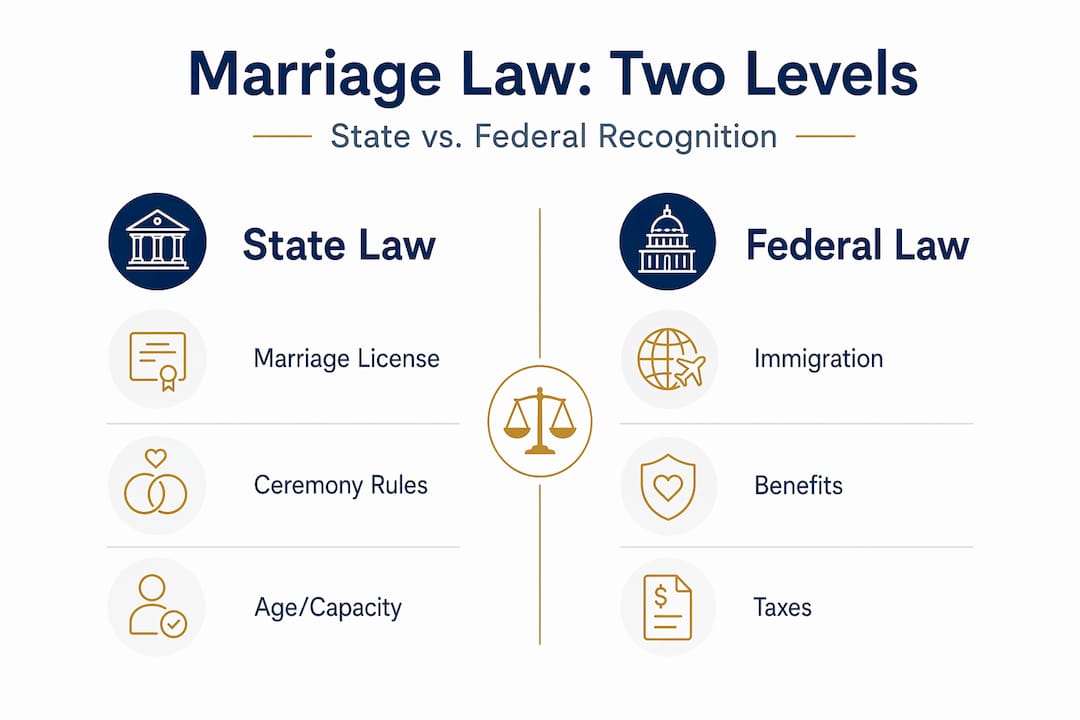
State law tells you whether you're married. Federal law tells you what that marriage means for immigration benefits, tax filing, Social Security, and federal programs. The two don't always align cleanly.
Federal marriage recognition applies the "place-of-celebration" rule. That means the federal government looks at whether your marriage was valid under the laws of the place where it was performed, not where you currently live. If your marriage ceremony took place legally in another country or another state, the federal government generally accepts it.
Key federal rules to know:
- Only two people. Federal law under 1 USC §7 defines marriage as a legal union between two individuals. Polygamous marriages are not recognized for any federal purpose, regardless of where they occurred.
- Bona fide requirement for immigration. USCIS does not simply accept a marriage certificate as proof. USCIS applies the place-of-celebration rule and also requires proof that the marriage is bona fide, meaning it was entered into with genuine intent, not solely to obtain immigration benefits.
- The certificate is evidence, not guarantee. A marriage certificate is prima facie evidence of a valid marriage. But USCIS can reject a marriage if it finds the union lacks good faith or violates U.S. public policy.
A marriage that looks valid on paper can still be challenged by federal agencies if the circumstances raise questions about intent, capacity, or legal compliance at the time of the ceremony.
Pro Tip: If your marriage involves an international component, gather documentation that goes beyond the certificate itself. Joint bank account statements, lease agreements, photos, and correspondence all help establish the bona fide nature of a marriage.
Common law and other non-traditional marriages in legal context
Common law marriage is one of the most misunderstood types of marriage laws in the US. Many people believe that simply living together for seven years creates a legal marriage. That is a myth.
To establish a valid common law marriage in a state that recognizes it, you typically need to prove all of the following:
- Cohabitation. You must have lived together as a couple, though no specific minimum time period applies in most states.
- Intent. Both parties must have intended to be married, not merely to cohabit.
- Holding out. You must have presented yourselves publicly as a married couple, using language like "my husband" or "my wife," filing joint taxes, or sharing a last name.
- Capacity. The same legal capacity requirements that apply to ceremonial marriages apply here.
- State recognition. The marriage must have been formed in a state that recognizes common law marriage.
USCIS recognizes common law marriages for naturalization and immigration purposes if they were validly established in the state where they occurred. That means if you formed a valid common law marriage in Colorado, USCIS can recognize it even if you later move to a state that does not allow new common law marriages.
The practical risk is documentation. Common law marriages generate no automatic paper trail. If you ever need to prove yours, in a divorce, an estate dispute, or an immigration case, the burden falls entirely on you.
How invalid or void marriages affect your legal rights
Most people assume that once you have a ceremony and a certificate, you are legally married. That assumption is wrong in more situations than you might expect.
A marriage can be void or voidable if the legal requirements were not met at the time of the ceremony. The distinction matters:
- Void marriages are legally nonexistent from the start. Examples include marriages between close relatives or marriages where one person was already legally married to someone else. No court action is needed to declare them invalid, though a declaratory judgment is often advisable.
- Voidable marriages are legally valid until a court steps in. Grounds include fraud, lack of capacity, or underage marriage without proper consent. Either party can petition for annulment.
- Invalid marriages confer no legal rights. If your marriage is void, you cannot claim spousal inheritance rights, spousal immigration benefits, or joint marital property protections based on that union.
- Cross-jurisdictional recognition gets complicated. A marriage invalid in your home state but performed in another state raises complex questions about which state's law applies, particularly in divorce or immigration proceedings.
Pro Tip: If there is any reason to question the legal validity of your marriage, don't wait for a dispute to surface. Seek a legal opinion proactively. An annulment or a fresh ceremony is far less costly than fighting a federal agency or an estate challenge later.
Practical steps to protect your marriage rights and ensure validity
How marriage laws work in practice comes down to documentation and timing. Here is what to do:
- Verify requirements before your ceremony. Check the marriage legal requirements in the state or country where the ceremony will occur, not where you live.
- Obtain and register your license on time. File within the window required by your jurisdiction. Late filing can create gaps in the legal record.
- Secure certified copies of your marriage certificate. Get at least three certified copies from the issuing authority. You will need them for name changes, benefits enrollment, and any future immigration filings.
- Build a documentation file. For immigration cases especially, USCIS requires proof of both legal validity and bona fide intent. Collect joint financial records, correspondence, lease agreements, and photos from the start.
- Review your state's rules on common law marriage. If your relationship might qualify, understand the legal implications, especially if you later move to a non-recognizing state.
- Consult a legal resource if validity is in doubt. Whether you're dealing with a potential void marriage, cross-border recognition issues, or immigration questions, getting clarity early prevents larger problems later.
Understanding contract law basics can also help you appreciate why marriage creates enforceable obligations, not just social ones.
The overlooked complexity of marriage law and its real-life impact
Here is the uncomfortable truth: most people treat marriage law as a formality they satisfy by showing up at the courthouse. They get a license, they say the words, they file the paperwork, and they assume they are done. The law disagrees with that assumption more often than anyone talks about.
The biggest mistake we see, across immigration cases, estate disputes, and benefits claims, is that people confuse the ceremony with the contract. They are not the same thing. A ceremony is a ritual. A contract is a legal relationship with enforceable rights and obligations, and it only exists if the underlying legal requirements were satisfied.
The variation between states makes this worse. Couples who move frequently or marry across borders often discover their legal status is murkier than they thought. A marriage formed legally in one jurisdiction may face challenges in another. Federal agencies apply their own standards. And when a relationship ends through death or divorce, the validity of the marriage suddenly matters enormously.
The deeper issue is that understanding marriage law is not just about the wedding. It's about the years that follow. Spousal rights in medical decisions, inheritance without a will, immigration sponsorship, joint tax benefits, and property division in divorce all depend on whether your marriage is legally recognized, by the right authority, at the right time.
Thinking of marriage as a contract, just as you would think of any other significant legal relationship, is not unromantic. It is protective. It is what keeps a promise enforceable when circumstances get difficult.
Explore how BXP Legal AI can simplify your marriage law questions
Navigating marriage law is genuinely complex, especially when state rules, federal standards, and immigration requirements all pull in different directions. BXP Legal AI was built for exactly this kind of challenge.
With BXP Legal AI's features, you can get instant, citation-backed answers to your marriage law questions, draft documents relevant to your situation, and understand how state and federal rules apply to your specific circumstances. Whether you're verifying the validity of an existing marriage, preparing immigration documentation, or trying to understand your rights under state law, BXP Legal AI gives you a clear starting point without the wait or cost of a traditional consultation. As always, use AI guidance as a starting point and follow up with a qualified attorney for decisions that carry legal weight.
Frequently asked questions
What does the "place-of-celebration" rule mean for marriage validity?
It means your marriage is legally recognized for federal and immigration purposes only if it was valid under the laws of the place where the ceremony occurred. Federal marriage recognition follows this rule consistently.
Can a common law marriage qualify for immigration benefits?
Yes. If the common law marriage was validly established in a state that recognizes it, USCIS accepts it for immigration and naturalization purposes, even if you now live in a state that does not allow new common law marriages.
What factors can make a marriage legally void?
A marriage is void if either party lacked legal capacity, was already married, was too closely related by blood, or was below the legal age. Marriages failing these requirements are treated as if they never legally existed.
Is a wedding ceremony alone enough to prove legal marriage?
No. A ceremony does not guarantee legal status on its own. The marriage must meet all legal contract requirements and be valid where celebrated. A ceremony without legal prerequisites satisfied can result in a void or voidable union.
How can I protect my legal rights after marriage?
Meet all legal requirements before the ceremony, obtain certified copies of your marriage certificate, document the bona fide nature of your relationship from the start, and consult legal advice if your status is ever questioned. Proving bona fide intent is especially critical for immigration purposes.