
TL;DR:
- Contract mistakes can lead to costly legal disputes and revenue loss for small businesses.
- Understanding core contract law principles and ensuring all essential elements are present helps prevent unenforceable agreements.
- Using vetted templates, clear terms, and legal guidance reduces dispute risks and builds stronger business relationships.
Contract mistakes are expensive. 43% of small businesses face lawsuit threats, and poorly managed agreements drain an average of 9.2% of annual revenue. Yet most small business owners and individuals sign contracts without fully understanding what makes them legally binding or what happens when something goes wrong. Contract law doesn't have to be intimidating. Once you understand the core principles, the essential elements, and the most common pitfalls, you can make smarter decisions, protect your interests, and avoid the disputes that derail so many businesses every year.
Table of Contents
- What is contract law and why does it matter?
- The six essential elements of a legally binding contract
- Comparing contract law frameworks: Common law vs. UCC and beyond
- Common contract issues and how to avoid costly disputes
- Why most people get contract law wrong — and how to get it right
- Take the next step: Smarter contracts with BXP Legal AI
- Frequently asked questions
Key Takeaways
| Point | Details |
|---|---|
| Contract law basics matter | Understanding contract law fundamentals helps you avoid costly legal mistakes. |
| Six essentials for validity | All contracts need offer, acceptance, consideration, intention, capacity, and legality to be enforceable. |
| Right framework saves money | Knowing whether common law or UCC applies protects your interests in contracts. |
| Risk reduction strategies | Use clear, tailored contracts and mediation clauses to reduce litigation and protect your business. |
What is contract law and why does it matter?
Contract law is the legal framework that makes agreements enforceable. In plain terms, contract law governs the creation, interpretation, enforcement, and remedies for legally binding agreements between parties. It covers everything from the handshake deal with your landlord to a multi-page vendor agreement with a supplier across state lines.
You encounter contract law constantly, even when you don't realize it. Employment agreements, service contracts with freelancers, software license terms, lease agreements, purchase orders — all of these fall under contract law. When these agreements are clear and properly formed, they protect everyone involved. When they're not, things get expensive fast.
"A contract isn't just a formality. It's a written record of exactly what each party agreed to, and courts rely on that record when disputes arise."
For small business owners especially, the stakes are real. 60% of small business litigation involves contract disputes. That's not a fringe issue — it's the leading cause of legal trouble for small businesses across the country. And the financial impact goes well beyond legal fees. Lost time, damaged relationships, and disrupted operations add up quickly.
Here's what contract law actually covers in practice:
- Formation: How a valid agreement is created between two or more parties
- Interpretation: How courts read and apply contract language when meaning is disputed
- Performance: What each party is obligated to do under the agreement
- Breach: What happens when one party fails to meet their obligations
- Remedies: What the injured party can recover, including damages or specific performance
Understanding these basics puts you in a much stronger position, whether you're reviewing a vendor agreement or navigating a dispute. You can explore legal guidance for small businesses and get a clearer picture of your legal risk overview before signing anything significant.
The six essential elements of a legally binding contract
Understanding what contract law is sets the stage, but to actually form a binding agreement, specific requirements must be met. A contract that's missing even one of these elements may be unenforceable — leaving you with no legal protection if things go sideways.
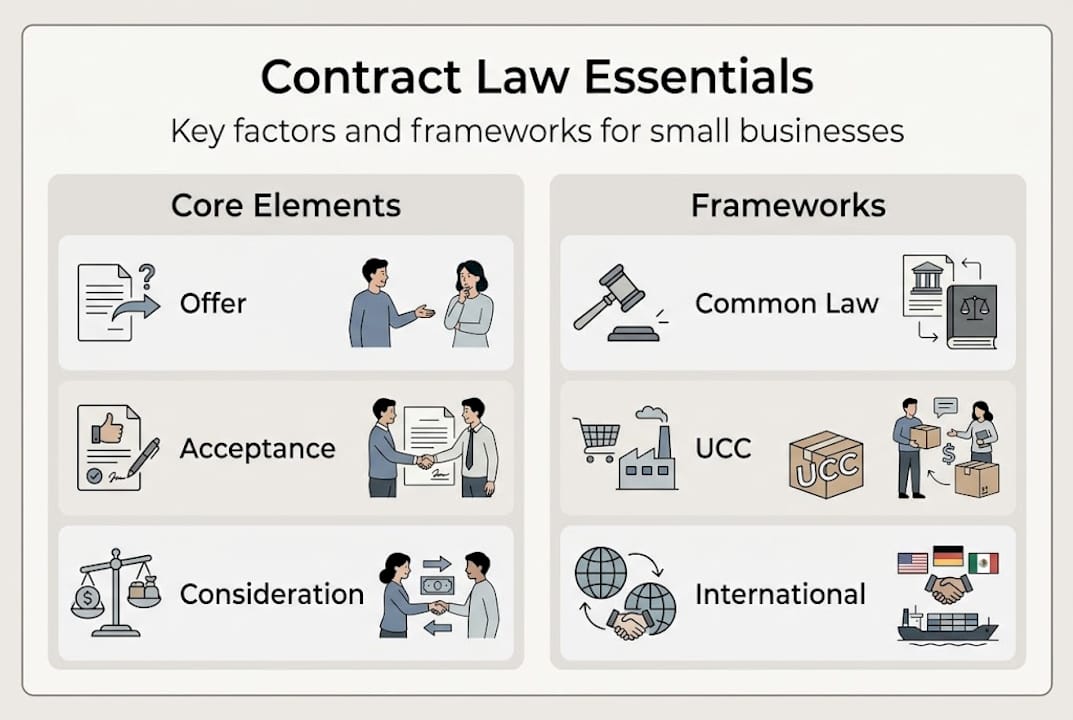
A valid contract requires six essential elements: offer, acceptance, consideration, intention to create legal relations, capacity, and legality. Here's what each one means in practice:
- Offer: One party proposes specific terms. This has to be clear and definite, not vague. "I'll do some work for you" is not an offer. "I'll design your website for $2,500, delivered in four weeks" is.
- Acceptance: The other party agrees to those exact terms. If they change anything — even a small detail — it becomes a counteroffer, not acceptance.
- Consideration: Both parties exchange something of value. This is usually money for goods or services, but it can be a promise to do or not do something. Without it, a contract is generally not enforceable.
- Intention to create legal relations: Both parties must intend for the agreement to be legally binding. Casual social arrangements typically don't meet this threshold.
- Capacity: Parties must have legal ability to understand and bind themselves. Adults who are mentally competent and not intoxicated generally have capacity. Minors and incapacitated persons typically do not.
- Legality: The subject matter must be legal. A contract to perform an illegal service is void from the start, regardless of what was agreed.
Pro Tip: Before signing any agreement, run through this six-point checklist mentally. If you can't identify clear consideration or you're unsure whether the other party has capacity, pause and get clarification before you commit.
Missing any of these elements doesn't just weaken your contract — it can make the whole thing unenforceable. That means no legal remedy if the other party walks away or fails to deliver. Good contract drafting strategies and a solid multi-jurisdictional contract checklist can help you verify all six elements are present before you sign.
Comparing contract law frameworks: Common law vs. UCC and beyond
Once you know the essential elements, you must also navigate how different legal systems treat contracts. In the US, not all contracts play by the same rules. The framework that applies depends largely on what the contract covers.
Common law versus UCC is the most important distinction for most small business owners. Common law is state-based and judge-made, built from decades of court decisions. The Uniform Commercial Code (UCC) is a standardized set of rules adopted across US states that governs the sale of goods specifically.
Here's a quick breakdown of how these two frameworks differ:
| Feature | Common law | UCC |
|---|---|---|
| What it covers | Services, real estate, employment | Sale of goods (products, inventory) |
| Acceptance rules | Must mirror the offer exactly | More flexible, allows minor differences |
| Consideration | Required, must be bargained for | Still required, but more flexible |
| Modification | Requires new consideration | Can be modified without new consideration |
| Applies to | Most professional services contracts | Retail, wholesale, manufacturing deals |
Why does this matter for you? If you're a consultant or a marketing agency, your service contracts are governed by common law. If you manufacture or sell physical products, the UCC applies. Mixing up the two can lead to real problems, especially when disputes arise over whether an acceptance was valid or whether a contract modification is enforceable.
For businesses operating across state lines or internationally, the complexity increases further. Different states can apply slightly different versions of the UCC, and international contracts may invoke the UN Convention on Contracts for the International Sale of Goods (CISG).
Pro Tip: Before you sign, identify whether your contract is for goods or services. That single question tells you which legal framework applies and what rules govern things like modifications and acceptance.
A solid SMB compliance checklist can help you stay on the right side of whichever framework governs your agreements.
Common contract issues and how to avoid costly disputes
Knowing the frameworks is only half the battle — even the best contract can cause problems if not managed well. Most contract disputes don't come from complicated legal questions. They come from basic, avoidable mistakes.
Here's where things most often go wrong:
- Vague terms: Words like "reasonable time" or "satisfactory quality" mean different things to different people. Define every key term explicitly.
- Missing signatures: An unsigned contract is often unenforceable. Always confirm that all parties have signed before work begins.
- Oral-only agreements: While many oral contracts are technically valid, proving what was agreed becomes nearly impossible without written documentation.
- Using generic templates: A contract pulled from a random online source may not reflect your state's laws or your specific situation.
- No dispute resolution clause: Without one, you're heading straight to litigation if something goes wrong.
The numbers tell the story clearly:
| Risk factor | Impact |
|---|---|
| Small businesses facing lawsuit threats | 43% |
| Litigation involving contract disputes | 60% |
| Revenue lost to poor contract management | 9.2% annually |
| Litigation reduction from vetted templates | Up to 60% |
| Cost savings from mediation clauses | Up to 50% |
Vetted templates reduce litigation by up to 60%, and mediation clauses cut costs by as much as 50%. That's a massive return on a little upfront effort.

The fix isn't always expensive. Using a well-drafted contract review checklist, following smart document drafting for small businesses practices, and truly understanding the importance of legal documentation can protect you far more effectively than reacting after a dispute starts.
Why most people get contract law wrong — and how to get it right
Here's a perspective most legal articles won't give you: the biggest contract mistakes aren't legal mistakes. They're communication mistakes.
Most disputes we see stem from two parties who thought they agreed — but never actually spelled out the details. One side expected weekly deliverables; the other thought the deadline was flexible. Neither wrote it down. By the time the relationship soured, both parties had legitimate grievances and no clear contract to resolve them.
Contracts aren't bureaucratic paperwork. They're a clarity tool. When you write down exactly what each party is doing, when, for how much, and what happens if something goes wrong, you're not being paranoid. You're being professional.
The why legal help matters argument isn't just about avoiding lawsuits. It's about building business relationships that don't collapse under pressure. A clear, well-drafted contract actually builds trust because both sides know exactly where they stand.
And the data backs this up — written contracts with mediation clauses can cut dispute costs in half. That's not a legal technicality. That's a business strategy.
Stop thinking of contracts as the last line of defense. Start thinking of them as the foundation of every professional relationship you build.
Take the next step: Smarter contracts with BXP Legal AI
If you're ready to make contract law work for you, trusted help is available. BXP Legal AI gives you instant, AI-powered guidance on contract questions, common law versus UCC issues, dispute clauses, and more — all backed by authoritative sources.
Whether you need to review an agreement before signing, compare two contract versions, or simply understand what a clause actually means, BXP Legal's contract comparison tools and AI-powered legal guidance make the process faster and far less stressful. You don't need a law degree to protect your business. You need the right tools and the confidence to use them. Start with BXP Legal AI and take control of your contracts today.
Frequently asked questions
What are the main elements required for a valid contract?
A valid contract requires offer, acceptance, consideration, intention to create legal relations, capacity, and legality — all six must be present for the agreement to be enforceable.
Why do so many small businesses face contract disputes?
Poorly drafted, unclear, or unsigned agreements lead to misunderstandings; 60% of small business litigation involves contract disputes, making this the leading legal threat for small businesses.
Is a written contract always required by law?
Not always — many oral contracts are legally valid, but written contracts with vetted templates reduce litigation risk by up to 60% and are far easier to enforce in court.
What is the difference between common law and UCC contract rules?
Common law governs most service and real estate contracts based on state court decisions, while the UCC applies specifically to the sale of goods, with more flexible rules around acceptance and contract modification.
How can small businesses reduce their contract risk?
Use tailored, vetted templates and include clear mediation clauses in every agreement — these two steps alone can cut dispute costs and litigation exposure significantly.