
Contract drafting errors cost businesses thousands in disputes and delays every year. A missing clause, unclear term, or even a misplaced comma can transform a straightforward agreement into a legal nightmare. Whether you're a small business owner finalizing a vendor agreement or an individual creating a service contract, understanding the contract drafting process is essential. This guide walks you through proven strategies to create clear, enforceable contracts that protect your interests and prevent costly misunderstandings.
Table of Contents
- Understanding essential contract elements and their role
- Preparing for drafting: clarity and verification essentials
- Executing the drafting process: step-by-step instructions
- Verifying and finalizing: avoiding mistakes and ensuring enforceability
- Streamline your contract drafting with BXP Legal AI
Key takeaways
| Point | Details |
|---|---|
| Five essential elements | Contracts require five essential parts for enforceability: offer and acceptance, consideration, capacity and authority, and legal purpose. |
| Clarity prevents disputes | Precise language and verified authority eliminate ambiguity that leads to litigation and financial loss. |
| AI tools enhance reliability | Top AI tools marginally outperform humans in producing reliable first drafts and identifying material risks lawyers miss. |
| Authority verification matters | Confirming signatories have legal power to bind organizations prevents invalid agreements and wasted negotiations. |
| Details determine outcomes | Punctuation mistakes like missing commas have resulted in multimillion dollar disputes. |
Understanding essential contract elements and their role
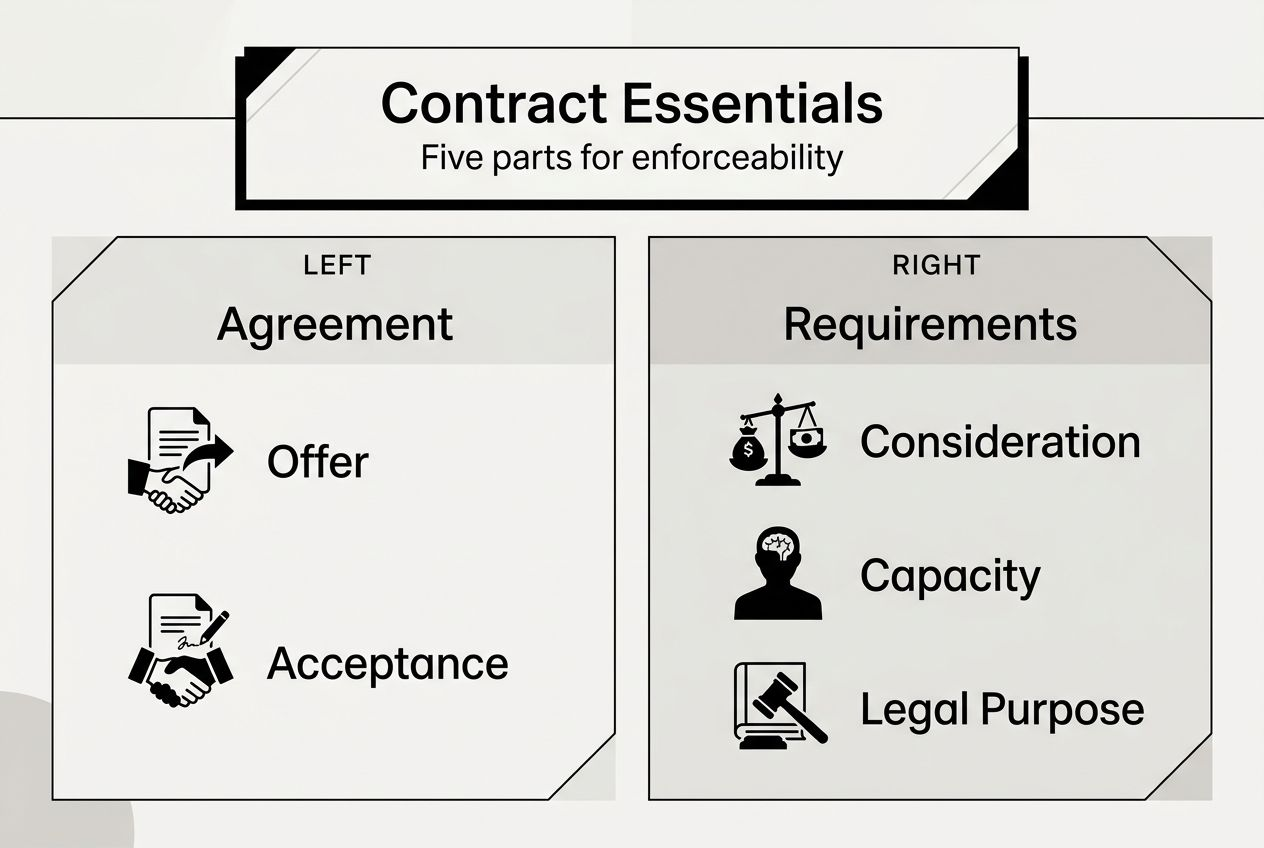
Every legally enforceable contract must contain five fundamental components. Missing even one element can render your entire agreement void, leaving you without legal recourse when disputes arise. Understanding these building blocks helps you recognize whether you're creating a binding commitment or simply exchanging informal promises.
Offer and acceptance form the foundation of mutual agreement. One party proposes specific terms, and the other accepts those exact terms without modification. If the responding party changes any detail, they've created a counteroffer rather than acceptance. This back and forth continues until both parties agree to identical terms.
Consideration represents the exchange of value between parties. Each side must give something of worth, whether money, services, goods, or a promise to act or refrain from acting. Courts won't enforce one sided agreements where only one party benefits. The consideration doesn't need equal value, but it must exist on both sides.
Capacity and authority ensure that signatories possess legal power to enter binding agreements. Individuals must be of legal age and sound mind. Business representatives must hold proper authorization from their organizations. Verifying signing authority is essential to ensure that individuals signing have the legal right to bind their organization. Without verified capacity, you risk creating an unenforceable contract.
Legal purpose requires that contract objectives comply with applicable laws. Agreements for illegal activities, even if all other elements exist, carry no legal weight. Courts refuse to enforce contracts that violate statutes or public policy.
Contracts lacking any essential element face immediate challenges in enforcement. You might invest significant time negotiating terms only to discover your agreement holds no legal standing. Understanding these requirements before drafting saves time and protects your interests across various types of legal documents you'll encounter in business.
Preparing for drafting: clarity and verification essentials
Preparation determines whether your contract succeeds or fails in court. Rushing into drafting without verifying authority and establishing clear language standards invites disputes that could have been prevented. Smart preparation focuses on two critical areas: confirming who can legally bind parties and establishing communication standards that eliminate ambiguity.
Verify signatory authority before investing time in negotiations. Request documentation proving that representatives hold power to commit their organizations. Corporate resolutions, partnership agreements, or powers of attorney provide this evidence. Clarity in contract language is crucial because contracts are interpreted by individuals who were not present during the agreement and may have different motivations. Judges and arbitrators reading your contract months or years later won't have context from your conversations.
Simple, precise language prevents misinterpretation. Avoid legal jargon unless absolutely necessary, and define technical terms on first use. Each sentence should convey one clear idea. When you must use complex concepts, break them into digestible components that any educated reader can understand.
Pro Tip: Create a glossary section defining specialized terms before they appear in contract body text, ensuring consistent interpretation throughout the document.
Ambiguous terms create litigation opportunities. Words like "reasonable," "promptly," or "substantial" mean different things to different people. Replace vague language with specific metrics, deadlines, and quantities. Instead of "deliver promptly," write "deliver within 5 business days of order confirmation."
Check for consistency across all contract sections. Terms defined in one clause should carry identical meaning throughout. If you call a party "Vendor" in the introduction, don't switch to "Supplier" later. Logical flow matters too. Organize clauses so each section builds naturally on previous content.
Common pitfalls include:
- Failing to define party roles and responsibilities clearly
- Using inconsistent terminology for the same concept
- Leaving payment terms, deadlines, or deliverables vague
- Omitting dispute resolution procedures
- Neglecting to specify applicable law and jurisdiction
These preparation steps protect your business with legal documentation that withstands scrutiny. Invest time upfront verifying authority and establishing clarity standards, and you'll avoid expensive disputes downstream.
Executing the drafting process: step-by-step instructions
Systematic drafting transforms preparation into a functional contract. Following structured steps ensures you capture all essential elements while maintaining clarity and enforceability. Modern technology enhances this process, but human judgment remains critical for context and strategic decisions.
Step 1: Gather foundational information. Document the contract's purpose, identify all parties with complete legal names and addresses, and clarify each party's role. Specify what problem the contract solves and what outcomes each party expects. This foundation guides every subsequent drafting decision.
Step 2: Draft core terms and obligations. Articulate the offer clearly, stating exactly what one party proposes. Define consideration by specifying what each party gives and receives. Detail obligations with concrete actions, deadlines, and performance standards. Avoid phrases like "best efforts" in favor of measurable commitments.
Step 3: Apply precise language throughout. Review each sentence for ambiguity. Replace subjective terms with objective criteria. Check that punctuation supports your intended meaning rather than creating alternative interpretations. Commas, semicolons, and periods can change legal obligations dramatically.

Step 4: Leverage AI tools strategically. The top AI tool marginally outperformed the top human in producing reliable first drafts. Legal AI tools surfaced material risks that lawyers missed entirely. Use AI to generate initial drafts, identify potential risks, and suggest standard clauses. These AI document drafting advantages accelerate your workflow while improving accuracy.
Pro Tip: Run your AI generated draft through multiple review cycles, asking the tool to identify ambiguous terms, missing clauses, and potential enforcement challenges.
Step 5: Review and revise systematically. Read the entire contract aloud to catch awkward phrasing. Verify that all essential elements appear and connect logically. Confirm signatory authority one final time. Check cross references between sections for accuracy.
The following table compares traditional versus AI enhanced drafting efficiency:
| Drafting Approach | Average Time | Risk Identification | Consistency | | --- | --- | --- | | Manual drafting | 4-6 hours | Moderate, depends on experience | Variable, prone to oversight | | AI assisted drafting | 1-2 hours | High, systematic analysis | Excellent, automated checks | | Hybrid review | 2-3 hours | Highest, combines AI and human judgment | Optimal, best of both methods |
This structured approach balances speed with accuracy. Technology handles repetitive tasks and pattern recognition while you focus on strategic decisions and relationship management.
Verifying and finalizing: avoiding mistakes and ensuring enforceability
Final verification separates enforceable contracts from expensive mistakes. Even well drafted agreements fail when common errors slip through review. Understanding what to check and why these details matter protects you from disputes that undermine your contract's purpose.
Common drafting errors include missing essential clauses like termination provisions, dispute resolution procedures, or force majeure protections. Ambiguous language creates multiple valid interpretations, giving parties room to argue their preferred meaning. Punctuation mistakes change obligations fundamentally. The absence of a comma in a legal document can lead to ambiguity and costly legal disputes.
The Oakhurst Dairy case illustrates these stakes perfectly. A missing Oxford comma in Maine's overtime law cost the company $5 million in settlements. The dispute centered on whether "packing for shipment or distribution" meant one activity or two separate activities. That single punctuation decision determined whether drivers qualified for overtime pay. Clarity in contract drafting is crucial to avoid misinterpretations and potential litigation.
Use this verification checklist before finalizing any contract:
- Confirm all five essential elements appear with sufficient detail
- Verify signatory authority with supporting documentation
- Check that defined terms maintain consistent meaning throughout
- Review payment terms, amounts, and due dates for accuracy
- Ensure deadlines specify calendar dates or measurable triggers
- Validate that dispute resolution and governing law clauses exist
- Confirm contact information and legal names match official records
- Check cross references between sections for accuracy
The following comparison shows how drafting quality impacts outcomes:
| Contract Quality | Dispute Likelihood | Enforcement Success | Relationship Impact | | --- | --- | --- | | Well drafted, clear terms | Low, terms leave little room for disagreement | High, courts enforce unambiguous language | Positive, parties understand obligations | | Poorly drafted, ambiguous | High, multiple interpretations create conflict | Moderate, courts may rewrite or void terms | Negative, breeds mistrust and litigation |
Final review strategies reduce risk significantly. Read contracts from the opposing party's perspective, looking for loopholes or alternative interpretations they might exploit. Have someone unfamiliar with negotiations review the document. Fresh eyes catch assumptions and gaps that drafters overlook.
Consider jurisdiction specific requirements that affect enforceability. Different states and countries impose varying rules on contract formation, performance, and remedies. A multi-jurisdictional contract checklist helps ensure compliance across relevant territories. Pay special attention to signature requirements, which vary by jurisdiction and contract type.
Risk mitigation extends beyond the contract itself. Document all communications leading to agreement. Retain evidence of authority verification. Store signed contracts securely with proper version control. These practices support enforcement if disputes arise despite your careful drafting.
Thorough verification transforms adequate contracts into reliable business tools. The time invested in final review pays dividends by preventing disputes, preserving relationships, and ensuring that agreements accomplish their intended purposes.
Streamline your contract drafting with BXP Legal AI
Efficient contract drafting requires both expertise and smart tools. BXP Legal AI combines artificial intelligence with legal knowledge to help you create reliable contracts faster. The platform identifies risks, suggests standard clauses, and ensures your documents include essential elements that courts enforce.
Integration with Microsoft Word and other common tools means you work in familiar environments while accessing AI powered guidance. The platform's contract drafting templates provide starting points for common agreement types, saving hours on initial drafts. AI legal chat features answer questions as you draft, helping you make informed decisions about terms and structure. These capabilities reduce errors while accelerating your workflow, letting you focus on strategic negotiations rather than mechanical drafting tasks. Explore how AI technology transforms contract creation from a time consuming challenge into a streamlined process.
FAQ
What are the five essential parts of a legally enforceable contract?
Every enforceable contract requires offer and acceptance, where parties agree to identical terms. Consideration means each side exchanges something of value. Capacity and authority ensure signatories can legally bind themselves or their organizations. Legal purpose requires that contract objectives comply with applicable laws. Missing any element renders the agreement unenforceable, leaving you without legal recourse when disputes arise.
How can AI tools improve the contract drafting process?
AI tools produce reliable first drafts that match or exceed human quality while working significantly faster. These platforms systematically identify material risks that even experienced lawyers might overlook during manual review. AI document drafting benefits include consistent terminology, automated clause suggestions, and real time risk analysis. The technology handles repetitive tasks while you focus on strategic decisions and relationship management.
Why is clarity in contract language so important?
Ambiguous language creates multiple valid interpretations, giving parties room to argue their preferred meaning in disputes. Judges and arbitrators reading your contract weren't present during negotiations and interpret words based solely on document text. The Oakhurst Dairy case demonstrates these stakes, where a missing comma cost $5 million in settlements. Clear, precise language eliminates interpretation disputes and ensures that legal documentation protects your business effectively.
What common mistakes should I avoid when drafting contracts?
Avoid vague terms like "reasonable" or "promptly" that mean different things to different people. Replace them with specific metrics, deadlines, and quantities. Missing essential clauses for termination, dispute resolution, or force majeure leaves gaps that create problems later. Inconsistent terminology confuses readers and creates ambiguity. Punctuation errors can fundamentally change obligations and lead to expensive litigation. Verify signatory authority before finalizing to ensure agreements bind the intended parties.