
Small and medium-sized businesses face a growing maze of regulatory requirements in 2026. The legal compliance landscape for SMBs is increasingly complex with new data privacy, cybersecurity, and environmental requirements. Failing to meet these obligations can result in devastating fines, legal disputes, and reputational damage that threatens your business survival. A comprehensive legal compliance checklist provides a structured framework to navigate federal, state, and local regulations while protecting your operations. This guide walks you through the essential criteria, key compliance areas, common mistakes, and practical tools to build and maintain an effective checklist that keeps your business legally sound and operationally efficient.
Table of Contents
- Criteria for an effective legal compliance checklist
- Key legal compliance areas for SMBs in 2026
- Common compliance mistakes and how to avoid them
- Comparing legal compliance tools and approaches for SMBs
- How BXP Legal AI supports SMB legal compliance in 2026
- Legal compliance checklist FAQ
Key takeaways
| Point | Details |
|---|---|
| Regulatory complexity increases | SMBs must navigate federal, state, and local laws across multiple domains in 2026. |
| Non-compliance costs millions | Penalties for violations can reach into millions of dollars and threaten business survival. |
| Checklists reduce legal risks | Structured compliance frameworks improve efficiency and demonstrate reasonable effort during audits. |
| Common pitfalls harm businesses | HR errors, ignoring local laws, and outdated checklists create costly legal gaps. |
| Technology streamlines compliance | Automated tools provide real-time updates and documentation that manual processes cannot match. |
Criteria for an effective legal compliance checklist
Your legal compliance checklist must address regulations at every level of government. Federal laws establish minimum standards, but state and local requirements often impose stricter obligations that vary by jurisdiction. A checklist covering only federal rules leaves dangerous gaps that expose your business to penalties and legal action.
Effective checklists incorporate five critical regulatory domains: data privacy, cybersecurity, labor and employment, environmental standards, and financial reporting. Each domain contains specific requirements that change frequently as legislatures and agencies update rules. Your checklist should include concrete action items for each area, such as conducting annual cybersecurity audits or updating employee handbooks to reflect new wage laws.

Static checklists become obsolete quickly in today's regulatory environment. A basic compliance program helps demonstrate reasonable effort and reduce risk when reviewed by regulators or business partners. Build a dynamic system that incorporates regular review cycles, typically quarterly or when major legal changes occur. Assign specific team members to monitor regulatory updates in their areas and flag necessary checklist revisions.
Clarity and usability determine whether staff actually follow your checklist. Use plain language instead of legal jargon, provide step by step instructions, and include deadlines for recurring tasks. Create visual aids like flowcharts for complex processes such as multi-jurisdiction legal steps that require coordination across different regulatory frameworks.
Documentation proves compliance when disputes arise. Your checklist should require written evidence for every completed task, from training attendance records to vendor audit reports. Store this documentation systematically so you can quickly produce proof during regulatory inspections or legal proceedings.
Pro Tip: Schedule quarterly compliance review meetings where department heads verify checklist completion and identify emerging regulatory risks before they become violations.
With these criteria established, let's explore key compliance areas every SMB checklist must include.
Key legal compliance areas for SMBs in 2026
Data privacy regulations now affect nearly every business that collects customer information electronically. Laws like GDPR and CCPA impose strict requirements for data collection, storage, and breach notification. Your checklist must include procedures for obtaining consent, implementing encryption, conducting privacy impact assessments, and responding to data subject requests within mandated timeframes.
Human resources compliance encompasses wage and hour laws, worker classification, anti-discrimination protections, and workplace safety standards. Misclassifying employees as independent contractors triggers back taxes and penalties. Your HR checklist should verify correct classification, ensure minimum wage compliance, track overtime properly, maintain required posters, and document all disciplinary actions following consistent procedures.
Compliance obligations include environmental standards, data protection, labor laws, and financial regulations that vary significantly by industry and location. Environmental compliance affects manufacturing, construction, and retail businesses through waste disposal rules, emissions standards, and hazardous material handling requirements. Include regular environmental audits and permit renewals in your checklist.
Financial regulations require accurate bookkeeping, tax filing, and reporting to multiple agencies. Your checklist should cover quarterly tax payments, annual filings, sales tax collection and remittance, payroll tax deposits, and proper handling of legal document types like financial statements and audit reports. Maintain separate procedures for each tax jurisdiction where you operate.
Contract management and supplier compliance protect your business relationships and market access. Include checklist items for reviewing vendor certifications, conducting due diligence on new partners, maintaining current insurance certificates, and auditing supplier adherence to your standards. Implement a business cybersecurity plan that extends to third-party vendors who access your systems or data.
- Verify data privacy consent mechanisms meet current legal standards
- Audit worker classifications quarterly to prevent misclassification penalties
- Track environmental permit expiration dates and renewal requirements
- Document all financial transactions with proper supporting records
- Review supplier contracts annually for compliance clause updates
Understanding these domains helps SMBs build a comprehensive checklist tailored to their operations.
Common compliance mistakes and how to avoid them
Ignoring local regulations beyond federal minimums creates substantial liability. Many SMBs focus exclusively on federal requirements while overlooking stricter state and municipal rules. California's privacy laws, for example, impose obligations far exceeding federal standards. Your checklist must explicitly address every jurisdiction where you operate, employ workers, or serve customers.
Worker misclassification remains one of the costliest compliance errors. Treating employees as independent contractors to avoid payroll taxes and benefits triggers audits from multiple agencies simultaneously. The IRS, Department of Labor, and state agencies can all assess penalties and back payments. Use the economic reality test and control factors consistently, and document your classification analysis for every worker.
Failing to update compliance checklists as laws evolve guarantees gaps that lead to violations. A 2024 checklist misses critical 2026 regulatory changes in areas like cybersecurity disclosure requirements and environmental reporting standards. Establish a formal update process with assigned responsibility and scheduled review dates. Subscribe to regulatory alert services and consult with legal professionals when major changes occur.
Non-compliance penalties can be devastating, with fines reaching $14 million for button battery standard breaches in documented cases. These penalties can exceed annual revenue for small businesses and force closure. Written contracts and thorough documentation prevent disputes and provide evidence if litigation occurs.
"Small businesses often underestimate the cumulative cost of compliance failures across multiple regulatory domains, where violations in one area trigger scrutiny in others."
Overlooking cybersecurity compliance jeopardizes operations and reputation. Data breaches expose you to regulatory fines, civil lawsuits, and customer loss. Your checklist must include regular security assessments, employee training, incident response procedures, and vendor security reviews. Implement multi-factor authentication, encryption, and access controls as baseline protections.
Lack of written policies and procedures makes consistent compliance impossible. Verbal instructions lead to inconsistent application and provide no evidence of your compliance efforts. Document every policy, train employees on requirements, and maintain records of training completion. Store policies in accessible locations and update them promptly when regulations change.
Pro Tip: Conduct annual mock audits using your compliance checklist to identify gaps before regulators do, and use findings to strengthen your procedures and documentation.
- Create jurisdiction specific checklist sections for each location where you operate
- Document worker classification analysis using IRS and DOL guidelines
- Assign compliance update responsibility to specific team members
- Implement written policies for every regulatory requirement
- Schedule regular cybersecurity training and simulated phishing tests
Avoiding these pitfalls requires vigilant use and regular updates of your legal compliance checklist. Review common compliance mistakes that other businesses have made to learn from their experiences.
Comparing legal compliance tools and approaches for SMBs
Manual checklists using spreadsheets or paper forms offer low initial costs but require significant administrative effort. You must manually track deadlines, update requirements, and maintain documentation across multiple files and locations. This approach works for very small businesses with simple compliance needs in a single jurisdiction, but becomes unmanageable as your business grows or operates across state lines.
Automated compliance software provides real-time regulatory updates, automated reminders, and centralized documentation storage. These platforms monitor legal changes and flag when your checklist needs updates. Many systems integrate with your existing business software to automatically populate compliance data from payroll, accounting, and HR systems. Utilizing technology solutions like automated compliance software helps streamline processes and reduce costs for SMBs.
Multi-jurisdiction features become essential when you operate in multiple states or serve customers across different regulatory zones. Advanced platforms map requirements by location and automatically adjust your checklist based on where you do business. This functionality prevents the common mistake of applying one state's rules uniformly when different jurisdictions impose varying obligations.
Automation creates audit trails that demonstrate compliance efforts to regulators and business partners. The software timestamps every completed task, stores supporting documentation, and generates compliance reports on demand. This evidence proves invaluable during regulatory inspections or when customers require proof of your compliance status before awarding contracts.
| Feature | Manual Checklists | Automated Software |
|---|---|---|
| Initial cost | Low to none | Moderate subscription fees |
| Regulatory updates | Manual research required | Automatic notifications |
| Documentation storage | Scattered across systems | Centralized repository |
| Multi-jurisdiction support | Requires separate tracking | Built-in mapping |
| Audit evidence | Must compile manually | Automated reporting |
| Scalability | Limited by admin capacity | Grows with business |
Choose your approach based on business complexity, budget constraints, and growth trajectory. A startup with five employees in one state can manage with spreadsheets initially. A business with 50 employees across three states needs automated tools to maintain compliance efficiently. Consider AI document drafting capabilities that generate compliant policies and contracts as your needs expand.
- Evaluate your current compliance workload and administrative capacity
- Calculate the cost of potential violations versus software investment
- Test platforms with free trials before committing to subscriptions
- Ensure any software integrates with your existing business systems
- Prioritize platforms offering industry specific compliance templates
This comparison helps SMBs decide how to implement and maintain the checklist effectively.
How BXP Legal AI supports SMB legal compliance in 2026
Navigating complex compliance requirements without dedicated legal staff challenges most small and medium-sized businesses. BXP Legal AI delivers practical solutions that make compliance management accessible and efficient for SMBs operating in today's regulatory environment.
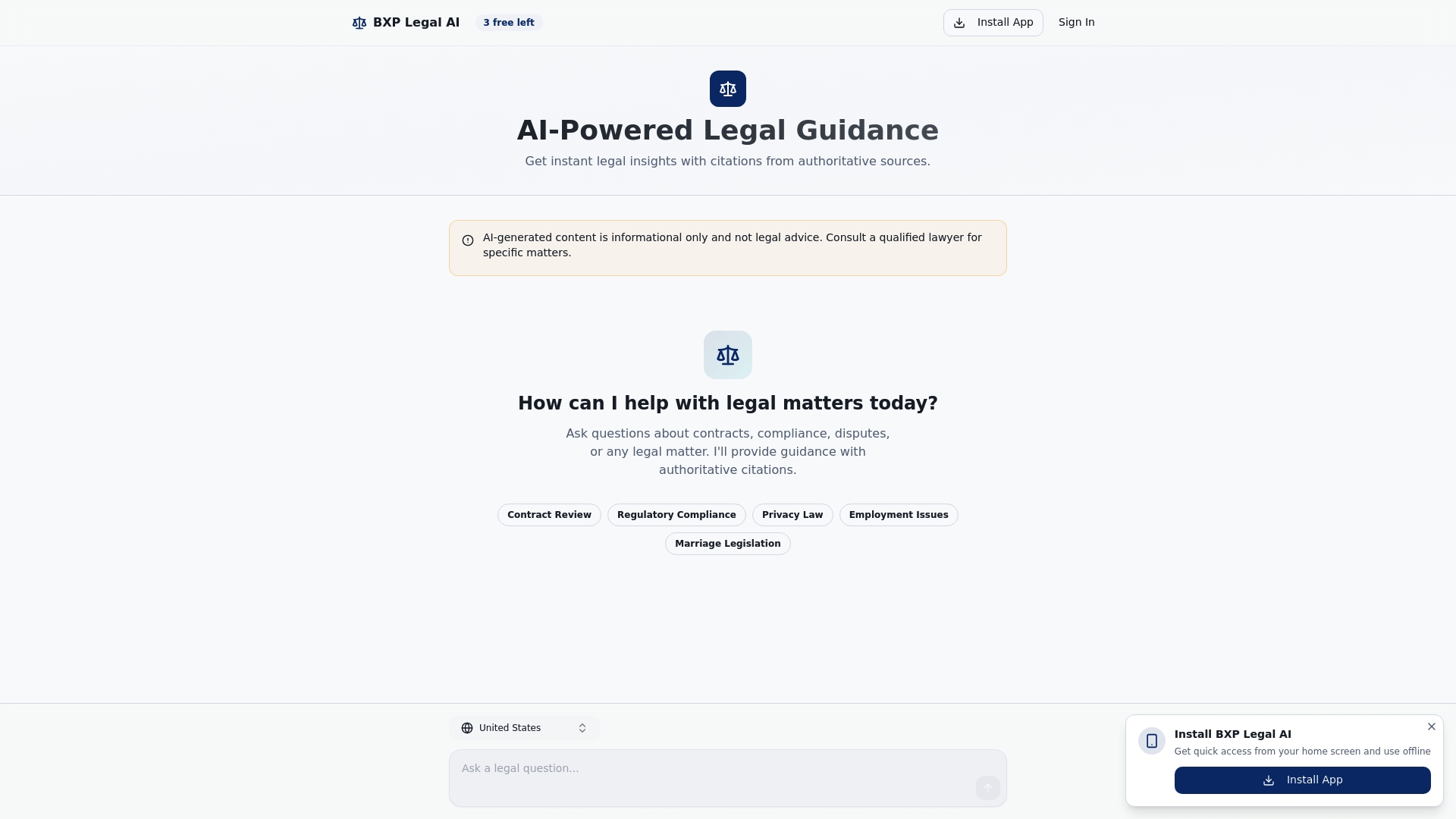
Our AI-powered platform provides instant legal guidance across contracts, compliance, employment law, and regulatory requirements. You get authoritative answers supported by citations, helping you understand obligations quickly without expensive legal consultations for routine questions. The legal document drafting feature generates customized policies, contracts, and compliance documentation tailored to your specific business needs and jurisdiction.
Businesses operating across state lines face multiplied compliance complexity. Our multi-jurisdiction legal support automatically identifies applicable requirements for each location where you operate, ensuring your checklist addresses every relevant regulation. Access legal templates designed specifically for SMB compliance needs, from employee handbooks to vendor agreements, all maintained current with 2026 legal standards. BXP Legal AI helps you build, update, and maintain comprehensive compliance checklists that protect your business from costly violations while freeing your time to focus on growth.
Legal compliance checklist FAQ
What are the must-have items on an SMB legal compliance checklist?
Your checklist must include business registration and licensing, tax compliance across all jurisdictions, employment law adherence covering wages and classification, data privacy protections, and industry specific regulations. Include documentation requirements, renewal dates, and responsible parties for each item. Regular review cycles and update procedures are equally essential components.
How often should I update my compliance checklist?
Review your checklist quarterly at minimum, with immediate updates when major regulatory changes occur in your industry or operating jurisdictions. Assign specific team members to monitor legal developments in their areas and flag necessary revisions. Annual comprehensive audits ensure nothing falls through the cracks between quarterly reviews.
What are the consequences of ignoring local regulations?
Local violations trigger fines, business license revocation, and legal disputes that can exceed federal penalties. Many municipalities impose daily fines for continuing violations, rapidly accumulating costs. You may face operational shutdowns until you achieve compliance, losing revenue and damaging customer relationships.
Can small businesses manage compliance without legal staff?
Yes, through systematic checklist use, compliance software, and strategic legal consultation for complex issues. Many SMBs successfully maintain compliance by combining automated tools with periodic professional reviews. Focus internal resources on routine monitoring and documentation while consulting attorneys for policy development and regulatory interpretation.
How does technology improve compliance efforts?
Automated systems provide real-time regulatory updates, deadline reminders, and centralized documentation that manual processes cannot match. Technology reduces human error, creates audit trails, and scales efficiently as your business grows. AI-powered platforms offer instant guidance on routine questions, reserving expensive legal consultations for truly complex matters.
What happens if I discover past compliance violations?
Address violations immediately through corrective action and documentation of remediation steps. Many regulatory agencies reduce penalties for businesses that self-report and demonstrate good faith compliance efforts. Consult legal counsel to assess exposure and develop an appropriate response strategy that minimizes liability while achieving full compliance.
Recommended
- Why legal documentation matters: protect your business in 2026
- Streamline multi-jurisdiction legal steps with AI in 2026
- Types of legal documents: your 2026 guide
- Multi-jurisdictional contract checklist for 2026
- 7 Essential Steps for a Swiss Company Compliance Checklist
- Korp.ph | Tax and Compliance in the Philippines – Essential Steps for Entrepreneurs