
TL;DR:
- Nearly 43% of small businesses face lawsuits, mainly due to contract disputes dangerous for growth.
- Legal mistakes like poor contracts, wrong business structure, and IP neglect significantly increase costs.
- Combining AI tools with expert legal guidance offers affordable, proactive protection for small businesses.
Nearly 43% of small businesses have faced a lawsuit or serious legal threat, and contract disputes drive 60% of that litigation. Most owners assume a downloaded template or a quick internet search is enough to stay protected. It rarely is. The gap between what you think your legal documents cover and what they actually cover is exactly where businesses lose money, clients, and sometimes everything they built. This guide breaks down the most common legal risks facing small businesses in 2026, the mistakes that make them worse, and how combining smart technology with expert guidance gives you a real defense.
Table of Contents
- The real risks small businesses face without legal guidance
- Common legal mistakes and how to avoid them
- How expert legal guidance protects your business
- Leveraging AI-based legal resources for affordable, proactive guidance
- What most small business guides miss about legal protection
- Get affordable legal guidance tailored for small business
- Frequently asked questions
Key Takeaways
| Point | Details |
|---|---|
| Lawsuits are common | Over 40% of small businesses face legal action and contract disputes, making guidance essential for everyone. |
| Costly mistakes add up | Defending even one lawsuit or contract mistake can cost more than $50,000 without proactive planning. |
| Prevention is cheaper | Early legal guidance prevents disputes and regulatory fines that are far more expensive to fix later. |
| Tech plus expertise wins | Combining AI-powered legal tools with expert advice gives broad protection at an affordable price. |
The real risks small businesses face without legal guidance
The numbers are harder to ignore than most business owners expect. 43% of small businesses have been threatened with or involved in a lawsuit, and contract disputes alone account for 60% of small business litigation. These are not rare events reserved for careless operators. They happen to careful, well-intentioned owners who simply did not have the right legal structure in place.
The financial exposure is equally alarming. The average defense cost for a tort liability claim against a small business runs $54,000. Complex contract disputes can push fees to $91,000 or even $170,000. For a business running on tight margins, a single lawsuit can be the difference between growth and closure.
Understanding your business risk protection starts with knowing where the threats actually come from. Here are the top five legal threats small businesses face:
- Contract disputes with clients, vendors, or partners over unclear terms
- Regulatory fines from non-compliance with industry or employment laws
- Employee misclassification treating workers as contractors when they legally qualify as employees
- Intellectual property infringement using names, content, or designs without proper clearance
- Premises and product liability claims from customers or third parties
| Legal issue | Average cost to resolve |
|---|---|
| Contract dispute (complex) | $91,000 to $170,000 |
| Tort liability defense | $54,000 |
| Employment misclassification fine | $5,000 to $25,000+ |
| IP infringement settlement | $15,000 to $50,000+ |
| Regulatory non-compliance penalty | $1,000 to $100,000+ |
"Reactive legal support after a problem surfaces costs exponentially more than proactive guidance. Most small business owners do not realize they are exposed until the lawsuit arrives."
Following regulatory compliance best practices from the start is not a luxury. It is the cheapest insurance you can buy. With the scale of risk apparent, it is crucial to understand exactly where most small business owners go wrong when navigating legal issues.
Common legal mistakes and how to avoid them
Most legal disasters for small businesses trace back to four predictable mistakes. Recognizing them early gives you a real chance to avoid them.
Wrong business structure. Choosing a sole proprietorship or the wrong entity type exposes your personal assets to business liability. If your business gets sued, your savings, home, and personal accounts can be at risk. Common legal mistakes include wrong business structure choice exposing personal liability, poor contracts leading to disputes, employee misclassification causing fines, and IP neglect.

Poorly written contracts. A contract that is vague about payment terms, deliverables, or dispute resolution is not much better than no contract at all. Clients will interpret ambiguous language in their own favor, and courts often do the same.
Employee misclassification. Calling someone a contractor when they work fixed hours, use your equipment, and follow your schedule is a legal risk. The IRS and state agencies actively audit this, and penalties add up fast.
Ignoring intellectual property. Your brand name, logo, website content, and product designs all have legal value. Failing to register or protect them means a competitor can legally copy your work or, worse, claim you infringed on theirs.
Here is a quick look at where business owners most often stumble:
- Using free online templates for complex or high-value contracts
- Skipping an operating agreement for an LLC because it feels unnecessary
- Hiring workers without written agreements that clearly define the relationship
- Launching a brand without a trademark search
| Approach | Risk level | Best use case |
|---|---|---|
| DIY templates | High for complex deals | Simple, low-value agreements |
| AI-guided legal tools | Medium | Standard contracts, compliance checks |
| Expert legal review | Low | High-value deals, disputes, entity setup |
Pro Tip: If a contract involves more than $5,000, a business partner, or an ongoing service relationship, do not rely on a template alone. The cost of a quick legal compliance essentials review is almost always less than fixing a dispute later. For contracts specifically, expert contract drafting guidance can save you from language that sounds fine but creates enormous exposure.
Knowing where mistakes happen is only half the battle. Proactive, efficient legal support is essential to prevent issues from arising in the first place.
How expert legal guidance protects your business
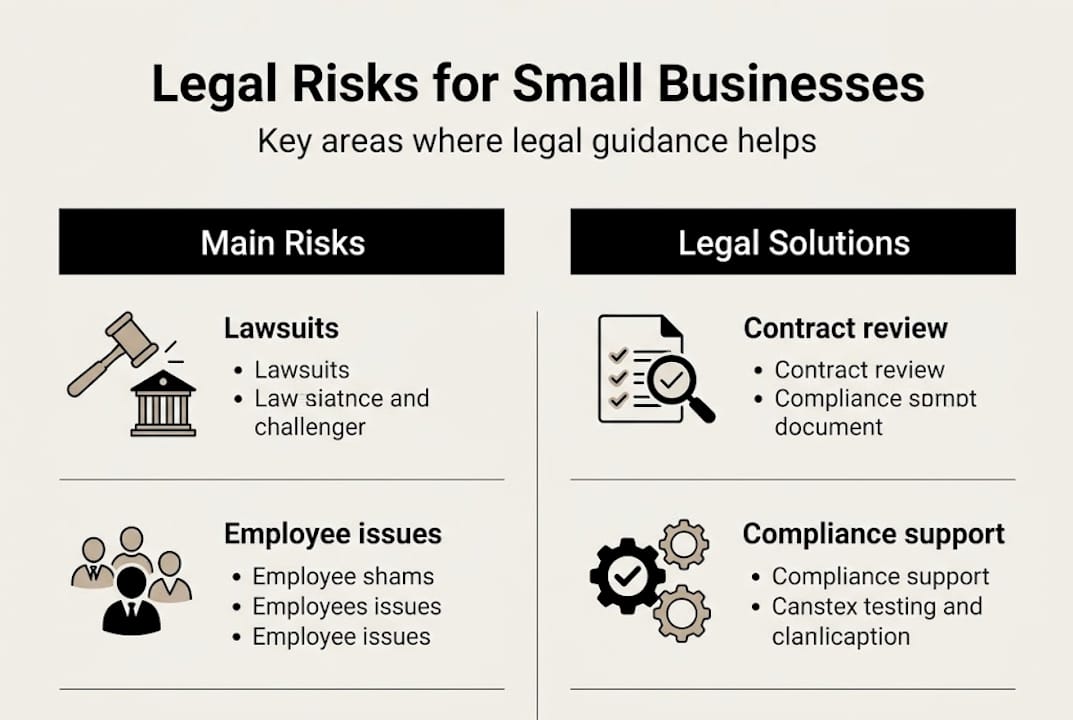
Legal advisors do more than help you respond to problems. The most valuable work they do happens before anything goes wrong. Here are five core functions that protect your business at every stage:
- Entity formation Choosing the right business structure from the start limits personal liability and can reduce your tax burden significantly.
- Contract drafting and review A well-written contract sets clear expectations, reduces disputes, and gives you a strong position if a disagreement does arise.
- Employment compliance Proper classification of workers, compliant offer letters, and up-to-date policies protect you from regulatory audits and employee claims.
- IP protection Registering trademarks, copyrights, and trade secrets creates enforceable rights that protect your brand and competitive advantage.
- Dispute resolution When conflicts arise, having an advisor who knows your business and its contracts means faster, cheaper resolution.
Legal guidance helps with entity formation, contract drafting and review, employment compliance, IP protection, and dispute resolution to avoid costly fixes after the fact.
Consider a real scenario. A small marketing agency signed a client contract using a free template. The payment terms were ambiguous, and when the client refused to pay the final invoice, the agency had no clear legal ground to stand on. A single contract review before signing would have cost a few hundred dollars. The dispute cost them over $12,000 in lost fees and legal fees to recover a fraction of what they were owed.
Using a contract compliance checklist before every major agreement is one of the simplest ways to reduce that risk. Pairing it with a compliance checklist for SMBs ensures you are not missing regulatory requirements that apply to your industry.
Pro Tip: Match your legal support to the stakes. Use AI tools and templates for routine documents. Bring in an expert for anything involving equity, employment disputes, or contracts over $10,000.
With the advantages of expert legal help clear, the next step is integrating efficient, affordable solutions into daily business operations.
Leveraging AI-based legal resources for affordable, proactive guidance
AI-powered legal tools have changed what is possible for small businesses with limited budgets. Speed, cost efficiency, and accuracy for standard tasks are the biggest wins. What used to require a billable hour can now take minutes.
Here is what AI legal tools can and cannot do for your business:
- Can do: Draft standard contracts, NDAs, and service agreements
- Can do: Flag missing clauses or risky language in existing documents
- Can do: Answer compliance questions with cited legal references
- Can do: Guide you through entity formation requirements by state
- Cannot do: Represent you in court or formal dispute proceedings
- Cannot do: Provide jurisdiction-specific advice for highly regulated industries
- Cannot do: Replace human judgment in complex negotiations or investor deals
- Cannot do: Guarantee outcomes in edge cases or novel legal situations
DIY legal approaches fail in edge cases like complex partnerships, investor deals, or industry-specific regulations, and can lead to personal liability or lost IP. That is not an argument against AI tools. It is an argument for using them strategically.
AI-powered document drafting is genuinely useful for getting a solid first draft quickly. The key is knowing when to stop and get a human review. For routine documents, AI handles the heavy lifting. For anything with significant financial or legal exposure, human expertise closes the gap.
Understanding legal documentation importance is the foundation. Using AI legal templates as a starting point, then layering in expert review for high-stakes documents, gives you the best of both worlds.
Pro Tip: Build a two-tier system. Use AI tools for drafts, compliance checks, and routine questions. Reserve expert legal review for entity changes, key hires, investor agreements, and any situation where a mistake could cost you more than $5,000.
While technology enables safer, more affordable legal access, every small business must assess its unique risk profile for the best mix of resources.
What most small business guides miss about legal protection
Most guides frame legal protection as damage control. They walk you through what to do after a lawsuit lands, after a fine arrives, after a contract falls apart. That framing treats law as a cost center, something you deal with when things go wrong.
The smarter frame is legal protection as a growth asset. Businesses that invest in proactive legal structure close bigger deals because clients trust their contracts. They hire confidently because their employment policies are solid. They scale without regulatory surprises because compliance is built in from the start.
Proactive legal support before issues arise prevents 30% of lawsuit-related worry and enables real growth. Reactive fixes cost far more, not just in money but in time and focus.
The most underappreciated move any small business owner can make is combining AI efficiency with expert judgment. AI handles the volume and speed. Experts handle the nuance and stakes. Neither alone is enough.
Understanding lawsuit risks is not about fear. It is about making smarter decisions before the pressure is on.
Get affordable legal guidance tailored for small business
You have seen the numbers and the mistakes. Now the question is what you do with that knowledge. Small business owners in 2026 have access to faster, more affordable legal tools than any previous generation.
BXP Legal AI gives you instant, citation-backed answers to your legal questions across contracts, compliance, employment, and more. You can draft documents, run AI document comparison on existing agreements, and get clarity on regulatory requirements without waiting for a callback. It is built for business owners who need real answers fast, with the transparency to know when to bring in expert support.
Frequently asked questions
What are the biggest legal risks for small businesses?
Contract disputes account for 60% of small business litigation, making them the single largest legal threat, alongside regulatory compliance failures and employment misclassification.
How much do legal mistakes typically cost small businesses?
Defending a single lawsuit can cost $54,000 or more, and complex contract disputes frequently reach $91,000 to $170,000 before resolution.
Can AI legal tools replace a lawyer for my small business?
AI tools handle standard documents and compliance checks efficiently, but complex partnerships and investor deals require expert legal judgment that AI cannot replicate.
Recommended
- Legal Risk Explained: Protect Your Business in 2026
- Legal compliance explained: essential steps for SMBs
- Why legal documentation matters: protect your business in 2026
- Document drafting guide for small businesses: compliance
- Financial Planning for Small Business: Complete Guide - My Mobile Notary
- Notary process for Ontario small businesses: 2026 guide - The Online Notary