
TL;DR:
- Non-compliance costs small businesses 2.7 times more than maintaining compliance.
- SMBs must adhere to laws across operations, data privacy, employment, licensing, and taxes.
- Building a culture of compliance with simple policies and tech tools reduces risks and scaling hurdles.
Most small business owners assume compliance is a big-company problem. It is not. Non-compliance costs 2.7x more than staying compliant, and 37% of organizations missed regulatory requirements last year alone. The penalties, lawsuits, and operational disruptions that follow can hit an SMB far harder than a corporation with a full legal department. This guide breaks down what legal compliance actually means, which areas matter most for your business, and how to build a system that protects you without requiring a law degree or an enterprise budget.
Table of Contents
- What is legal compliance and why does it matter?
- Key areas of legal compliance for SMBs
- Common challenges, edge cases, and how businesses get compliance wrong
- Making compliance practical: How SMBs can build proportionate systems
- A fresh perspective: Why effective compliance is about culture, not just checklists
- Simplify legal compliance with AI-powered solutions
- Frequently asked questions
Key Takeaways
| Point | Details |
|---|---|
| Legal compliance definition | It means following all applicable laws and rules across your business operations. |
| Main compliance areas | Focus on registration, tax, labor, privacy, permits, and sector-specific rules. |
| SMB risks and solutions | Small businesses face higher compliance risks but can use simple tech-driven programs. |
| Common pitfalls | Many SMBs struggle with state laws, documentation, and scaling their systems over time. |
| Practical steps | Start with a risk assessment, set policies, use automation, and review regularly. |
What is legal compliance and why does it matter?
With an understanding of the high stakes, let's clarify what legal compliance really means for your business.
Legal compliance means ensuring your business adheres to all applicable laws, regulations, standards, and ethical practices across every part of your operations. That covers everything from how you register your business to how you store customer data. It is not a box you check once at startup. Compliance is an ongoing obligation that evolves as your business grows, as laws change, and as you enter new markets.
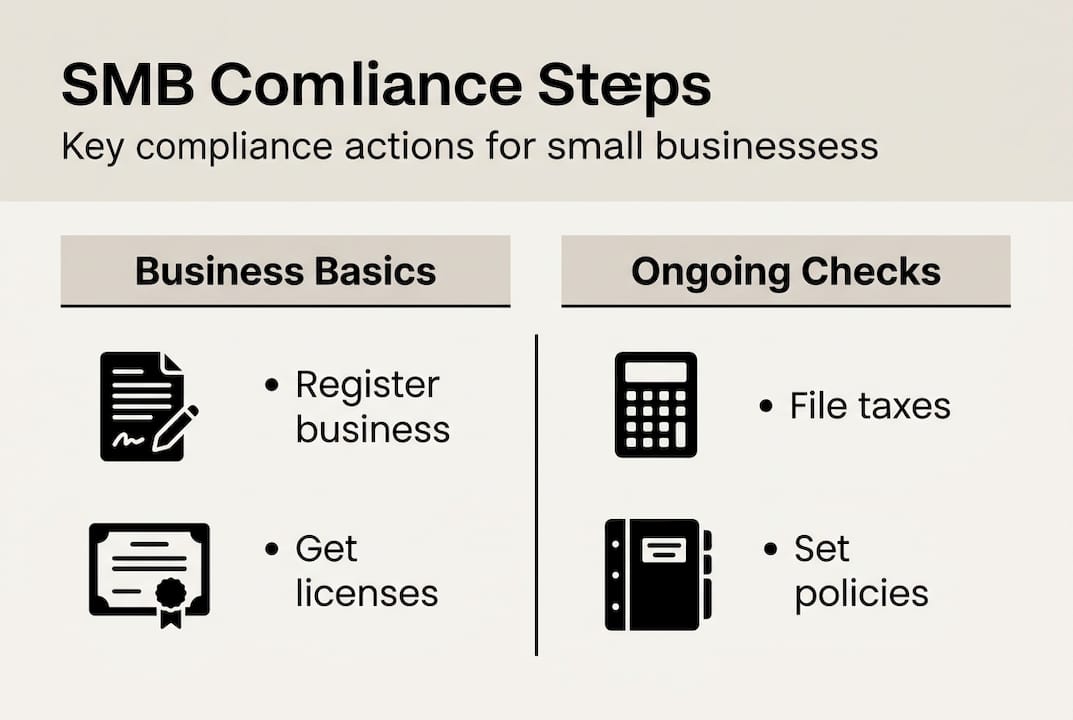
For SMBs, the scope can feel overwhelming. But the core idea is simple: your business must operate within the rules set by federal, state, and local governments, as well as industry-specific bodies. Falling short, even accidentally, creates real exposure.
Here is a snapshot of what non-compliance can cost:
| Consequence | Example impact |
|---|---|
| Regulatory fines | $1,000 to $50,000+ per violation |
| Lawsuits | Legal fees, settlements, reputational damage |
| Business interruption | License suspension, forced shutdowns |
| Tax penalties | Back taxes, interest, audits |
| Data breach liability | Fines under HIPAA, CCPA, GDPR |
"Compliance is not just about avoiding penalties. It is about building a business that can survive scrutiny, attract partners, and scale with confidence."
Common compliance scenarios SMBs face every day include:
- Hiring a first employee and triggering federal and state labor law obligations
- Collecting customer email addresses without a proper privacy policy
- Operating in a second state without registering as a foreign entity
- Accepting payments without meeting PCI DSS (Payment Card Industry Data Security Standard) standards
A solid SMB compliance checklist helps you track these obligations systematically rather than reacting to problems after they arise. And when you are drafting contracts or policies, compliance in document drafting is just as important as the legal language itself.
Key areas of legal compliance for SMBs
Now that we have established the "what" and "why," let's break down exactly where legal compliance applies in your day-to-day operations.
Key compliance areas for SMBs include registration and licensing, tax obligations, employment law, data privacy, environmental rules, consumer protection, financial reporting, and industry-specific permits. Each one carries its own risk profile and complexity level.
Here is a practical comparison to help you prioritize:
| Compliance area | Risk level | Complexity | Common failure rate |
|---|---|---|---|
| Employment and labor | High | High | Very common |
| Data privacy (CCPA, HIPAA) | High | Medium-High | Common |
| Tax and financial reporting | High | Medium | Common |
| Business registration | Medium | Low | Less common |
| Consumer protection | Medium | Medium | Moderate |
| Environmental rules | Low-Medium | High | Less common |
| Industry permits | Varies | Varies | Sector-dependent |
Here is a numbered breakdown of what each area actually requires:
- Registration and licensing: Your business must be properly registered in every state where it operates, with the right licenses for your industry.
- Tax compliance: Federal, state, and local tax filings must be accurate and on time, including payroll taxes if you have employees.
- Employment and labor law: Covers minimum wage, overtime, anti-discrimination rules, workplace safety, and proper classification of workers.
- Data privacy: If you collect personal data, you must follow applicable laws like CCPA or HIPAA, including proper disclosures and security measures.
- Environmental rules: Depending on your industry, waste disposal, emissions, and chemical use may be regulated.
- Consumer protection: Truth-in-advertising, refund policies, and fair billing practices fall here.
- Financial reporting: Accurate bookkeeping and, for some entities, audited statements are required.
- Industry permits: Restaurants, healthcare providers, contractors, and others need sector-specific approvals.
Pro Tip: Start with the highest-risk area for your specific sector. A healthcare startup should prioritize HIPAA before anything else. A retail shop should focus on consumer protection and tax compliance first. Good document verification tips can help you confirm you have the right paperwork in place for each area.
Common challenges, edge cases, and how businesses get compliance wrong
Knowing the main compliance categories is only half the battle. Let's look at why many SMBs still get into trouble.

Compliance obligations vary significantly by size, jurisdiction, and the nature of your operations. State laws are often stricter than federal minimums, and technology introduces edge cases that traditional compliance frameworks never anticipated.
Some of the trickiest situations SMBs encounter include:
- Employee count triggers: Hiring your 15th employee activates Title VII anti-discrimination protections. Reaching 50 employees triggers FMLA (Family and Medical Leave Act) obligations. Many owners miss these thresholds entirely.
- Multi-state operations: Selling in multiple states can create sales tax nexus, employment obligations, and registration requirements in each state, even if you have no physical office there.
- State vs. federal conflicts: California's CCPA data privacy rules are stricter than federal standards. Operating there means following the tougher standard.
- Technology edge cases: Using AI tools for hiring, customer screening, or data processing may trigger specific regulations that did not exist five years ago.
"Most compliance failures are not acts of bad faith. They are the result of not knowing what you did not know."
Poor documentation is the most common root cause of compliance problems. If you cannot show that you trained employees on a policy, regulators may treat it as if the policy never existed. The same applies to contracts, privacy notices, and safety procedures. Reviewing multi-jurisdiction compliance steps before expanding can prevent costly surprises.
Understanding "safe harbor" provisions also matters. A safe harbor is a legal protection that shields you from penalties if you made a good-faith effort to comply, even if you fell short. Documenting your processes, training, and decisions is how you demonstrate that good faith. AI-powered legal guidance can help you identify where these protections apply and what documentation you need. As one analysis of AI in legal R&D points out, technology can support compliance but still requires careful human oversight for edge cases.
Pro Tip: Document all policies, employee training sessions, and compliance decisions in writing. A simple log with dates and names is often enough to demonstrate good faith during an audit or dispute.
Making compliance practical: How SMBs can build proportionate systems
Understanding challenges is vital, but how do you actually make legal compliance manageable and scalable for your small business?
Proportionate compliance management for SMBs focuses on risk assessment, clear policies, basic training and monitoring, regular reviews, and smart use of automation. You do not need a compliance department. You need a system that fits your size.
Here is a step-by-step approach to building one:
- Run a risk assessment: List every area where your business touches regulated activity. Rank them by likelihood of violation and potential impact. Start there.
- Write clear, simple policies: A one-page data privacy policy beats a 20-page document no one reads. Clarity drives actual behavior.
- Train your team: Even a 30-minute onboarding session on key policies creates a documented record and reduces mistakes.
- Set up monitoring: Use calendar reminders for license renewals, tax deadlines, and annual reviews. Automate what you can.
- Schedule regular reviews: Compliance needs change as you grow. Trigger a full review when you hire significantly, enter a new state, or launch a new product line.
- Use affordable tech tools: AI for document workflows can automate contract generation, flag missing clauses, and keep your templates current. Legal technology explained covers how these tools work and what to look for.
The compliance statistics are clear: organizations that invest in proactive compliance spend far less over time than those that react to violations. For SMBs operating on tight margins, that math matters.
Pro Tip: Schedule a compliance review every January and every time your headcount crosses a major threshold (15, 50, 100 employees). Treat it like a financial audit, not an afterthought.
A fresh perspective: Why effective compliance is about culture, not just checklists
Here is something most compliance guides will not tell you: the businesses that struggle most with compliance are not the ones that lack tools or templates. They are the ones where compliance is treated as a burden rather than a value.
Checklists and policy documents are essential. But they only work when the people using them actually understand why the rules exist. When a team member sees a privacy policy as a legal formality rather than a genuine commitment to customers, they will find ways around it without even realizing the risk.
The SMBs that handle audits, regulatory changes, and growth transitions most smoothly are the ones where compliance thinking is embedded in everyday decisions. When your operations manager asks "is this documented?" before signing a vendor agreement, that is compliance culture at work. It is not about fear of fines. It is about building a business that earns trust from customers, partners, and regulators alike.
A healthy compliance culture also makes scaling dramatically easier. New regulations feel less disruptive when your team already has the habit of checking requirements before acting. Starting with a complete compliance checklist builds that habit systematically.
Simplify legal compliance with AI-powered solutions
Looking for practical, time-saving ways to implement compliance right now?
Managing compliance manually is time-consuming and easy to get wrong, especially when regulations shift or your business crosses into new territory. BXP Legal AI gives SMBs instant access to AI-driven legal guidance across contracts, privacy, employment, and more, all backed by authoritative citations.
Need to check requirements across multiple states? The platform's multi-jurisdiction support makes fast work of complex regulatory landscapes. Want to compare contract versions or verify document language? Document comparison tools help your team catch gaps before they become problems. For SMBs that want confidence without the cost of a full legal team, BXP Legal AI is built exactly for that gap.
Frequently asked questions
What are the main areas of legal compliance for my small business?
The main areas include registration and licensing, taxes, labor laws, data privacy, environmental rules, consumer protection, financial reporting, and industry-specific permits. Each area carries different risk levels depending on your industry and size.
How does non-compliance impact SMBs differently than large companies?
SMBs face 280% higher relative impact from compliance fines and risks compared to large organizations, often because they lack the legal resources and cash reserves to absorb penalties without major disruption.
How can technology or AI help with legal compliance?
95% of organizations now use technology in audits, and AI tools can reduce manual work, monitor requirements, and simplify documentation. However, they still require careful human oversight, especially for edge cases and jurisdiction-specific rules.
What is a proportionate compliance program?
A proportionate program focuses on your biggest risks first, using clear policies, basic staff training, and affordable technology tools that match your actual business size and complexity rather than enterprise-level systems.