
Legal services have long felt like a members-only club: expensive, slow, and hard to navigate without a law degree. That assumption is crumbling fast. Legal technology is transforming how legal tasks are handled, making legal help faster, more affordable, and accessible to more people than ever before. This guide breaks down exactly what legal technology is, how it works under the hood, where it delivers real value for individuals and small businesses, and what risks you need to watch for before you dive in.
Table of Contents
- Defining legal technology: What it really means
- How legal technology works: Behind the scenes
- Key uses of legal technology for individuals and small businesses
- The real-world impact: Data, time savings, and industry adoption
- Risks, limits, and human oversight in LegalTech
- Success factors: How to choose and use legal technology wisely
- Explore AI-powered legal help with BXP Legal
- Frequently asked questions
Key Takeaways
| Point | Details |
|---|---|
| LegalTech simplifies legal work | Modern software can automate, accelerate, and lower the cost of many legal tasks for businesses and individuals. |
| Real benefits and limits | Tools save time and improve accuracy but still require human review, especially for complex or sensitive cases. |
| Choosing the right tool matters | Select solutions based on integration, cost, security, and support to get the best results. |
| Affordable entry options | Even small businesses and individuals can now access easy-to-use legal technology with minimal investment. |
Defining legal technology: What it really means
Legal technology is not just a buzzword. It covers a wide range of software and digital tools built specifically to handle legal work more efficiently. Think of it as the bridge between complex legal processes and the people who need them most.
LegalTech refers to software and digital tools designed to streamline legal services, operations, and processes, including document automation, case management, AI-powered research, e-discovery, and contract analysis. That is a broad definition, and intentionally so, because the category is genuinely wide.
Here is a quick breakdown of the main categories you will encounter:
- Document automation: Software that generates contracts, agreements, and legal forms from templates, cutting hours of drafting down to minutes.
- Case management: Platforms that track deadlines, filings, and client communications in one place.
- AI-powered legal research: Tools that scan thousands of cases and statutes to surface relevant precedents in seconds.
- E-discovery: Software that identifies and organizes digital evidence for litigation.
- Contract analysis: AI that reads contracts, flags risky clauses, and compares versions automatically.
For small businesses and individuals, the payoff is straightforward: lower costs, faster turnaround, and fewer errors. You can explore legal research techniques that pair well with these tools to get even more out of your research time. If you want a broader picture of what is legal tech and how it fits into the modern legal industry, the landscape is evolving quickly.
How legal technology works: Behind the scenes
Knowing what LegalTech does is useful. Knowing how it does it gives you real confidence when choosing and using these tools.
The mechanics involve data capture, AI analysis with human-in-the-loop oversight, automation of repetitive tasks using templates and rules, and integration with existing workflows. In practice, that breaks down into four steps:
- Data capture and organization: The system ingests documents, contracts, case files, or legal databases and structures that information so it can be searched and analyzed.
- AI analysis: Algorithms, often powered by large language models, read and interpret the organized data to identify patterns, flag issues, or generate summaries.
- Automation: Templates and business rules handle routine steps automatically, such as populating a contract with client details or sending deadline reminders.
- Integration: The tool connects with your existing software, whether that is email, cloud storage, or billing systems, so nothing falls through the cracks.
One important concept here is Retrieval-Augmented Generation, or RAG. Instead of letting an AI generate answers purely from its training data, RAG grounds responses in actual legal texts and documents. This significantly reduces the risk of the AI inventing facts. You can see how this powers AI in legal drafting and how automation workflows are built around these principles. For a deeper look at where this is all heading, the AI legal roadmap offers a useful strategic view.

Pro Tip: Always keep a human reviewer in the loop for any document that carries real legal weight. AI handles the heavy lifting; a qualified professional catches the edge cases.
Key uses of legal technology for individuals and small businesses
Understanding the technology is essential, but what counts is how these tools come to life for users. Legal technology encompasses document automation, case management, legal research platforms, e-discovery, and contract lifecycle management, and each of these has a direct application for everyday users.
Here is where LegalTech makes the biggest difference in practice:
- Document generation: Create NDAs, employment agreements, or lease contracts in minutes using guided templates.
- Legal chatbots: Get instant answers to common legal questions without scheduling a consultation.
- Contract review: Upload a contract and receive a plain-language summary of key terms and risk flags.
- Case tracking: Monitor deadlines, filings, and correspondence without juggling spreadsheets.
| Task | Manual approach | Technology-assisted approach |
|---|---|---|
| Drafting a contract | 2 to 4 hours | 10 to 20 minutes |
| Reviewing a 30-page agreement | Half a day | Under 30 minutes |
| Legal research on a topic | Several hours | Minutes with AI search |
| Tracking case deadlines | Manual calendar entries | Automated alerts |
The AI drafting guide walks through exactly how to use these tools step by step. If you prefer a conversational interface, AI legal chat lets you ask questions and get cited answers instantly. The Gartner report on legal tech confirms that adoption is accelerating across both enterprise and small business segments.
The real-world impact: Data, time savings, and industry adoption
So, does the hype match reality? Here is what the data shows about the tangible benefits LegalTech users experience.
64% of legal leaders are accelerating technology investments, generative AI reduces routine work by 44 to 60%, and case analysis is now up to 75% faster. Those are not projections. Those are current benchmarks.
"The shift is not just about efficiency. It is about access. Legal technology is putting tools in the hands of people who previously had no affordable path to legal support."
| Metric | Before LegalTech | With LegalTech |
|---|---|---|
| Contract drafting time | 3 to 5 hours | 15 to 30 minutes |
| Routine task reduction | Baseline | 44 to 60% less time |
| Case analysis speed | Baseline | Up to 75% faster |
| Legal leader tech investment | Gradual | 64% accelerating now |
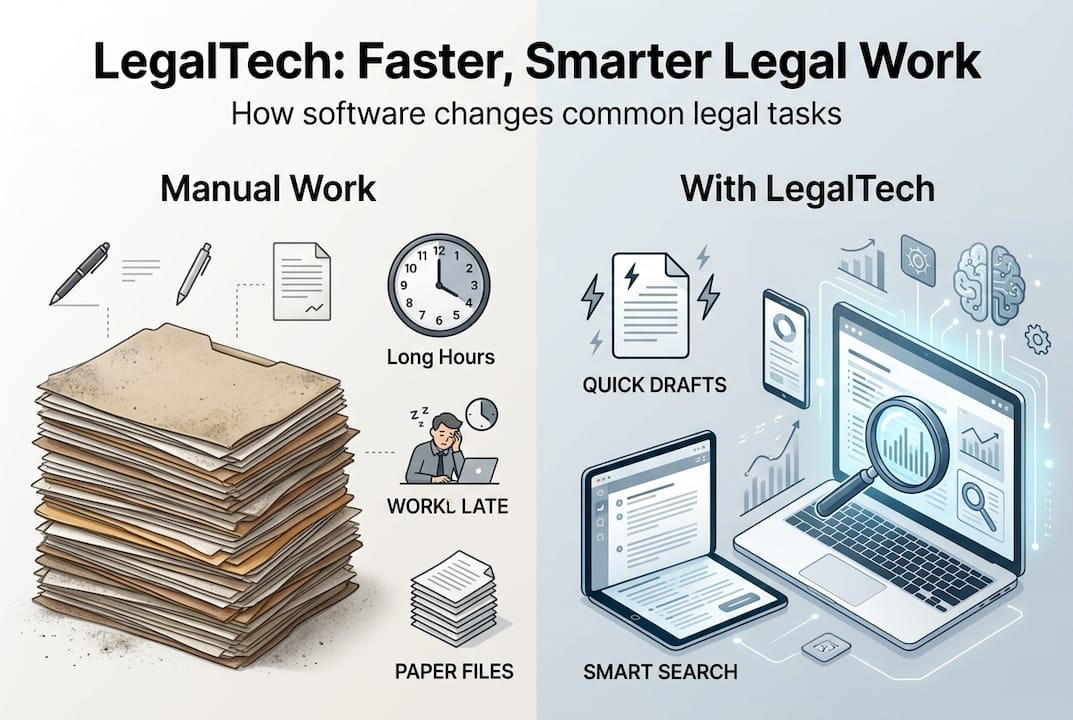
These numbers matter because they translate directly into money saved and decisions made faster. For a small business owner, cutting contract review time by 75% means you can close deals faster and spend less on outside counsel. Tools that AI streamlines legal work are already delivering this in practice. The legal industry benchmarks from CLOC's 2026 State of the Industry report reinforce these trends across organizations of all sizes. You can also review legal research time savings to see how research specifically benefits from these tools.
Risks, limits, and human oversight in LegalTech
While the upsides are compelling, it is crucial to be aware of the risks so you can take advantage of LegalTech with your eyes open.
AI hallucinations occur in 49% of ungrounded large language models, and privacy, integration, and probabilistic outputs pose key risks in legal deployments. That statistic should give you pause, not panic.
Here are the main risks to keep in mind:
- Hallucinations: AI can generate plausible-sounding but completely fabricated legal citations or case outcomes.
- Data privacy: Uploading sensitive contracts or personal information to an unsecured platform creates real exposure.
- Over-reliance: Treating AI output as final without review is the fastest way to create a legal problem instead of solving one.
- Integration gaps: Poorly connected tools can create version control issues or missed deadlines.
"Technology is a powerful assistant, not a replacement for judgment. The best outcomes come from pairing AI efficiency with human expertise."
Pro Tip: Before uploading any sensitive document to a LegalTech platform, check its data handling policy and whether it stores your files after processing. This single step protects you from most privacy risks.
The AI oversight guide covers exactly when and how to bring a qualified professional into the process. For structured approaches to evaluating AI tools, evaluation frameworks provide a useful starting point.
Success factors: How to choose and use legal technology wisely
Once you are aware of both the benefits and the risks, here is how you can make smart, confident choices about LegalTech for your needs.
LegalTech democratizes access via affordable AI tools, but success depends on digital readiness, integration quality, and human-AI collaboration models that mitigate bias and errors. Choosing the right tool is as important as choosing to use one at all.
Here is a practical checklist for evaluating any LegalTech solution:
- Cost and value: Does the pricing fit your budget? Many solid tools start under $70 a month. Check the industry statistics for current pricing benchmarks.
- Ease of integration: Will it connect with the tools you already use, like Google Drive, Dropbox, or your email client?
- Data privacy standards: Look for SOC 2 compliance, end-to-end encryption, and clear data retention policies.
- Human review support: Does the platform make it easy to export work for attorney review when needed?
- Ongoing support and updates: Legal rules change. Your tool should update to reflect new regulations automatically.
- User readiness: Does your team have the basic digital literacy to use the tool effectively from day one?
The strongest results come from treating AI as a collaborator, not a replacement. Use it to handle volume and speed, then apply human judgment to anything with real stakes. Building automation workflows around this model gives you the best of both worlds.
Explore AI-powered legal help with BXP Legal
If reading this has made you want to put LegalTech to work for your own documents and questions, BXP Legal is built exactly for that moment. The platform gives individuals and small businesses instant access to AI-driven legal guidance, document drafting, and contract analysis, all backed by authoritative citations.
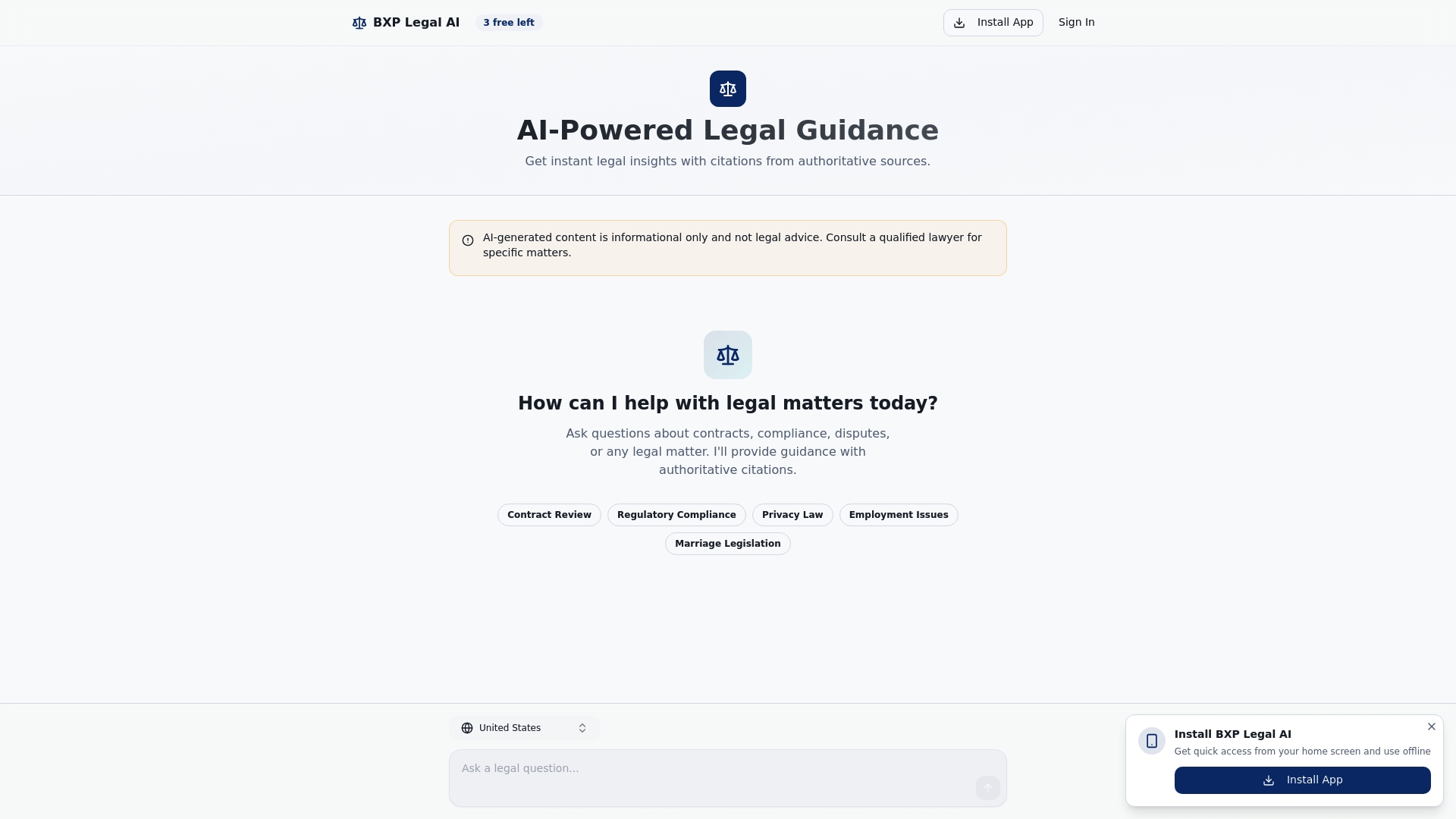
You can use document comparison features to spot differences between contract versions in seconds, or browse ready-to-use legal templates that cover everything from NDAs to employment agreements. Whether you are just starting to explore LegalTech or ready to streamline a specific workflow, BXP Legal offers a practical, affordable entry point with no law degree required.
Frequently asked questions
What is legal technology in simple terms?
LegalTech is software and digital tools that automate, organize, or speed up legal tasks that people previously handled manually, from drafting contracts to researching case law.
Can legal technology replace lawyers?
LegalTech handles routine work well, including transcription at 99% accuracy and invoice review at 92%, but high-stakes legal decisions still require human judgment and professional accountability.
Is LegalTech secure and private?
Most reputable platforms use strong encryption and compliance standards, but AI hallucinations and privacy risks are real. Always review the tool's data policy and never skip human review for sensitive matters.
How can I get started with LegalTech affordably?
Affordable AI tools for document drafting and legal advice typically run $20 to $69 per month. Start with document automation or contract review platforms designed for small teams and scale from there.