
Navigating contracts, compliance issues, and legal risks can feel overwhelming when you're running a small business or managing personal legal matters. Traditional legal research demands time, expertise, and access to expensive databases, yet mistakes can cost thousands in penalties or disputes. The good news: a structured framework combining proven research methods with modern AI tools can transform how you approach legal questions. You'll learn seven practical techniques that deliver accurate results efficiently, plus checklists and pro tips to avoid common pitfalls and build confidence in your research process.
Table of Contents
- Key Takeaways
- 1. Start with a clear framework: issue framing and jurisdiction
- 2. Leverage secondary sources for context and efficient grounding
- 3. Identify and analyze primary sources: statutes, cases, and regulations
- 4. Confirm authority and currency using citators and AI verification tools
- 5. Use advanced search techniques: Boolean operators and docket research
- 6. Maintain research logs and checklists for defensibility and organization
- 7. Harness AI legal research tools effectively with human verification
- Explore BXP Legal AI for efficient, accurate legal research
- FAQ
Key Takeaways
| Point | Details |
|---|---|
| Framing and jurisdiction | Define the exact legal question and identify the applicable jurisdiction early to focus research and avoid irrelevant results. |
| Secondary sources first | Use legal encyclopedias, practice guides, and annotated codes to gain plain language context before tackling statutes or cases. |
| Research log from day one | Start and maintain a research log with your issue statement, jurisdictions considered, and sources chosen to build a defensible trail. |
| Hybrid AI human approach | Hybrid AI human approach yields up to 50 percent time savings while preserving nuanced judgment. |
| Primary sources and citators | Identify statutes and cases and use citators to verify authority and current status. |
1. Start with a clear framework: issue framing and jurisdiction
Before diving into databases or AI tools, define your exact legal question. Are you reviewing an employment contract clause, checking state licensing requirements, or researching liability for a service dispute? Pinpointing the issue prevents hours spent on tangentially related materials. Next, identify which jurisdiction's law applies: federal statutes, state regulations, local ordinances, or a combination. A contract dispute in California follows different rules than one in Texas, and compliance obligations vary dramatically across state lines.
Use a simple checklist to verify your scope. List the legal issue in one sentence, note all potentially relevant jurisdictions, and confirm whether federal law preempts state rules. This preliminary analysis forms the foundation for everything that follows. Without it, you risk researching the wrong jurisdiction's law or missing critical federal requirements that override state provisions.
Pro Tip: Start a research log from day one. Record your initial issue statement, jurisdictions considered, and why you selected certain sources. This log becomes invaluable if you need to revisit your reasoning, share findings with a colleague, or consult legal experts who require context. Early framing saves time and builds a defensible research trail that protects you if questions arise later.
2. Leverage secondary sources for context and efficient grounding
Once you've framed your issue, turn to secondary legal materials before tackling dense statutes or case opinions. Legal encyclopedias, practice guides, and annotated codes explain the law in plain language and highlight key authorities you'll need. These sources distill complex doctrine into digestible overviews, saving hours of trial and error. For small business owners, practice guides tailored to your industry offer checklists and sample language for common scenarios like vendor agreements or employee handbooks.
Trusted platforms provide free access to many secondary sources. Government websites, law school library guides, and nonprofit legal aid organizations publish primers on employment law, contract basics, and regulatory compliance. Using secondary sources first orients your research efficiently, revealing which statutes, regulations, and landmark cases matter most for your question. They also flag nuances like exceptions, safe harbors, or recent amendments that might otherwise go unnoticed.
Pro Tip: Bookmark free online legal research platforms that aggregate secondary materials. Many offer topic specific guides for small businesses, covering areas like tax compliance, intellectual property basics, and contract drafting. These resources often include links to relevant legal compliance checklists and templates, giving you practical starting points for your own documents.
3. Identify and analyze primary sources: statutes, cases, and regulations
Primary sources are the actual law: statutes enacted by legislatures, regulations issued by agencies, and court opinions interpreting both. These materials carry binding authority, meaning they dictate legal outcomes in your jurisdiction. To locate statutes, use official government databases like govinfo for federal law or your state legislature's website for state codes. Regulations appear in the Code of Federal Regulations or state administrative codes, often organized by topic.

For case law, free databases like Google Scholar and Justia provide access to published court opinions. Focus on the exact text relevant to your question, reading the court's reasoning and any limiting language. Check the publication status: some opinions are unpublished and carry less precedential weight. Regulatory materials require extra attention to effective dates and amendments, as agencies frequently update rules. Legislative history and dockets can reveal why a law was enacted or how courts have applied it in practice.
Understanding primary sources like statutes, cases, and regulations is non negotiable for defensible legal research. These documents form the backbone of any legal analysis, whether you're drafting a contract clause, assessing compliance obligations, or evaluating litigation risk. Cross reference multiple primary sources to see how they interact, especially when federal and state laws overlap. Familiarize yourself with the structure of legal documents so you can navigate statutes, regulations, and opinions efficiently.
4. Confirm authority and currency using citators and AI verification tools
Finding a relevant case or statute is only half the battle. You must verify it remains good law and hasn't been overruled, amended, or distinguished by later decisions. Citators are specialized tools that track the treatment history of legal authorities, showing whether subsequent cases have followed, criticized, or reversed the precedent. Leading platforms like Shepard's and KeyCite provide this service, flagging red for overruled cases and yellow for negative treatment.
AI tools now complement traditional citators by quickly flagging potential issues with source validity. They scan databases in seconds, highlighting cases that have been distinguished or statutes that have been amended. For contract clauses and compliance points, AI can cross reference the latest case law to ensure your language aligns with current standards. However, AI sometimes hallucinates citations or misinterprets nuanced treatment, so always verify findings with official citators or the original source.
Pro Tip: Adopt a two step verification process. Let AI tools perform the initial scan for speed, then confirm critical findings with a reputable citator or by reading the updating case yourself. This hybrid approach combines AI efficiency with human judgment, delivering the highest accuracy for AI document drafting and compliance work. Never rely solely on AI for high stakes matters like litigation or regulatory filings.
5. Use advanced search techniques: Boolean operators and docket research
Broad keyword searches return thousands of irrelevant results, wasting time and obscuring the materials you need. Advanced search techniques using Boolean operators refine queries dramatically. Combine terms with AND to require both appear, OR to capture synonyms, and NOT to exclude unrelated topics. Proximity operators like "within 5 words" ensure terms appear close together, filtering out documents where they're unrelated. These methods transform vague searches into laser focused queries.
Court dockets and legislative histories offer nuanced materials often unavailable in standard databases. Dockets reveal procedural details, settlement agreements, and unpublished orders that shed light on how courts handle specific issues. Legislative history shows the intent behind statutes, helping interpret ambiguous language. Jurisdictional filters improve accuracy, especially in multi jurisdictional contexts where federal and state laws intersect. Boolean and proximity searches maximize result relevance, saving hours compared to basic keyword queries.
Experiment with different operator combinations to see which yields the best results for your issue. For example, searching "non compete AND (California OR Texas) NOT employment" narrows results to non compete agreements in those states while excluding employment specific cases if your focus is vendor contracts. Advanced searches require practice but pay dividends in efficiency and precision.
6. Maintain research logs and checklists for defensibility and organization
Every research step, source consulted, and decision made should be documented in a centralized log. This practice ensures accountability, simplifies review if you revisit the issue months later, and provides an audit trail for compliance checks or contract negotiations. Logs also help you avoid duplicating effort, as you can quickly see which databases you've searched and which terms returned useful results. For small businesses, checklists tailored to common legal risks like compliance obligations and contract reviews keep research organized and comprehensive.
Digital logs and AI assisted tracking tools offer advantages over manual methods. They automatically timestamp entries, link directly to sources, and flag when you've verified AI generated findings with official citators. However, manual logs provide simplicity and don't require software subscriptions. Choose the method that fits your workflow, but commit to consistency. Research logs and checklists ensure process defensibility, critical if your findings are later questioned by a regulator, opposing party, or business partner.
| Log Type | Pros | Cons |
|---|---|---|
| Manual (Word/Excel) | Simple, no cost, full control | Time consuming, no auto linking, easy to lose |
| Digital (Notion/Evernote) | Organized, searchable, shareable | Learning curve, subscription cost, potential data loss |
| AI assisted (integrated tools) | Auto timestamps, links sources, flags verification gaps | Expensive, may over rely on AI, requires validation |
This comparison shows the tradeoffs between manual, digital, and AI assisted research logs. For most small businesses, a digital log using free or low cost tools like Google Docs or Notion strikes the best balance of organization and affordability. Pair it with a legal compliance checklist to ensure you cover all essential areas without gaps.
7. Harness AI legal research tools effectively with human verification
AI powered platforms like Lexis+ Protégé, StrongSuit, and ai.law have transformed legal research by delivering rapid case and contract analysis. These tools scan vast databases in seconds, summarize key holdings, and generate research memos with citations. Studies show AI can save up to 50% of research time and reduce errors by up to 90% for routine tasks like contract clause verification and regulatory lookups. For small businesses, this efficiency means faster decision making and lower costs compared to traditional hourly legal fees.
Yet AI struggles with multi jurisdictional complexity, novel legal theories, and nuanced judgment calls. It may miss critical distinctions between jurisdictions or hallucinate citations that don't exist. The solution is a hybrid approach: use AI for preliminary research, routine document review, and initial compliance checks, then escalate to human experts for edge cases, high stakes contracts, or disputes. This strategy leverages AI speed while preserving the judgment essential for complex issues.
Pro Tip: Start with free or low cost AI tools for basic research before committing to premium platforms. Many offer trial periods or limited free tiers that let you test capabilities. Always cross check AI generated memos with official sources to prevent hallucinations. For critical matters like AI document drafting or multi jurisdictional compliance, verify results using document comparison tools that highlight discrepancies between AI output and authoritative templates.
Explore BXP Legal AI for efficient, accurate legal research
Navigating contracts, compliance, and legal risks demands tools that combine AI efficiency with human oversight. BXP Legal offers advanced AI powered legal research and document drafting designed specifically for individuals and small business owners. The platform supports multi jurisdiction research, critical when your business operates across state lines or faces federal and state regulatory obligations. Features like document comparison streamline contract review by highlighting discrepancies and flagging risky clauses instantly.
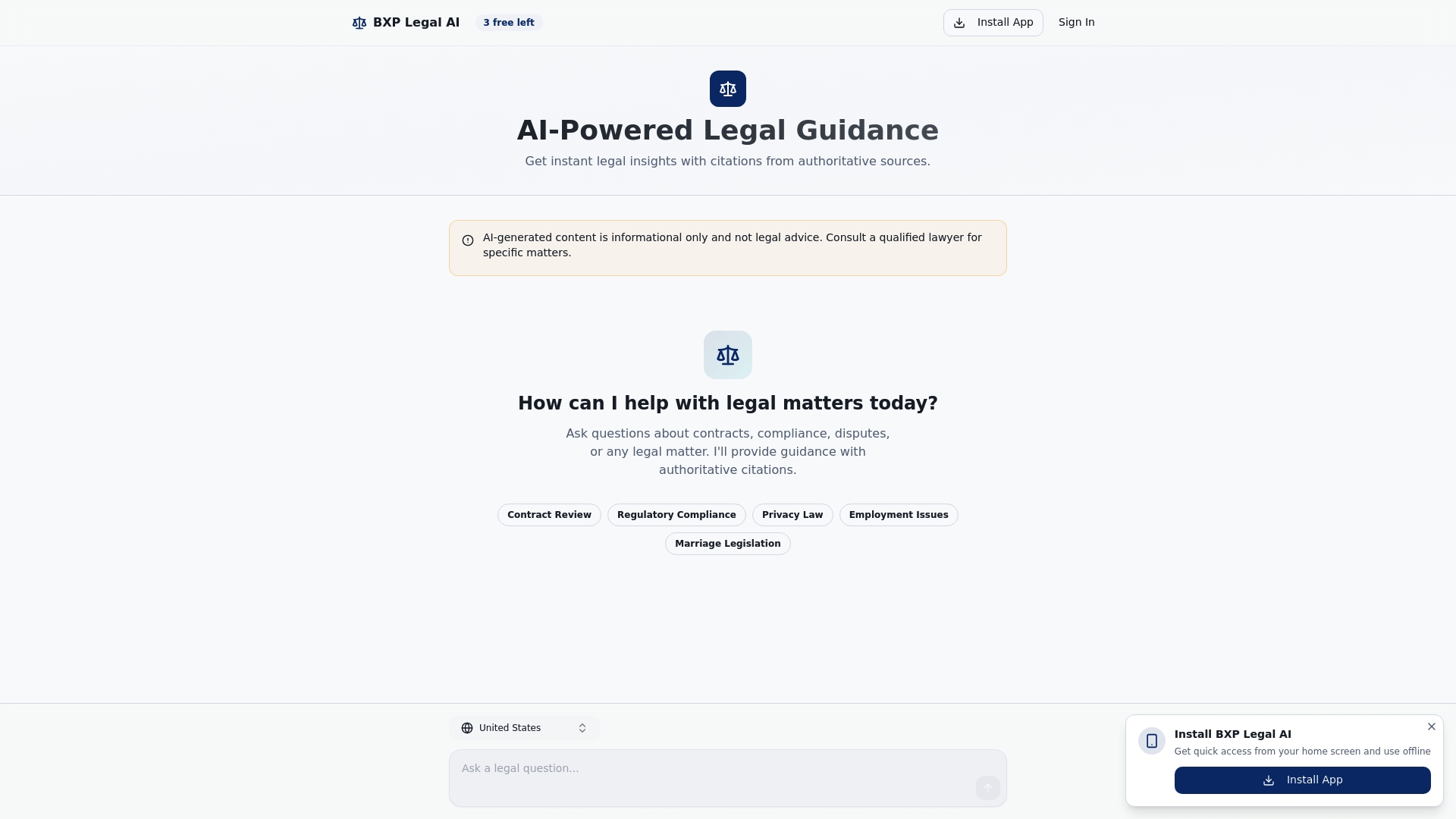
Whether you're drafting vendor agreements, reviewing employment contracts, or ensuring compliance with evolving regulations, BXP Legal delivers authoritative guidance backed by citations. The platform emphasizes accuracy and transparency, advising users when to consult qualified legal professionals for high stakes matters. Explore how AI can transform your legal research workflow while maintaining the judgment and verification essential for sound decision making.
FAQ
What are the best free resources for starting legal research?
Government websites like govinfo provide free access to federal statutes, regulations, and Congressional materials. Harvard Law Library guides and the Small Business Administration publish checklists and primers on common legal issues like contracts and compliance. AI tools like ai.law offer free tiers for basic research, letting you test capabilities before committing to paid platforms.
How can I avoid AI hallucinations during legal research?
Always verify AI findings with official citators and primary sources. Use a hybrid approach that combines AI speed for preliminary scans with human judgment for validation, especially on complex or multi jurisdictional issues. Cross check citations by reading the actual case or statute, and never rely solely on AI generated summaries for high stakes decisions like litigation or regulatory filings.
When should I consult a legal expert despite using AI tools?
Consult legal experts for novel legal issues, complex multi jurisdictional laws, or high risk contracts where mistakes carry significant financial or reputational consequences. Use AI for preliminary research and routine tasks like contract clause verification, but escalate when nuance, strategic judgment, or courtroom experience become critical. The cost of expert review often pales compared to the risk of getting it wrong.
How do I know which jurisdiction's law applies to my contract or compliance issue?
Review the contract's choice of law clause, which typically specifies the governing jurisdiction. For compliance, determine where your business operates, where customers are located, and which regulators have authority. Federal law may preempt state rules in areas like employment discrimination or securities. When in doubt, research both federal and relevant state laws, and consider consulting an expert if multiple jurisdictions create conflicting obligations.
Can I rely on AI tools for multi jurisdictional legal research?
AI tools can assist by quickly identifying relevant statutes and cases across jurisdictions, but they often miss nuanced differences in how states interpret similar laws. Use AI for initial scans and to generate a list of authorities, then verify findings with jurisdiction specific primary sources. For businesses operating in multiple states, a hybrid approach combining AI efficiency with expert review ensures you don't overlook critical variations in compliance requirements or contract enforceability.