
TL;DR:
- AI platforms are making legal guidance accessible and affordable for individuals and small businesses.
- AI is ideal for routine tasks like contract summaries, compliance checklists, and initial reviews.
- Complex legal issues still require professional attorneys, with AI serving as a strategic first layer.
Expert legal help used to feel like something reserved for corporations or people who could afford a retainer. That assumption is crumbling fast. AI-driven platforms are making it possible for individuals and small business owners to get instant, reliable guidance on contracts, compliance, employment issues, and more, without the traditional barriers of cost or access. This guide breaks down why legal guidance matters, how AI is reshaping the landscape, when to use each approach, and how to build a smarter strategy that protects you without draining your budget.
Table of Contents
- Why legal guidance matters for everyone
- How AI-driven legal guidance is transforming access
- When to use lawyers vs. AI: A practical comparison
- Maximizing value: Strategies for smarter legal decisions
- Why the future of legal guidance is smarter, not just cheaper
- Take the next step: Smarter legal guidance with BXP Legal AI
- Frequently asked questions
Key Takeaways
| Point | Details |
|---|---|
| Legal guidance prevents costly mistakes | Getting solid advice helps you avoid compliance errors and disputes that could impact your business or personal interests. |
| AI makes access easier and quicker | AI tools deliver plain-language answers and checklists in seconds, streamlining routine legal decisions for everyone. |
| AI and lawyers work best together | Smart strategies blend the speed of AI for drafts with the expertise of lawyers for complex scenarios. |
| Know when to escalate | Use AI for first steps and escalate to a lawyer for nuanced, sensitive, or high-stakes matters. |
Why legal guidance matters for everyone
Most people only think about legal help when something goes wrong. By then, the cost of fixing the problem is almost always higher than the cost of preventing it. Whether you're signing a vendor agreement, hiring your first employee, or launching a new product line, legal decisions are embedded in nearly every action you take as a business owner or individual.
Legal guidance for individuals and small businesses primarily involves professional advice from attorneys to understand rights, obligations, and risks in areas like contracts, compliance, employment, and disputes, preventing costly mistakes such as litigation or penalties. That's a broad scope, but it reflects reality. Legal exposure isn't limited to courtrooms.
The risks of operating without guidance are concrete. A poorly worded contract can make you liable for outcomes you never intended. A missed compliance deadline can trigger fines that exceed your monthly revenue. A handshake deal with no documentation can unravel a business partnership. These aren't edge cases; they happen to small businesses every day.
Knowing when to seek input is half the battle. Here are the most common triggers that signal you need a legal lens:
- Signing or drafting a contract with another party
- Hiring employees or engaging contractors
- Launching a new business or changing your structure
- Facing a dispute, complaint, or regulatory inquiry
- Expanding into a new state or country
- Handling intellectual property, privacy, or data issues
For ongoing operations, consider legal advice for compliance a proactive investment rather than a reactive expense.
"An ounce of prevention is worth a pound of cure" is especially true in law. Preventive counsel typically costs a fraction of what litigation does, and litigation costs in the U.S. can easily reach tens of thousands of dollars even for modest disputes.
Pro Tip: Even simple agreements can create lasting obligations. Before you sign anything, run it through a legal review, whether that's an AI tool for a first pass or an attorney for high-stakes terms.
How AI-driven legal guidance is transforming access
AI has changed the economics of legal information. Where you once needed to schedule a consultation and pay by the hour just to understand a clause in a lease, you can now get a plain-English explanation in seconds. That shift is significant, not just for convenience but for confidence.
AI-driven legal guidance enhances accessibility by providing free, instant information on contracts, compliance, and inquiries via chatbots and tools, offering plain-English explanations without replacing professional advice. The key phrase there is "without replacing." AI is a powerful first layer, not a final answer.

Here's a practical look at how AI legal tools stack up against traditional services:
| Feature | AI legal tools | Human attorney |
|---|---|---|
| Cost | Free to low-cost | $150 to $500+ per hour |
| Speed | Instant | Hours to days |
| Availability | 24/7 | Business hours |
| Accuracy (routine) | High for standard tasks | High across all tasks |
| Complex nuance | Limited | Strong |
| Confidentiality | Varies by platform | Protected by privilege |
For a deeper look at how these tools perform in practice, recent AI legal benchmarks show meaningful improvements in contract review and issue detection, though gaps remain in nuanced legal reasoning.
What AI can do well for you right now:
- Summarize contract terms in plain English
- Flag common risk clauses in standard agreements
- Generate compliance checklists for specific industries
- Answer routine legal questions with cited sources
- Draft initial versions of standard documents
What AI still struggles with:
- Jurisdiction-specific nuances
- Emotional or strategic negotiation
- Confidential matters requiring privilege protection
- Novel legal questions with no precedent
Explore AI legal tools overview to see how these capabilities translate into real workflow improvements, and check out AI-driven drafting benefits for document-specific use cases.
Pro Tip: Use AI for first-pass contract reviews or to prep questions before a paid consultation. Never input confidential client data or sensitive personal details into a tool without verifying its privacy policy.
When to use lawyers vs. AI: A practical comparison
The smartest users of legal technology don't choose between AI and lawyers. They use both, strategically. The decision framework isn't complicated once you understand what each does best.
Here's a simple process for triaging your legal needs:
- Identify the stakes. Is this a routine matter or does it involve significant money, liability, or long-term obligations?
- Check for complexity. Does the issue involve multiple jurisdictions, disputed facts, or specialized regulations?
- Assess urgency. Do you need an answer in minutes or can you wait for a scheduled consultation?
- Consider confidentiality. Is the information sensitive enough to require attorney-client privilege?
- Evaluate your comfort level. If you're unsure about the output, escalate to a professional.
AI tools shine in steps 1 and 3 for routine, time-sensitive tasks. Lawyers are indispensable for steps 2 and 4.
| Scenario | Best approach |
|---|---|
| Reviewing a standard vendor contract | AI first, lawyer if terms are unusual |
| Setting up a business entity | Attorney required |
| Answering an employment law question | AI for general info, lawyer for specifics |
| Responding to a lawsuit or dispute | Attorney required |
| Drafting a basic NDA | AI draft, lawyer review recommended |
| Multi-state compliance audit | Hybrid: AI checklist, lawyer confirms |
Benchmarks show AI value in contract review but note that 92% of complex tasks still trigger safety refusals, and human attorneys outperform AI in redlining at 79.7%. That's not a knock on AI. It's a clear signal about where each tool belongs.
For guidance on when to escalate, consulting legal experts walks through real scenarios. If you're comparing platforms, AI guidance alternatives offers a useful breakdown. You can also revisit basics of legal advice to ground your decisions in fundamentals.
Maximizing value: Strategies for smarter legal decisions
Once you understand the roles of AI and attorneys, the next step is building a workflow that saves time and money without cutting corners on protection.
Cost-benefits favor AI for high-volume routine tasks, with up to 80% time savings, but the value depends on the model used. Shallow models are cheap but lower accuracy; transformer-based models offer a better balance for small firms. Knowing which tool fits your task matters.
Here are four strategies to maximize your legal ROI:
- Use AI for first drafts. Start every standard document with an AI-generated template. It saves hours and gives you a structured baseline to refine.
- Escalate selectively. Reserve attorney time for negotiations, disputes, entity formation, and anything involving regulatory enforcement.
- Verify AI output on critical terms. Don't assume AI caught every risk. Spot-check key clauses, especially liability, termination, and payment terms.
- Document your workflow. Keep a log of which tools you used and when. This creates an audit trail and helps you identify patterns in your legal needs.
For small businesses, the efficiency wins are real. A retail owner who uses AI to pre-screen supplier contracts before sending them to a lawyer can cut legal spend by half while maintaining the same level of protection. An individual reviewing a lease agreement can use AI to flag red flags before negotiating, arriving at the conversation better prepared.
For practical guidance on execution, AI drafting best practices covers document-specific techniques. If your work spans multiple states or countries, optimize legal workflows addresses the added complexity of multi-jurisdictional compliance. And AI benchmark insights provides data to help you evaluate which tools are worth using.
Pro Tip: Always double-check AI output for critical terms before signing or sending. A five-minute manual review of the most important clauses is cheap insurance.
Why the future of legal guidance is smarter, not just cheaper
There's a narrative in legal tech that frames AI purely as a cost-cutting tool. We think that misses the bigger shift. The real transformation is about frequency, not just price.
When legal guidance was expensive and slow, most people asked legal questions rarely. They saved them for big moments. That meant operating in the dark for most decisions. AI changes the calculus entirely. You can now ask a legal question every time you need to, not just when the stakes justify the invoice. That changes how individuals and businesses relate to legal risk.
The hidden advantage isn't cheaper contracts. It's that legal thinking becomes part of your daily workflow instead of a rare event. You catch issues earlier. You negotiate better. You make fewer assumptions.
But this only works if you integrate AI and human expertise carefully. Over-relying on AI for complex matters is just as risky as ignoring legal guidance altogether. The future belongs to people who use streamlined document drafting as a starting point and know exactly when to bring in a professional. Smarter, layered guidance is the real competitive edge.
Take the next step: Smarter legal guidance with BXP Legal AI
You now have a clear picture of how AI and traditional legal guidance work together. The next step is putting that knowledge into practice with tools built for exactly this purpose.
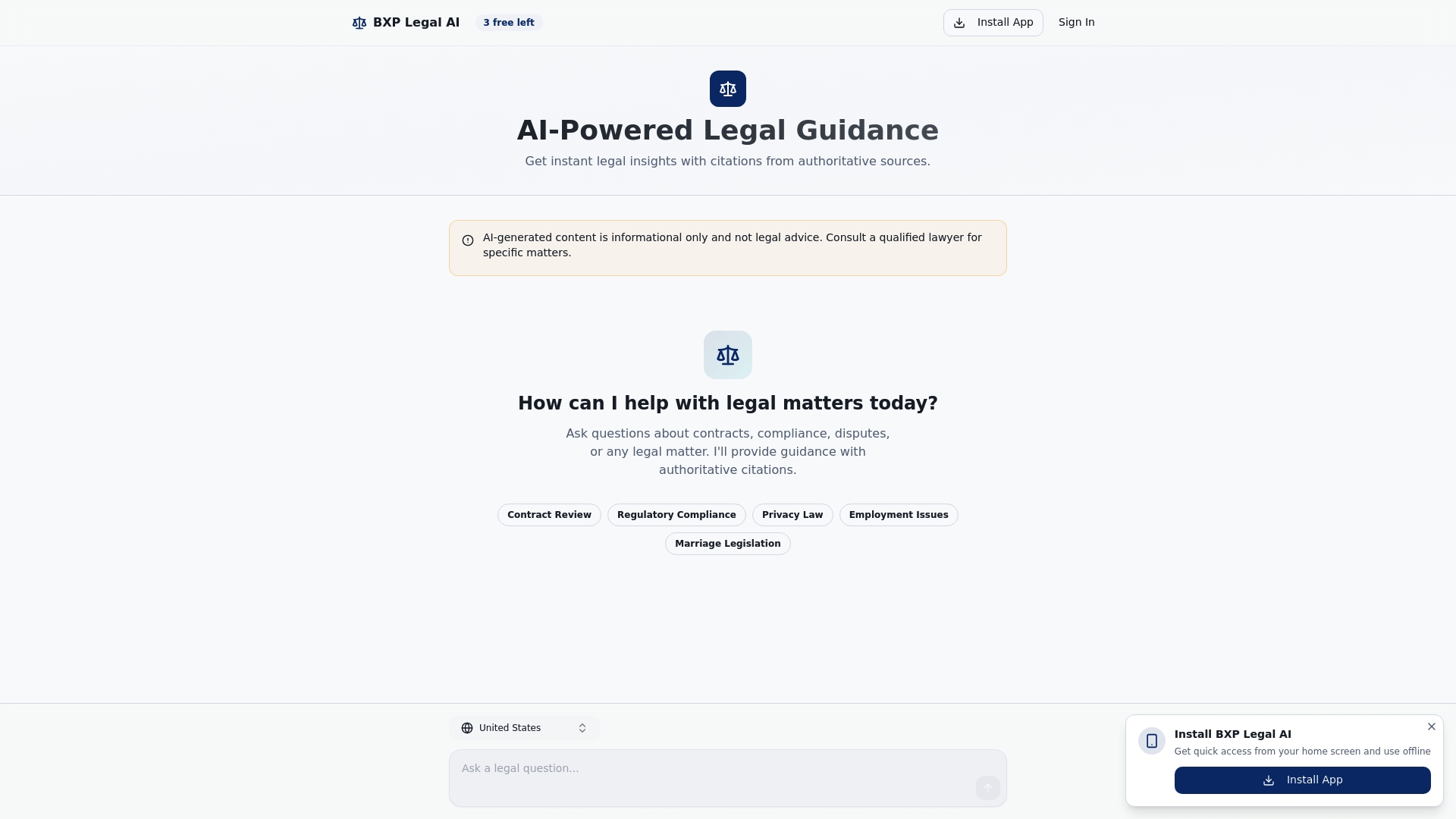
BXP Legal AI gives individuals and small businesses on-demand access to contract review, compliance checklists, and legal Q&A, all backed by authoritative citations. You can start with legal templates for common agreements, use the document comparison feature to spot differences between contract versions, or simply ask a legal question and get a plain-English answer in seconds. It's the practical first layer your legal workflow has been missing, designed to save time and build confidence before you ever pick up the phone to call an attorney.
Frequently asked questions
How reliable is AI-driven legal advice for contracts?
AI can reliably summarize and highlight standard risks in contracts, with 94% issue detection accuracy and 70 to 90% reduction in review time reported in benchmarks. For complex or sensitive terms, you should always consult a qualified attorney.
Can AI replace a lawyer for dispute resolution?
No. AI can help clarify issues and prepare documents, but lawyers are essential for negotiations, court representation, and any dispute involving significant liability or contested facts.
Is my data safe using AI legal guidance tools?
Reputable platforms use encryption, but AI tools carry confidentiality risks including potential data exposure and hallucinated outputs. Avoid sharing sensitive personal or business information without reviewing the platform's privacy safeguards first.
What are the costs of using AI legal guidance versus a lawyer?
AI tools are often free or low-cost and deliver up to 80% time savings on routine tasks. Attorneys charge more but provide specialized judgment and legal accountability that AI cannot replicate for complex matters.