
TL;DR:
- Legal research helps individuals and small businesses find, analyze, and apply relevant laws to avoid legal pitfalls.
- The process involves framing questions, consulting sources, verifying accuracy, and applying findings iteratively.
- Using the right methods and tools, non-lawyers can make smarter decisions, prevent costly mistakes, and know when to consult a lawyer.
Legal research isn't a skill reserved for attorneys with law degrees and expensive database subscriptions. Every time you sign a contract, hire a contractor, or try to understand a compliance requirement, you're already in territory where legal knowledge matters. One wrong assumption can mean an unenforceable agreement, a missed regulatory deadline, or a dispute that costs far more than it should. This guide breaks down what legal research actually is, how it works step by step, and how you as an individual or small business owner can use it to make smarter, safer decisions without needing a law firm on speed dial.
Table of Contents
- Defining legal research: Purpose and importance
- The basic steps of legal research explained
- Types of legal research methods: Doctrinal vs. empirical
- Legal research in action: Contracts and compliance for small business
- Why legal research is a non-lawyer's secret weapon
- Next steps: Make legal research easier
- Frequently asked questions
Key Takeaways
| Point | Details |
|---|---|
| Legal research is for everyone | Anyone can learn and apply legal research to avoid mistakes with contracts and compliance. |
| Understand the process | Break the task into clear steps—from framing the question to analyzing the law—to keep research manageable. |
| Verify and apply | Always check the currency of your sources and apply findings carefully to your real-world situation. |
| Choose the right method | Recognize when to use doctrinal vs. empirical approaches for better outcomes. |
| Get help for complex issues | Use legal research to inform yourself but consult a lawyer when questions go beyond the basics. |
Defining legal research: Purpose and importance
Legal research is the systematic process of finding, analyzing, and applying laws, regulations, and legal precedents that are relevant to a specific question or situation. It sounds formal, but the core idea is simple: before you act on a legal matter, you find out what the law actually says.
For small business owners and individuals, legal research shows up in situations like these:
- Reviewing a vendor contract before signing
- Checking whether your business needs a specific license or permit
- Understanding your rights in a dispute with a landlord or client
- Confirming that your employment practices meet current regulations
The stakes are real. Using outdated information or misreading a statute can lead to contracts that don't hold up in court, compliance violations with serious fines, or business decisions built on faulty assumptions.
One important thing to understand: legal research is iterative and intertwined with analysis. You start broad, narrow down to binding primary sources, and always verify currency. That means you rarely go in a straight line. You find one answer, which raises another question, which sends you back to check a different source. This is normal, not a sign you're doing it wrong.
"Legal research is not a one-time task. It's a cycle of questioning, finding, analyzing, and confirming that loops until you have a reliable answer."
The distinction between primary and secondary sources is foundational. Primary sources are the actual law: statutes, regulations, court opinions. Secondary sources are materials that explain or analyze the law, like legal encyclopedias, practice guides, and law review articles. You use secondary sources to understand the landscape, then primary sources to confirm what the law actually requires.
Modern legal technology has made this process significantly more accessible. AI-powered platforms can surface relevant statutes and case law in seconds, which used to take hours of manual database searching.
Pro Tip: When you start any legal research task, write your question down in plain language first. "Can my landlord keep my security deposit if I give 30 days notice?" is far easier to research than a vague sense of unease about your lease.
The basic steps of legal research explained
Understanding why legal research matters sets the stage for learning how it's actually done from start to finish. The core steps in legal research follow a clear pattern: frame the legal issue, locate secondary and primary sources, verify, and synthesize findings.
Here's how that looks in practice:
- Frame the question and identify jurisdiction. What exactly do you need to know? And which state, federal, or local law applies? Jurisdiction is everything. A contract dispute in Texas follows different rules than one in New York.
- Consult secondary sources. Start with legal encyclopedias, practice guides, or reputable legal blogs to get context. These won't give you binding authority, but they'll orient you quickly.
- Locate primary legal authority. Find the actual statutes, regulations, or court opinions that govern your issue. Government websites and resources like Cornell's Legal Information Institute are good starting points.
- Verify accuracy using citators. A citator tool checks whether a law or case is still valid. Laws get amended. Court decisions get overturned. Never rely on a source you haven't confirmed is current.
- Analyze and apply findings. Once you have verified, current legal authority, connect it to your specific situation. What does this law actually mean for your contract, your business, or your decision?
You can explore essential legal research steps in more depth to build a stronger research habit.
The three most common mistakes non-lawyers make are: misidentifying the actual legal issue (researching the wrong question entirely), ignoring jurisdiction (finding federal law when state law controls), and skipping source verification (trusting an outdated statute or reversed case).
Pro Tip: Keep a simple research log. Note each source you check, the date you checked it, and what it said. This protects you if your conclusions are ever questioned later.
Types of legal research methods: Doctrinal vs. empirical
With the basic steps covered, it's helpful to see that not all legal research is conducted the same way. There are two main approaches, and knowing which one fits your situation saves time and improves accuracy.
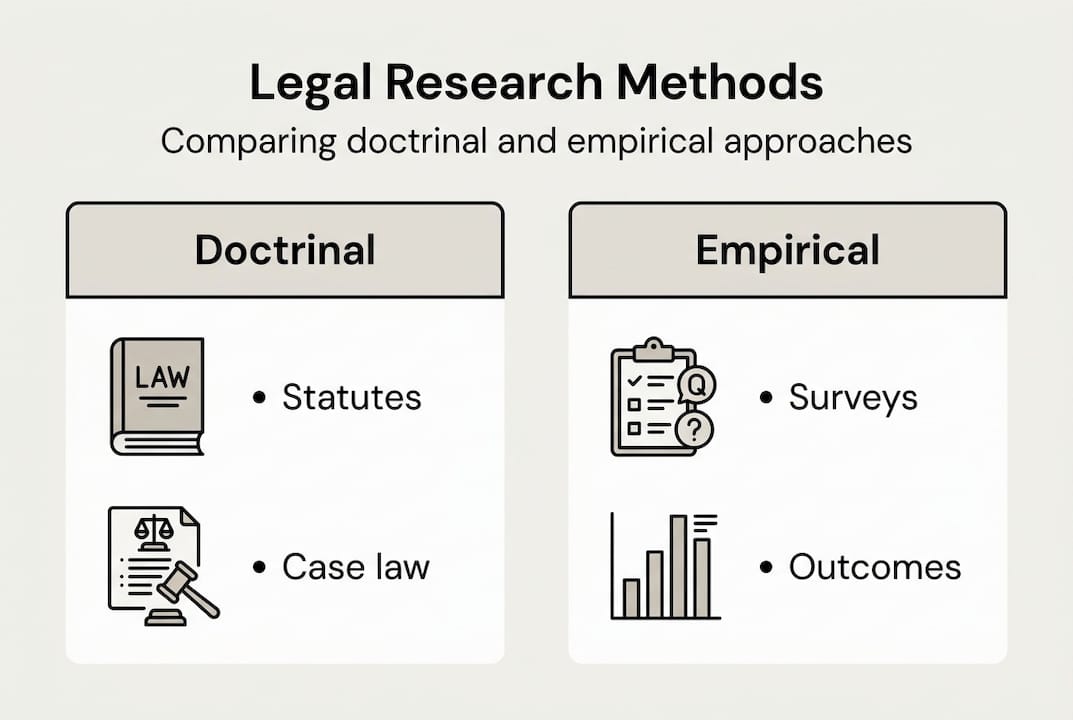
Doctrinal research analyzes the law as written. You read statutes, regulations, and court opinions to understand what the law says and how it has been interpreted. This is the method most relevant to contracts, compliance checks, and dispute resolution. If you need to know what a non-compete clause can legally require in your state, doctrinal research gives you the answer.
Empirical legal research uses real-world data, surveys, and outcome studies to understand how legal systems actually function. As empirical legal research shows, this approach focuses on real-world impact rather than just the text of the law. It's more common in policy analysis and academic settings, but it can be useful when you want to understand how courts actually rule in cases like yours, not just what the statute says.
Doctrinal methods analyze the law as written; empirical approaches focus on real-world impact and study legal systems with data.
| Feature | Doctrinal research | Empirical research |
|---|---|---|
| Focus | Law as written | Law in practice |
| Sources | Statutes, cases, regulations | Data, surveys, outcomes |
| Best for | Contracts, compliance | Policy analysis, litigation trends |
| Accessibility | High (free resources available) | Moderate (requires data access) |
| Typical user | Business owners, individuals | Researchers, policy teams |
For most small business and individual needs, doctrinal research is the right tool. You want to know what the law requires, not conduct a sociological study. But understanding that empirical data exists can help you find useful legal research tools that surface case outcome trends alongside statutory text.
A common misconception is that legal research methodology is one-size-fits-all. It isn't. Picking the right method for your question is itself part of good legal research practice.
Legal research in action: Contracts and compliance for small business
Knowing different research types sets you up to apply legal research directly to your contracts and compliance needs. Here's how to put it into practice.

When reviewing a contract, focus your research on four key clause types: scope of work, payment terms, liability limits, and termination conditions. For each clause, ask what the law in your jurisdiction says about enforceability. Applying legal research to contracts means checking relevant statutes and regulations alongside the contract language itself.
Here's a step-by-step example for a small business contract review:
- Identify the governing law clause in the contract (which state's law applies).
- Go to that state's official legislative website and search for relevant statutes on the contract type.
- Cross-reference with Cornell LII for plain-language summaries.
- Check for recent court decisions interpreting those statutes.
- Use a citator to confirm all sources are current.
- Flag any clause that conflicts with what the law requires or permits.
For compliance, the process is similar. Start with the relevant regulatory agency's website, find the applicable statute or rule, and verify it hasn't been amended recently.
| Resource | Best used for | Cost |
|---|---|---|
| Cornell Legal Information Institute | Statutes, regulations, plain-language summaries | Free |
| USA.gov / State legislature sites | Official statutes and agency rules | Free |
| Google Scholar (legal) | Court opinions and case law | Free |
| Westlaw / LexisNexis | Comprehensive research with citators | Paid |
| BXPLegal.com | AI-guided legal questions and document review | Varies |
A solid contract review checklist helps you apply research findings systematically. Pair that with small business compliance steps and resources for document drafting for compliance to build a repeatable process.
When should you stop researching and call a lawyer? When the stakes are high, when the law is genuinely unclear, or when you're making a decision that could expose your business to significant liability. Legal research informs you. A lawyer advises you. Both have a role.
Why legal research is a non-lawyer's secret weapon
Here's a perspective most articles won't give you: the goal of legal research for non-lawyers isn't to replace lawyers. It's to stop being passive about legal risk.
The most costly legal mistakes businesses make aren't exotic. They're avoidable misunderstandings: signing a contract without checking whether a key clause is enforceable, missing a licensing requirement because nobody looked it up, assuming a verbal agreement is binding when it isn't. Legal research is preventative medicine for exactly these situations.
Real power doesn't come from knowing every law. It comes from knowing where to look and when to ask for help. When you understand the basics of how legal research works, you ask smarter questions when you do hire a lawyer. You catch red flags in contracts before you sign. You recognize when a compliance issue is serious versus when it's a minor administrative matter.
We've seen small business owners save thousands simply by doing 30 minutes of preliminary research before a legal consultation. They arrived informed, asked targeted questions, and avoided paying for time spent on basics. That's the real value here.
Pro Tip: Think of legal research as a superpower for your business. It lets you spot trouble early, understand your options, and protect yourself before problems escalate. Protecting your business starts with understanding what the law actually says about your situation.
Next steps: Make legal research easier
Legal research isn't just possible for non-lawyers. It's easier than ever with the right tools and guidance.
BXPLegal.com is built for exactly this kind of work. Whether you need to review contract clauses, check compliance requirements, or get instant answers to legal questions backed by authoritative citations, the platform puts AI-powered legal guidance in your hands. Use the document comparison tool to spot differences between contract versions quickly, or browse legal document templates to start with professionally structured documents. For complex situations or high-stakes decisions, always consult a qualified attorney. But for the research, the context, and the groundwork? You don't have to start from zero.
Frequently asked questions
What are primary and secondary sources in legal research?
Primary sources include laws, regulations, and court opinions that carry binding legal authority. Secondary sources provide context and analysis, such as legal encyclopedias and practice guides, and are best used to understand an area of law before locating the primary authority.
How do I verify if a law is still valid?
Use citator tools like KeyCite or Shepard's to confirm that statutes or court decisions haven't been overturned or amended. Verifying currency is a non-negotiable step before relying on any legal source.
Can I do legal research without a paid database?
Yes. Free resources like government websites and Cornell's Legal Information Institute provide access to a wide range of statutes and regulations without any subscription cost.
When should I consult a lawyer instead of just doing my own research?
For complex situations, interpreting legal nuances, or making decisions with significant financial or legal consequences, consult a qualified attorney rather than relying solely on your own research findings.
What is the most common mistake in legal research?
Failing to correctly frame the question or identify the right jurisdiction leads to the most errors. Poorly defined questions send researchers down the wrong path from the very first step.