
TL;DR:
- Legal data analytics predicts litigation outcomes better than reputation rankings.
- It enhances legal operations through faster, data-driven processes like risk assessment and contract review.
- Effective adoption requires governance and human oversight to mitigate biases and limitations.
The best-known law firm isn't always the best choice for your case. Outcome-based legal analytics outperform reputation and size-only rankings when predicting litigation results, which means business owners and compliance officers who rely solely on prestige to guide legal decisions may be leaving better outcomes on the table. Legal data analytics changes that equation entirely. By turning vast amounts of legal information into actionable predictions, patterns, and risk signals, it gives your team the clarity to act faster, spend smarter, and defend positions with confidence. This article walks you through exactly what legal data analytics is, how it works in practice, where it excels, and where you need to stay careful.
Table of Contents
- Defining legal data analytics: What it really means
- How legal data analytics is applied in legal operations
- The strengths of outcome-based analytics vs traditional approaches
- Risks, limitations, and governance: What decision-makers must know
- Legal data analytics: Why careful adoption beats hype
- Empower your legal team with AI-driven analytics
- Frequently asked questions
Key Takeaways
| Point | Details |
|---|---|
| Evidence-based decision making | Legal data analytics helps organizations make smarter decisions by illuminating case trends and risks. |
| Analytics outperforms intuition | Outcome-based tools often surpass traditional reputational methods in practical predictions. |
| Balance tech with judgment | Analytics is most powerful when paired with legal expertise to ensure responsible outcomes. |
| Know the risks | Awareness of limitations and governance requirements is critical for compliant, effective use. |
Defining legal data analytics: What it really means
Legal data analytics is the use of advanced data analysis techniques, frequently AI-driven, to extract patterns and insights from large collections of legal information. Think court decisions, regulatory filings, contracts, statutes, and case outcomes. The goal is not just to understand what happened in the past but to generate predictions and guidance that inform decisions right now.
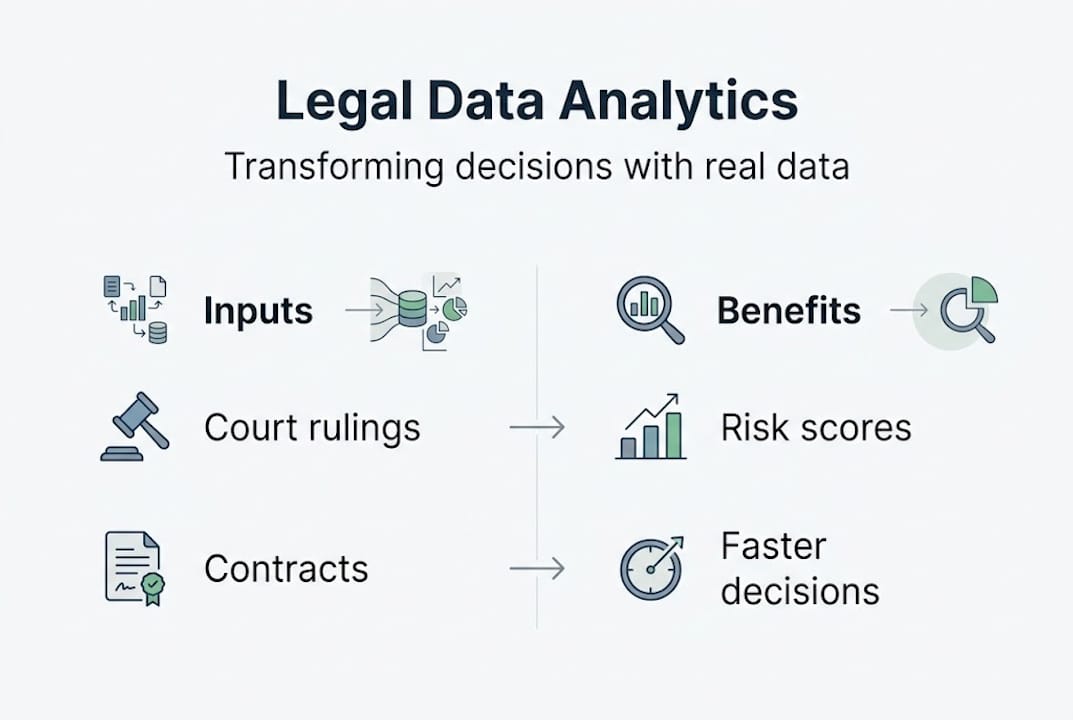
This is fundamentally different from traditional legal research. Traditional research asks: "What cases support our argument?" Legal data analytics asks: "Given the judge, jurisdiction, and claim type, what is the probability we win, and what does the data say about how similar matters resolved?" That shift from historical reference to probabilistic foresight is the core distinction.
Key features that define legal data analytics include:
- Predictive modeling: Using statistical algorithms to forecast litigation outcomes, regulatory risks, or contract dispute probabilities based on historical patterns.
- Pattern recognition: Identifying trends across thousands of cases or clauses that a human reviewer would never catch manually.
- Proactive decision support: Generating alerts when regulatory thresholds are approaching or when contract language matches a pattern linked to disputes.
- Objective benchmarking: Comparing your legal spend, settlement rates, or contract performance to industry-wide data rather than relying on gut instinct.
"Data-driven approaches can predict litigation outcomes better than reputation or size-only rankings, offering a more reliable basis for strategic legal decisions." Outcome-based legal analytics outperform reputation-based methods.
The practical implication for your organization is significant. Risk assessment becomes numerical rather than anecdotal. Budget forecasts get grounded in real case data. And you gain the ability to benchmark your legal team's performance against objective standards rather than subjective reviews. For business owners managing legal spend and compliance officers tracking regulatory exposure, this kind of clarity is not a luxury. It is a competitive necessity.
Understanding how these tools work under the hood matters too. Platforms like AI legal tools explained break down how machine learning models are trained on legal datasets to surface insights that would otherwise require hundreds of hours of manual analysis.
How legal data analytics is applied in legal operations
Once you understand what legal data analytics is, the next question is obvious: where does it actually show up in daily operations? The answer spans nearly every function your legal or compliance team handles.
Here are the most impactful applications ranked by operational value:
- Litigation forecasting: Before a dispute goes to court, analytics tools score the case based on prior rulings, the specific judge's history, and comparable matters in the same jurisdiction. You get a probability range, not a lawyer's opinion.
- Regulatory compliance tracking: Automated systems scan regulatory databases and flag changes that affect your industry in near real time, well before a compliance deadline hits.
- Contract and document review automation: AI models review clauses against a database of flagged language, surfacing risk terms in minutes rather than days.
- Legal spend analysis: Analytics platforms compare your outside counsel costs against market benchmarks and historical spend patterns, identifying where fees are running high.
- Vendor and counterparty risk profiling: Data analytics flags counterparties with a pattern of disputes or regulatory violations before you sign.
The ways AI supports legal research continue to grow as training data improves, and AI-driven document drafting now incorporates real-time analytics to generate contract language with lower dispute risk built in.
For SMBs operating with lean legal teams, these tools are particularly transformative. A two-person compliance function can effectively monitor regulatory obligations at a scale that once required a full department. Large in-house teams use the same applications for lawyers to speed up discovery review and settlement valuation.
| Process | Manual approach | Analytics-driven approach |
|---|---|---|
| Litigation risk assessment | 2 to 5 days of research | Under 1 hour with predictive scoring |
| Contract review (100 pages) | 8 to 12 hours per attorney | 20 to 40 minutes with AI review |
| Regulatory change monitoring | Weekly manual review | Real-time automated alerts |
| Legal spend benchmarking | Quarterly review, limited data | Continuous, market-wide comparison |
| Counterparty risk profiling | Ad hoc due diligence | Automated scoring before signing |
The before-and-after picture is stark. Speed increases dramatically. Costs drop. And the quality of decisions improves because they rest on data rather than memory.
Pro Tip: When integrating analytics tools into an existing legal operation, start with one high-volume process like contract review or compliance monitoring. Proving value in one area builds internal support for broader adoption without overwhelming your team or your budget.
For organizations managing obligations across multiple states or countries, multi-jurisdiction legal workflows show how analytics layers onto compliance frameworks to keep every obligation visible in one place.
The strengths of outcome-based analytics vs traditional approaches
Outcome-based analytics consistently outperform reputation rankings in contexts where data is rich, repeatable, and well-structured. This is not a marginal improvement. In high-volume litigation environments, commercial contract disputes, and regulatory compliance tracking, the accuracy gap between analytics and traditional intuition-based assessment is measurable and significant.
Here is a direct comparison of the two approaches:
| Dimension | Outcome-based analytics | Traditional reputation-based approach |
|---|---|---|
| Accuracy | Data-validated, improves with volume | Relies on experience, varies by practitioner |
| Transparency | Explainable models, auditable outputs | Largely opaque, subjective reasoning |
| Learning curve | Requires training and onboarding | Familiar, immediate to use |
| Best application | High-volume, structured, data-rich matters | Novel legal questions, emerging law areas |
| Cost scalability | Scales efficiently at volume | Cost grows linearly with complexity |
| Bias risk | Algorithmic bias possible | Cognitive and confirmation bias possible |
The analytics edge is clearest in repeatable, data-rich scenarios. Predicting how a specific court handles a particular claim type, for example, is exactly the kind of question that analytics handles well. Courts produce consistent, structured data. Patterns emerge quickly.

Where analytics is genuinely limited is in unsettled law. When a jurisdiction has issued few rulings on a new regulation, or when a legal question genuinely has no established precedent, the model has nothing reliable to train on. This is where legal AI nuance becomes critical. A tool that presents a confident prediction in an ambiguous area is not being accurate. It is being misleading.
The core principle here is combination, not replacement. Analytics excels at surface-level pattern detection and probability scoring. Experienced legal professionals excel at interpreting those scores in the context of strategy, ethics, and client-specific facts.
Key limits to keep in mind include:
- Jurisdictional divergence: A model trained predominantly on federal cases may perform poorly on state-level matters with different evidentiary rules.
- Recency gaps: If a major regulatory change occurred recently, historical training data may not reflect the new legal landscape.
- Novel claims: Emerging areas like AI liability or climate-related ESG compliance have thin case law and limited training data.
Understanding why consult legal experts remains essential even when analytics tools are delivering strong outputs is not about distrust of technology. It is about recognizing where human judgment adds irreplaceable value.
Risks, limitations, and governance: What decision-makers must know
Legal data analytics delivers real operational advantages, but using it without a governance framework is how organizations create new problems while trying to solve old ones. Decision-makers need to understand the specific risks and how to structure oversight before deploying any analytics tool at scale.
The most common risks break down into three categories:
- Overreliance: Treating a probability score as a definitive answer rather than one input among several. A 70% litigation success rate does not mean you will win. It means the data pattern favors you. Significant variation still exists.
- Unintended algorithmic bias: Models trained on historical legal data can encode historical inequities. If a jurisdiction has systematically ruled a certain way in the past due to factors unrelated to legal merit, the model learns that pattern and propagates it.
- Jurisdictional blind spots: Analytics tools built for one legal system can produce inaccurate outputs when applied to matters in a different jurisdiction with different procedural rules.
"Legal predictions are vulnerable to giving 'smoothed' answers" unless systems properly represent ambiguity and jurisdictional differences, which is precisely why governance frameworks must require human review at key decision points.
The academic and practitioner community has also flagged a deeper conceptual issue. The Governance of Legal Analytics research notes that machine learning models describe what happened in past cases, not what should happen in a normative legal sense. That distinction matters enormously when you are making a compliance decision or advising a client on litigation strategy.
For business owners and compliance officers, a practical governance checklist includes:
- Ongoing human oversight: Every analytics-generated recommendation on a material legal question should pass through a qualified reviewer before action is taken.
- Transparency requirements: Require vendors to explain how their models work, what data they were trained on, and how often they are updated.
- Escalation protocols: Define in writing which categories of legal questions automatically require specialist review regardless of what the analytics output shows.
- Audit trails: Maintain documentation of analytics-generated recommendations and the human decisions that followed, especially for regulatory compliance matters.
- Vendor due diligence: Evaluate whether the tool covers your specific jurisdictions with appropriate depth before full deployment.
Pro Tip: Always pair legal data analytics with specialist review in complex matters such as cross-border disputes, novel regulatory questions, or any case where the stakes exceed a defined financial or reputational threshold. The tool narrows the field. The expert closes it.
Maintaining multi-jurisdiction compliance workflows alongside analytics tools ensures that local nuance is always captured alongside the broader data pattern. For organizations using legal AI solutions, governance integration from day one is far more effective than retrofitting controls after deployment.
Legal data analytics: Why careful adoption beats hype
Every few years, a new technology promises to transform legal practice overnight. Legal data analytics is genuinely powerful, but the organizations getting the most from it are not the ones who rushed to adopt the fanciest platform. They are the ones who built the governance structure first.
We have seen organizations spend significantly on analytics tools and then underuse them because their teams were not trained to interpret probability outputs. A 65% litigation success rate means nothing to a compliance officer who has never worked with statistical confidence intervals. The tool is only as good as the team's ability to act on what it surfaces.
The deeper issue is that computational approaches describe regularities in what happened, not prescriptions for what should be decided. Analytics cannot replace the judgment call that a seasoned attorney makes when they weigh a technically strong legal position against business relationship risk, reputational exposure, or timing. Those factors rarely appear in training datasets.
The compliance programs that perform best treat analytics as a powerful advisor with clear limits. They feed data insights to their legal experts rather than around them. They invest in training so that business owners and compliance officers can read an analytics output and know what questions to ask. And they build escalation paths so that no high-stakes decision ever rests on an algorithm alone.
The practical wisdom here is straightforward. Start with consulting legal experts to define where analytics adds the most value for your specific operation before choosing a platform. The right adoption sequence is: assess your legal operations, identify the highest-volume and most data-rich processes, deploy analytics there first, measure the outcomes honestly, and expand from a position of proven results rather than vendor enthusiasm.
Empower your legal team with AI-driven analytics
Legal data analytics is not theoretical. For business owners and compliance officers ready to act on data rather than instinct, the right platform makes that transition practical and immediate.
BXP Legal AI offers legal analytics features built for modern teams, from contract review automation to real-time compliance monitoring and litigation risk scoring. The platform's BXP Legal AI features are designed to support decision-making across your entire legal operation, with robust multi-jurisdictional support that ensures local regulatory nuance is never lost in the data. Whether you manage a small legal function or a large compliance department, BXP Legal gives you the analytical foundation to move faster, reduce risk, and stay ahead of regulatory change. Explore what AI-driven legal analytics looks like for your team today.
Frequently asked questions
What types of data power legal data analytics?
Legal data analytics draws from court decisions, contracts, statutes, regulatory filings, and operational case outcomes to identify patterns and generate predictions.
Can legal data analytics replace traditional legal expertise?
No. Analytics supports and sharpens decision-making but must be paired with human legal judgment, particularly because ML models describe what happened rather than what should be decided.
What are the risks of overusing legal data analytics?
Overreliance may cause teams to miss legal nuances or regulatory changes, especially since smoothed analytic outputs can obscure genuine jurisdictional ambiguity.
Does legal data analytics cover multiple jurisdictions?
Yes, with properly built tools and governance frameworks, analytics can handle multi-jurisdictional data, though local nuance and human oversight remain essential for accuracy.