
TL;DR:
- AI legal tools expedite routine tasks but require human oversight for accuracy and risk mitigation.
- Most AI outputs can contain errors or fabricated content, especially in complex or specific clauses.
- Using AI tools safely involves verifying outputs, understanding data privacy terms, and consulting lawyers for high-stakes decisions.
Nearly 42% of legal professionals already use AI tools in 2026, yet most small business owners and individuals still aren't sure what these tools actually do, how reliable they are, or whether they can trust them with something as important as a contract. That gap between adoption and understanding is where costly mistakes happen. This article breaks down what AI legal tools are, where they genuinely help, where they fall short, and how you can use them safely for contracts, compliance, and document management without needing a law degree or a large legal budget.
Table of Contents
- What are AI legal tools?
- Strengths and benchmarks: How AI legal tools improve your workflow
- Limitations and risks: Where AI legal tools can go wrong
- Best practices for safe and effective use
- The uncomfortable truth about AI legal tools most experts won't tell you
- Streamline your legal tasks with trusted AI solutions
- Frequently asked questions
Key Takeaways
| Point | Details |
|---|---|
| AI excels in efficiency | AI legal tools quickly draft and review documents, reducing manual work time by up to 75%. |
| Human review remains essential | Critical errors and complex clauses still require verification by a legal expert, not just AI. |
| Choose tools with solid governance | Look for features like output grounding and transparent vendor policies to maximize reliability and data privacy. |
| Understand limitations | AI is not a substitute for full legal counsel, especially for tricky jurisdiction or intellectual property matters. |
What are AI legal tools?
AI legal tools are software applications that use artificial intelligence, typically large language models, to assist with legal tasks. Think of them as a smart assistant that can read, draft, summarize, and flag issues in legal documents far faster than a human can. They are not lawyers. They do not give legal advice in the traditional sense. But they can dramatically reduce the time and effort you spend on routine legal work.
The main categories of AI legal tools include:
- Contract drafting tools: Generate first drafts of agreements based on your inputs and templates
- Document review tools: Scan contracts for risky clauses, missing terms, or inconsistencies
- Legal research assistants: Pull relevant case law, statutes, or regulatory guidance on a topic
- Compliance checkers: Flag whether your documents or practices align with specific regulations
- Document comparison tools: Identify differences between two versions of a contract or policy
For individuals and small businesses, these tools are especially valuable because they make legal tasks that once required expensive attorney hours accessible and affordable. You can use AI in document drafting to generate a vendor agreement in minutes, or run a compliance check before signing a lease.
The growth in this space is hard to ignore. The legal AI market surpassed $2B in 2025 and is growing at a 20% annual rate. That kind of investment signals that these tools are becoming infrastructure, not novelty. Platforms offering AI legal solutions now cover everything from employment agreements to privacy policy generation, giving small businesses access to capabilities that were once reserved for large legal departments.
The key mindset shift is this: AI legal tools are not replacements for lawyers. They are force multipliers. They handle the repetitive, time-consuming parts of legal work so that when you do consult a professional, you arrive better prepared and spend less time on basics.
Strengths and benchmarks: How AI legal tools improve your workflow
The performance gains from AI legal tools are real and measurable. Contract review time drops by up to 75% with leading tools, and platforms like Spellbook benchmark across more than 2,300 contract types. That is not a marginal improvement. That is a workflow transformation.

Here is a side-by-side look at manual versus AI-powered contract review:
| Task | Manual review | AI-assisted review |
|---|---|---|
| Initial contract read | 2 to 4 hours | 5 to 15 minutes |
| Clause flagging | Varies by expertise | Automated, consistent |
| Version comparison | 30 to 60 minutes | Under 2 minutes |
| Risk summary | Requires attorney | Generated instantly |
| Cost per review | $300 to $800+ | Fraction of the cost |
Beyond speed, there is a financial case. 9% of contract value is lost annually to poor contract management, but those losses shrink significantly with proper AI tools and governance in place. For a small business processing dozens of contracts a year, that adds up fast.
Here is how to get the most measurable gains from AI legal tools:
- Start with a clear scope. Define what you need the tool to do before you open it. Drafting, reviewing, or comparing are different tasks.
- Use a contract review checklist alongside the AI output to catch what the tool may miss.
- Leverage the document comparison feature for any redlined or revised agreements to spot changes instantly.
- Iterate on drafts. AI tools improve with specific prompts. Vague instructions produce vague output.
- Document your process. Keep a record of what the AI produced and what you changed, especially for compliance purposes.
Pro Tip: Before relying on any AI tool for a new contract type, run a test with a document you already understand well. Compare its output to what you know. That gives you a baseline for how much to trust it in unfamiliar territory.
For more structured guidance on building strong agreements, the contract drafting strategies used by experienced practitioners translate well into AI-assisted workflows.
Limitations and risks: Where AI legal tools can go wrong
Here is the part most tool vendors gloss over. AI legal tools make mistakes, and in legal contexts, mistakes have consequences.
The most serious risk is AI hallucination. This is when the model generates content that sounds authoritative but is factually wrong. In legal documents, that can mean fabricated case citations, invented clauses, or incorrect jurisdictional rules. AI hallucinations affect 17 to 82% of outputs depending on the tool and task, and 486 court cases have already involved AI-generated errors. That range is wide because quality varies enormously across tools and use cases.
Some contract clauses are particularly error-prone for AI. Governing law and IP ownership clauses consistently trip up AI systems, requiring careful human validation before you sign anything.
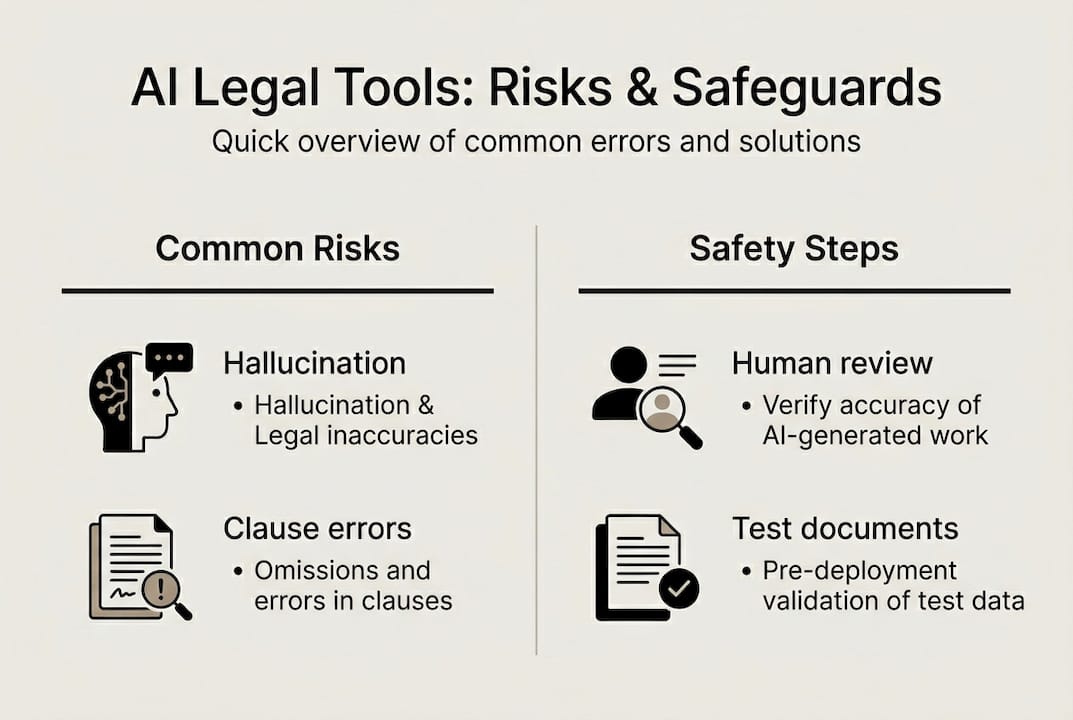
Here is a comparison of where AI performs well versus where it struggles:
| Area | AI performance | Risk level |
|---|---|---|
| Standard NDA drafting | Strong | Low |
| Governing law clauses | Weak | High |
| IP ownership terms | Unreliable | High |
| Formatting and structure | Good | Low |
| Jurisdiction-specific rules | Inconsistent | High |
| Plain language summaries | Generally solid | Medium |
Other common risk zones include:
- Outdated legal references: AI models have training cutoffs and may cite superseded laws
- Jurisdictional blind spots: A clause valid in one state may be unenforceable in another
- Data privacy exposure: Uploading sensitive documents to third-party AI tools can create compliance issues under regulations like the EU AI Act
- Vendor bias: Tools trained on certain contract types may skew outputs toward one party's interests
"The risk is not that AI will replace lawyers. The risk is that people will use AI as if it already has." This is the mindset that leads to the most preventable legal errors.
The AI legal drafting guide covers practical steps for catching these errors before they become problems, and understanding AI legal drafting limitations is the first step to using these tools responsibly.
Best practices for safe and effective use
Knowing the risks is only useful if you act on them. Here is a practical process for using AI legal tools without putting yourself at unnecessary risk.
- Choose tools with grounding features. Grounded AI tools cite their sources and limit outputs to verified content. AI reliability jumps to 90%+ when outputs are grounded and paired with good governance practices.
- Never skip human review for high-stakes documents. Any contract involving significant money, intellectual property, or long-term obligations needs a qualified attorney to review the final version.
- Use a structured contract review checklist every time, regardless of how confident the AI output looks.
- Check data privacy terms before uploading documents. Read the vendor's terms of service to understand how your data is stored and used.
- Test the tool on low-risk documents first. Build familiarity before using it for anything critical.
- Stay current on regulations. AI tools do not automatically update when laws change. You need to verify compliance manually or through a platform that tracks regulatory updates.
- Consult the AI users guide for knowing when to escalate from AI assistance to professional legal counsel.
Pro Tip: Treat AI output as a first draft, not a final answer. The tool does the heavy lifting on structure and language. Your job is to verify the substance, especially any clause that involves money, deadlines, or liability.
The most effective users of AI legal tools are not the ones who trust the technology most. They are the ones who understand its limits and build verification steps into their process from the start.
The uncomfortable truth about AI legal tools most experts won't tell you
Most guides on AI legal tools focus on what they can do for you. Few talk about what they do to you.
Here is what the vendor marketing leaves out: most AI legal tools shift risk to the user. When the output is wrong and you acted on it, the liability is yours, not the tool provider's. Vendor contracts favor AI providers in 92% of cases for data rights, meaning the platform often owns more of your interaction than you realize.
This does not mean you should avoid these tools. It means you should use them with clear eyes. AI will always need a human legal layer for anything complex, cross-border, or high-stakes. The technology is genuinely impressive for routine tasks, but it is not equipped to handle the judgment calls that define good legal work. For multi-jurisdictional situations especially, the multi-jurisdiction legal steps that AI can assist with still require human expertise to validate. Knowing when to consult legal experts is itself a skill worth developing.
Streamline your legal tasks with trusted AI solutions
You now have a clear picture of what AI legal tools can and cannot do. The next step is finding a platform that puts those capabilities to work without adding unnecessary risk to your process.
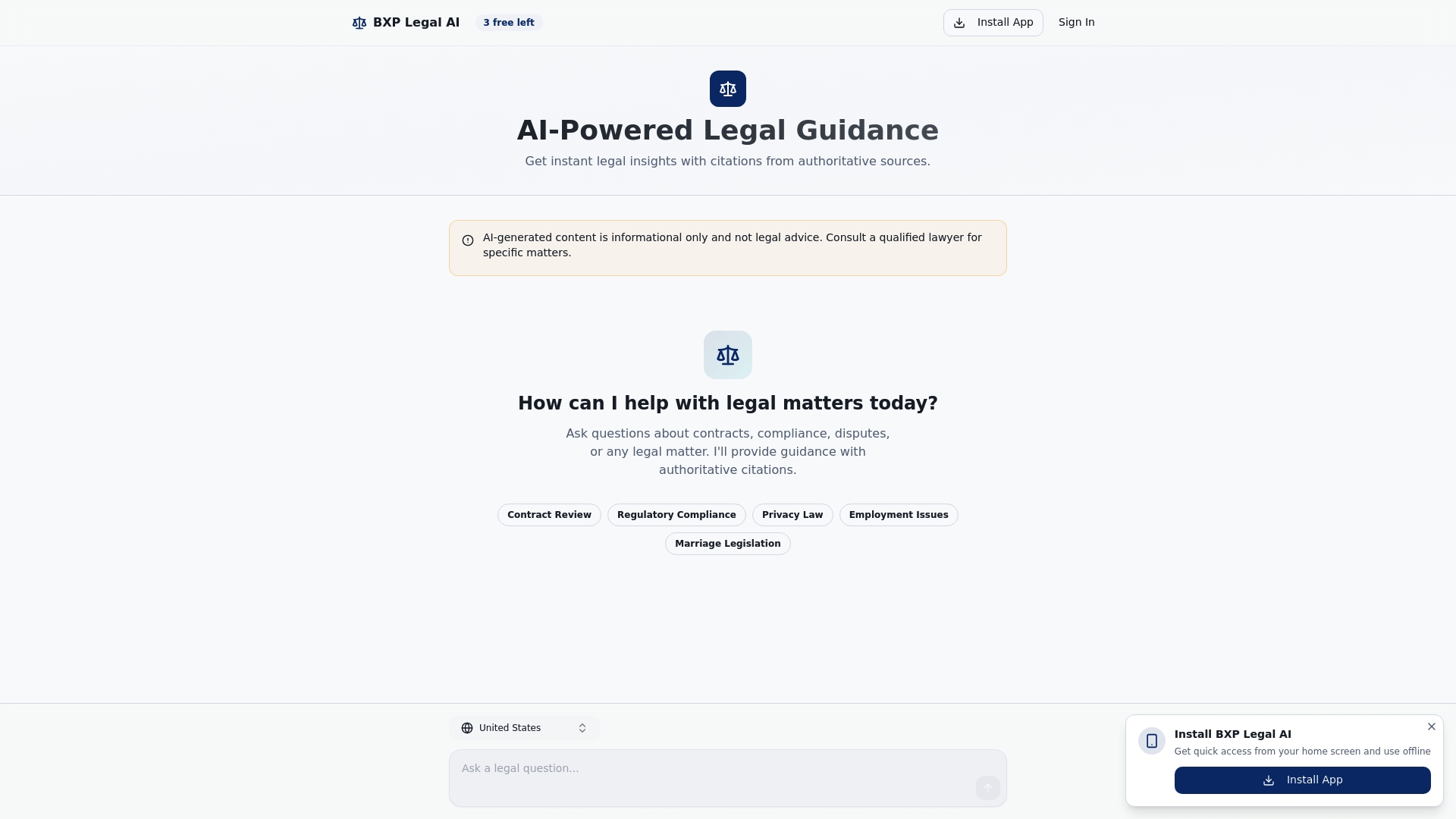
BXP Legal AI is built specifically for individuals and small businesses who need reliable legal guidance without the overhead of a traditional law firm. From instant answers on contracts and compliance to document comparison and ready-to-use AI legal templates, BXP Legal gives you the tools to manage legal tasks with confidence. Every response is backed by authoritative citations, so you always know where the information comes from. Start with a task you already have on your plate and see how much faster it gets done.
Frequently asked questions
What are common mistakes to avoid with AI legal tools?
The most common mistakes are blindly trusting AI outputs and skipping human verification of critical clauses. 17 to 82% of legal AI outputs can contain fabricated content if not reviewed by a qualified person.
Can AI legal tools fully replace lawyers for contracts?
No. AI speeds up drafting and review significantly, but human expertise is still required for complex issues, nuance, and risk management. AI routinely struggles with governing law, IP ownership, and non-standard clauses.
How secure is my information when using AI legal tools?
Data privacy depends entirely on the provider's terms. 92% of AI vendor contracts give data rights to the provider rather than the client, so reviewing those terms carefully before uploading sensitive documents is essential.
What should I look for in a reliable AI legal tool?
Prioritize tools with high accuracy rates, grounding features that cite verified sources, and strong human-in-the-loop options. Leading tools achieved 90%+ accuracy by grounding their outputs in authoritative legal content.