
A single ambiguous word in a contract once cost a company over $5 million in losses. That is not a hypothetical. Poor document drafting is one of the most overlooked legal risks for small businesses and individuals alike. Whether you are signing a vendor agreement, setting up a partnership, or writing an employment contract, the way your documents are written determines whether they protect you or expose you. This guide breaks down what document drafting actually means, what makes a document legally sound, and how you can approach the process with confidence.
Table of Contents
- What is document drafting?
- Essential elements of effective document drafting
- Common pitfalls and expert nuances in document drafting
- Practical steps for drafting better documents
- Take the next step with BXP Legal AI
- Frequently asked questions
Key Takeaways
| Point | Details |
|---|---|
| Clarity prevents disputes | Well-drafted documents eliminate ambiguity and protect your interests. |
| Follow standard structure | Use clear definitions, logical formatting, and standard provisions for legal compliance. |
| AI improves efficiency | Drafting tools can cut your workload, but final human review is crucial. |
| Templates save time | Leverage reliable templates to quickly create essential business documents. |
What is document drafting?
Document drafting is not just typing up an agreement and signing it. It is a deliberate, structured process. As defined by legal drafting experts, document drafting is the process of creating written legal documents designed to ensure enforceability and prevent disputes. That definition carries real weight. Every word you choose, every clause you include or leave out, shapes whether a document holds up when challenged.
The types of legal documents that fall under this umbrella are broad. They include:
- Contracts and service agreements between businesses and clients
- Employment agreements covering roles, compensation, and termination
- Non-disclosure agreements (NDAs) protecting confidential information
- Wills and estate planning documents governing asset distribution
- Lease agreements for commercial or residential property
- Partnership and shareholder agreements defining business relationships
The primary goals of document drafting are clarity, enforceability, and compliance. A well-drafted document leaves no room for misinterpretation. It tells every party exactly what they agreed to, what happens if something goes wrong, and which laws govern the relationship. As the legal drafting overview from Section 1 explains, precision in language is what separates a document that protects you from one that creates liability.
"A document that is hard to read is a document that is easy to dispute."
Understanding why legal documentation matters is the first step toward protecting your business or personal interests from avoidable legal conflict.
Essential elements of effective document drafting
Knowing what document drafting is gets you started. Knowing what makes a document well-drafted is what keeps you out of court. Key mechanics of strong drafting include using plain English, defining terms clearly, and structuring documents with standard formats that courts and counterparties can follow without confusion.
Here is a practical breakdown of the essential elements:
- Plain language over legalese. Write so that any reasonable person can understand the document without a law degree. Overly complex language creates ambiguity, not authority.
- Clear definitions. Define every key term the first time it appears. If your contract mentions "Deliverables," spell out exactly what that means in your specific context.
- Logical structure. Every document should have an introduction (parties and purpose), a body (rights, obligations, terms), and a conclusion (signatures, effective date, governing law).
- Consistent headings and formatting. Use numbered sections, bold headings, and white space. A document that is easy to navigate is easier to enforce.
- Thorough proofreading. Typos and inconsistencies are not just embarrassing. They can create legal ambiguity that a court may interpret against you.
- Signature and execution provisions. Confirm who signs, in what capacity, and under what authority. Missing this step can render a document unenforceable.
Pro Tip: Before finalizing any document, read it aloud. If a sentence sounds confusing when spoken, it will be even more confusing when disputed in writing.
The document drafting features available through modern legal tech platforms can help you apply these principles consistently, even if you are not a trained attorney. The goal is always the same: a document that says exactly what you mean and means exactly what it says.

Common pitfalls and expert nuances in document drafting
Even experienced professionals make drafting mistakes. For small business owners and individuals working without dedicated legal teams, the risks multiply quickly. Understanding where documents go wrong is just as important as knowing how to write them well.
The most common pitfalls include:
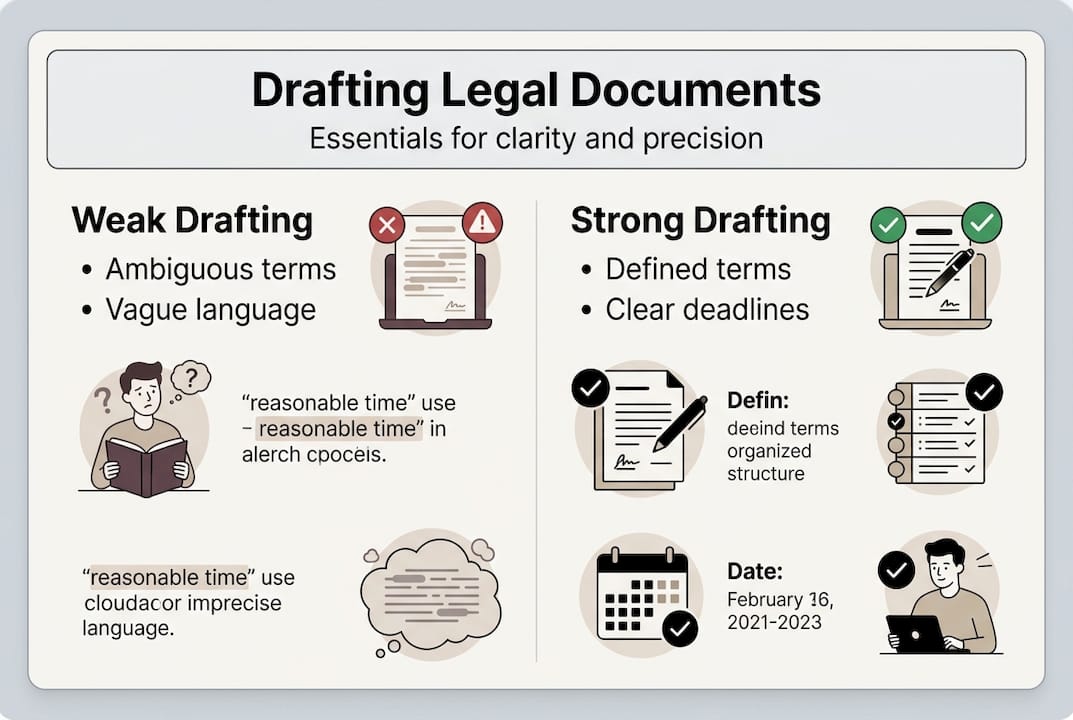
- Undefined or vague terms. Words like "reasonable," "timely," or "best efforts" sound professional but mean nothing without a clear definition. Courts have ruled against parties simply because these terms were left open to interpretation, as highlighted in common AI drafting errors.
- Inconsistent language. Calling the same party "Client" in one section and "Customer" in another creates confusion about who owes what to whom.
- Overcomplexity. Stacking clause upon clause without clear organization makes a document nearly impossible to enforce or interpret.
- Missing risk allocation clauses. Indemnity provisions and liability caps tell each party who bears the financial risk if something goes wrong. Leaving these out is a serious oversight.
- No governing law clause. If your contract does not specify which state's laws apply, a dispute could be litigated anywhere, at enormous cost.
Here is a quick comparison of strong versus weak drafting practices:
| Element | Weak drafting | Strong drafting |
|---|---|---|
| Term definition | "Reasonable timeframe" | "Within 10 business days" |
| Risk allocation | No indemnity clause | Clear indemnity and liability cap |
| Governing law | Not specified | "Governed by the laws of New York" |
| Language consistency | Mixed party names | Single defined term used throughout |
| Structure | Dense paragraphs | Numbered sections with headings |
On the topic of AI: recent benchmarking research shows that top AI tools actually outperform human lawyers on first drafts, with AI reaching 73.3% reliability compared to humans at 56.7%. That is impressive. But AI still struggles with nuanced risk allocation, jurisdiction-specific rules, and context-dependent clauses. Read more about AI in document drafting and contract drafting strategies to understand where technology helps and where human judgment is still essential.
Pro Tip: Never copy a contract template from the internet without reviewing every clause for your specific situation. A template built for a California freelancer may not protect a Texas retailer.
Practical steps for drafting better documents
With the risks and best practices in mind, here is a clear roadmap you can follow to draft documents more safely and efficiently.
- Identify the purpose and parties. Before writing a single word, be clear on what the document needs to accomplish and who is involved. Ambiguity often starts here.
- Choose the right starting point. Use a reputable template or AI-generated draft as your foundation. This saves time and ensures you do not miss standard clauses. Legal drafting standards recommend starting with a proven structure.
- Customize for your situation. Adjust every clause to reflect your actual agreement. Do not leave placeholder language in the final version.
- Define all key terms upfront. Add a definitions section near the beginning of the document. This single step eliminates most ambiguity disputes.
- Review for consistency and completeness. Check that every defined term is used consistently and that no critical provisions are missing.
- Get a professional review for high-stakes documents. For contracts above a certain value or complexity, a lawyer's review is worth the cost. AI benchmarking research confirms that AI accelerates drafting for small businesses but requires human oversight for nuanced compliance.
Here is a practical reference for when to use each approach:
| Document type | DIY template | AI-assisted draft | Lawyer review |
|---|---|---|---|
| Simple NDA | Yes | Yes | Optional |
| Vendor service agreement | With caution | Recommended | Recommended |
| Employment contract | Not advised | Yes | Required |
| Partnership agreement | Not advised | Yes | Required |
| Will or estate document | Not advised | No | Required |
Using a drafting with AI guide can help you understand exactly where AI adds value and where it falls short. For businesses handling multiple documents regularly, exploring document automation workflows can dramatically reduce the time and cost of routine drafting tasks.
Pro Tip: Keep a master checklist of clauses required for each document type your business uses regularly. This turns a stressful task into a repeatable, reliable process.
Take the next step with BXP Legal AI
You now have a solid foundation for understanding document drafting, what it involves, where it goes wrong, and how to do it better. The next step is putting that knowledge into practice without spending hours on every document.
BXP Legal AI gives individuals and small business owners access to AI-powered drafting tools, a document comparison tool that flags inconsistencies and missing clauses, and a library of legal document templates built for real-world use cases. Whether you need to draft a vendor agreement in minutes or review an existing contract for risk, BXP Legal AI makes the process faster, clearer, and more reliable. It is not a replacement for a lawyer, but it is the smartest starting point for anyone who wants to get documents right the first time.
Frequently asked questions
Why is document drafting important for small businesses?
Precise drafting prevents costly disputes by ensuring your agreements are clear and enforceable from day one. A poorly worded contract can cost far more to litigate than it would have cost to draft correctly.
Can I use AI or templates to draft my own contracts?
Yes, AI and templates are effective starting points that can reduce drafting time significantly, but human oversight remains essential to catch nuances, jurisdiction-specific requirements, and context-dependent clauses that automated tools may miss.
What are the biggest mistakes in document drafting?
The most common errors are ambiguous terms and inconsistent language, such as using undefined words like "reasonable" or switching between different names for the same party throughout the document.
How long does it take to draft a legal document with and without AI?
Manual drafting of a complex document can take over 15 hours, while AI-assisted drafting typically reduces that to 2 to 4 hours for most small business use cases, freeing up significant time and resources.