
TL;DR:
- Having compliance policies on paper is insufficient without effective implementation and monitoring. Regulators focus on whether controls are operational and produce results, not just whether policies exist. Effective management involves ongoing staff training, accountability assignment, and regular reviews to mitigate real-world compliance risks.
Having the right compliance policies on paper is not the same as managing compliance risk effectively. Regulators are increasingly focused on whether controls actually work in practice, not just whether they exist. The European Securities and Markets Authority recently issued record fines tied directly to governance and organizational control failings, even where written frameworks were present. For compliance officers and risk managers at small to medium-sized enterprises, that signals something important: compliance risk is about far more than documentation, and closing the gap between policy and practice is where your most critical work happens.
Table of Contents
- Defining compliance risk: More than just regulations
- Core components of compliance risk
- How compliance risk arises: Scenarios and warning signs
- Managing and mitigating compliance risk
- Why compliance risk frameworks fall short—and what actually works
- Streamline compliance risk management with the right tools
- Frequently asked questions
Key Takeaways
| Point | Details |
|---|---|
| Compliance risk is broad | It covers regulatory, financial, and reputational consequences from failing legal obligations. |
| Policies aren’t enough | Even with written policies, poor procedures or lack of accountability still expose firms to risk. |
| Nuanced controls matter | Regulators examine not just policies, but how compliance is embedded and demonstrated in daily operations. |
| Mitigation needs actions | Checklists, clear documentation, regular training, and assigning ownership help reduce risk. |
| Technology is an enabler | Tech tools can improve ongoing risk management and simplify compliance for SMEs. |
Defining compliance risk: More than just regulations
Now that we've challenged the idea that simply having compliance policies is enough, let's clarify exactly what compliance risk means and why that matters for your business.
The most cited formal definition comes from the Federal Reserve. According to their supervisory guidance, compliance risk covers regulatory sanctions, fines, penalties, and financial losses that arise when an organization fails to comply with applicable laws, rules, regulations, or supervisory requirements. That definition is clear, but it is also deliberately narrow in scope.
"Compliance risk is the risk of regulatory sanctions, fines, penalties, or losses arising from failure to comply with applicable laws, rules, regulations, or supervisory requirements." — Federal Reserve SR0808 Letter
In practice, many risk professionals work with a broader view. The Federal Reserve's SR0808 guidance frames compliance risk around legal and regulatory consequences, but industry practitioners regularly extend this to include reputational harm, loss of customer trust, and indirect financial damage from negative press or lost contracts. Both perspectives are valid. What matters is that you and your team agree on which consequences are in-scope for your organization's risk appetite and how those consequences are tracked in your reporting.
For SMBs in particular, the reputational dimension can be more damaging than the fine itself. A mid-sized firm might absorb a $50,000 penalty but lose a major client who discovers the breach through public records or news coverage. Understanding the compliance essentials for SMBs means mapping all of these consequence types, not just the ones most likely to show up in a regulator's enforcement notice.
A common pitfall is treating compliance risk as a documentation exercise. Teams write policies, file them, and consider the job done. But regulators are looking for evidence that policies are implemented, monitored, and updated. If your anti-money laundering policy is three years old and no one has been trained on it in that time, you carry compliance risk regardless of whether the document exists.
Core components of compliance risk
With a working definition in mind, it's important to zoom in on the practical factors that actually create compliance risk for SMEs.
Compliance risk does not come from a single source. It builds from several directions simultaneously, and failing to track all of them creates blind spots.
Primary sources of compliance risk include:
- Applicable laws and statutes (federal, state, and local)
- Regulatory rules and supervisory guidance specific to your industry
- Contractual obligations with clients, partners, and vendors
- Internal codes of conduct and ethical standards
- Industry-specific requirements such as data privacy frameworks or workplace safety standards
Each of these sources generates its own category of potential consequence. The Federal Reserve defines this risk around sanctions, fines, and losses, but in day-to-day risk management, you will encounter four overlapping consequence types that your program needs to address.
| Consequence type | Description | Example |
|---|---|---|
| Legal | Litigation, enforcement actions, criminal liability | EEOC lawsuit for employment law violation |
| Regulatory | Fines, license suspension, reporting sanctions | SEC penalty for late disclosure |
| Reputational | Loss of client trust, negative press, brand damage | Public breach of consumer data protection rules |
| Financial | Indirect revenue loss, contract termination, remediation costs | Client exits contract after compliance audit failure |
Notice that legal and regulatory consequences are often the most visible, but financial and reputational consequences can persist long after a fine is paid. This is why assessing legal risk across all four categories, rather than just regulatory obligations, produces a more realistic picture of where your business is exposed.
Failures in procedures, evidence, or accountability structures are where SMBs most often run into trouble. Suppose your organization has a data protection policy that technically meets current requirements. If there is no defined owner responsible for reviewing it annually, no training records showing staff have read and acknowledged it, and no process for updating it when regulations change, every one of those gaps elevates your compliance risk profile. Regulators do not just look at the policy itself. They look at the entire operating environment around it.

Pro Tip: Map each compliance requirement to a named individual in your organization who owns it. Without clear accountability, even well-written policies tend to decay over time and create exposure.
How compliance risk arises: Scenarios and warning signs
Knowing what compliance risk looks like conceptually is useful, but how does it actually arise in day-to-day business activity?
Compliance risk most commonly develops through five practical routes.
-
Regulatory changes that go untracked. New rules are issued, but no one in your organization picks them up, reviews them for applicability, or updates internal controls. This is especially common in areas like employment law, data privacy, and environmental reporting where regulations evolve frequently.
-
Controls that become outdated. A control that worked under last year's regulatory framework may not meet the updated standard. Annual reviews catch this. Ad-hoc, reactive management typically does not.
-
Poor documentation of compliance activities. Staff may follow the right procedures, but if there are no records, you cannot demonstrate compliance to a regulator during an inspection or investigation.
-
Insufficient or infrequent staff training. Policies only reduce risk if the people responsible for following them understand what they require. Training that happens once at onboarding and never again is rarely sufficient for high-risk compliance areas.
-
Breakdowns in third-party compliance. Many SMBs rely on vendors, contractors, or partners who handle regulated activities on their behalf. If those third parties fail to comply, your organization may share the liability.
The most uncomfortable truth for many compliance officers is that compliance risk can persist even when policies exist. If evidence is missing, procedures are not followed, accountability structures are unclear, or controls are not operationally effective, regulators may treat the organization as having failed its compliance obligations entirely. This is exactly what played out in recent ESMA enforcement actions where firms had frameworks on paper but lacked the operational rigor to back them up.
Early warning signs of compliance vulnerabilities include:
- Staff unable to locate or describe the policy relevant to their role
- No log of when policies were last reviewed or updated
- Compliance tasks assigned to departments rather than named individuals
- Vendor contracts that do not include compliance representations or audit rights
- No formal process for reviewing regulatory updates in your industry
Reviewing compliance best practices for SMBs on a structured schedule, rather than waiting for a problem to surface, is the single most reliable way to catch these warning signs early.
Pro Tip: Run a brief quarterly "pulse check" where each compliance owner confirms whether anything in their area has changed or is at risk of falling out of date. It takes less than an hour and often catches issues before they become reportable events.
Managing and mitigating compliance risk
Recognizing compliance risk is half the battle. Success depends on systematizing your prevention and response strategies.
Effective compliance risk management does not require a large legal team. It requires a disciplined process applied consistently. Here are the core steps risk managers at SMBs should build into their annual program.
-
Conduct an annual compliance review. Inventory every regulatory obligation relevant to your business, confirm which controls are in place, and identify any gaps. Document the output of this review formally.
-
Assign named owners to every compliance requirement. Accountability is the single biggest predictor of whether controls remain effective over time. When everyone is responsible, no one is.
-
Train staff regularly and record it. Training records are among the first things regulators request. Build a training schedule and keep sign-off documentation for every session.
-
Evaluate whether your controls actually work. This means testing, not just checking that a policy exists. Run spot checks, internal audits, or scenario-based exercises to confirm your controls perform as intended under real conditions.
-
Update controls when regulations change. Assign someone to monitor regulatory updates in your key areas and trigger a review whenever a relevant change occurs.
-
Document everything. Compliance risk can persist even when policies exist if evidence of implementation is absent. Treat documentation as a risk control in its own right, not just an administrative task.
| Risk category | Mitigation measure | Review frequency |
|---|---|---|
| Regulatory | Monitor rule changes, update controls promptly | Ongoing and annual |
| Legal | Legal review of contracts, employment practices | Annual or event-driven |
| Reputational | Incident response plan, staff communication training | Annual |
| Financial | Compliance budget, fine reserves, insurance review | Annual |
| Third-party | Vendor due diligence, contractual compliance clauses | On contract and annually |
Using a structured compliance checklist for SMBs keeps your annual review organized and ensures nothing falls through the cracks. A small business compliance guide that is updated for current regulatory requirements can serve as the backbone of your annual planning process.
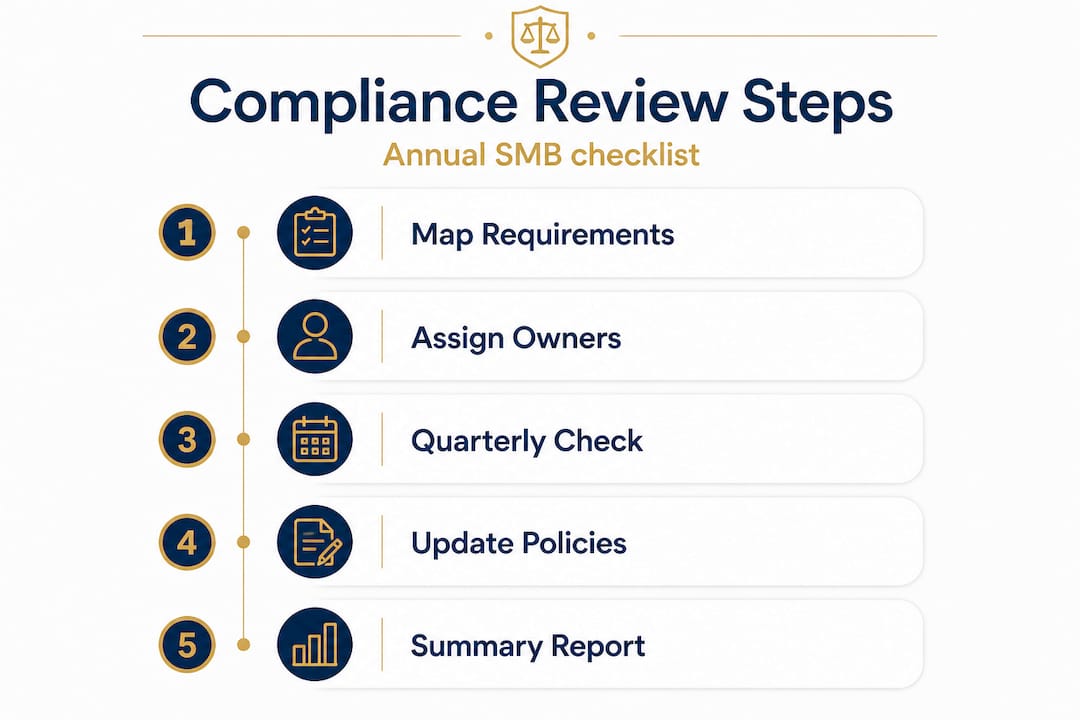
Pro Tip: When you complete your annual compliance review, produce a brief written summary that captures what was reviewed, what gaps were found, and what actions were taken. That document is evidence of good-faith compliance effort, and regulators take it seriously.
Why compliance risk frameworks fall short—and what actually works
Here is the uncomfortable reality that most compliance guides skip over: the majority of compliance failures are not documentation problems. They are execution problems.
Organizations invest heavily in writing frameworks. They hire consultants, subscribe to compliance platforms, and build out policy libraries. Then a regulator arrives, asks to see how the anti-bribery program works in practice, and discovers that no one in the front office can describe it, training logs are missing for two years, and the designated compliance officer left eight months ago without a formal handoff. The policy exists. The compliance program, in any meaningful sense, does not.
Enforcement actions consistently show that regulators are sophisticated enough to look past paperwork. When they examine governance and control failings, they are asking whether the organization actually operated within a compliance culture, not just whether policies were filed in the right folder.
The lesson from why compliance matters is not that you need a more elaborate framework. It is that you need leadership at every level treating compliance as a live operational responsibility rather than an annual checkbox. That means middle managers who flag potential issues rather than suppress them. It means compliance owners who feel genuinely accountable, not just nominally listed in a chart. It means a culture where asking "are we sure this is compliant?" is encouraged rather than seen as a friction point.
The most effective SMBs we observe do something simple but powerful: they make compliance discussions a regular part of operational meetings. Not a separate quarterly compliance review buried in the calendar, but a consistent agenda item in the rooms where business decisions are actually made. That is where execution gaps get caught before they become regulatory findings.
Streamline compliance risk management with the right tools
For SMEs aiming to transform their compliance efforts from reactive to proactive, the right technology is the final piece.
Managing compliance risk manually across multiple regulatory areas is time-consuming and prone to human error. Gaps in tracking, outdated documentation, and missed regulatory updates are all risks that the right tools can systematically reduce.
BXPLegal.com provides AI-powered legal guidance designed specifically for businesses that need fast, reliable answers on compliance, contracts, employment obligations, and regulatory requirements. Whether you need to review a contractual obligation, understand a new regulatory requirement, or draft documentation to support your compliance program, the platform delivers instant insights backed by authoritative citations. It is built for compliance officers and risk managers who need to move quickly without sacrificing accuracy. Explore how BXPLegal.com can support your compliance risk management program today.
Frequently asked questions
What are examples of compliance risk?
Examples include regulatory fines for missing reports, penalties for violating labor laws, and reputational damage following a data protection breach. Any failure to meet legal, regulatory, or contractual obligations creates compliance risk exposure.
How does compliance risk differ from operational risk?
Compliance risk focuses specifically on failures to meet legal and regulatory obligations and consequences, while operational risk covers breakdowns in internal processes, people, or systems, even when no laws are broken.
What happens if a company ignores compliance risk?
Ignoring compliance risk can trigger regulatory investigations, significant fines, civil litigation, and lasting reputational harm. Even firms with written policies can face enforcement action if control failings are identified by regulators in practice.
How can risk managers reduce compliance risk?
Risk managers should conduct regular compliance reviews, assign clear accountability, maintain thorough training records, and use structured compliance programs to monitor for regulatory changes and close control gaps before they become enforcement issues.