
TL;DR:
- Small businesses face high legal costs, averaging over $54,000 per dispute.
- Key legal risks include employment issues, contracts, data privacy, compliance, and intellectual property.
- Regular, structured legal risk assessments with clear ownership and AI tools enhance legal resilience.
A single legal dispute can cost a small business over $54,000 in defense costs alone, and 43% of small businesses are currently threatened by or involved in a lawsuit. Contract disagreements and employment issues top the list. For most SMEs, legal risk isn't a distant possibility—it's a recurring reality. This guide walks you through exactly how to identify, assess, and manage the legal risks most likely to affect your business. Whether you're a five-person startup or a growing company with 200 employees, a structured approach to legal risk can mean the difference between a close call and a business-ending event.
Table of Contents
- Understanding legal risk in SMEs
- Preparation: What you need before starting
- Step-by-step legal risk assessment for SMEs
- Verification and continuous improvement
- Why most SMEs fall short on legal risk—and how you can do better
- Use AI tools to simplify and strengthen your legal risk process
- Frequently asked questions
Key Takeaways
| Point | Details |
|---|---|
| Legal risks are common | Almost half of SMEs will face legal threats, making proactive management essential. |
| Tiered assessment works best | A scalable, step-by-step approach lets small businesses match their risk process to their size. |
| Continuous improvement is key | Effective legal risk management means regularly reviewing and improving your controls. |
| AI tools streamline compliance | Automated solutions help SMEs save time and reduce errors when managing legal risks. |
Understanding legal risk in SMEs
Legal risk sounds technical, but it has a simple definition: the possibility that your business suffers a financial loss, penalty, or operational disruption because of a legal problem. That problem could be a breach of contract, an employment dispute, a data privacy violation, or a regulatory fine. Understanding legal risk basics is the first step every SME owner should take before anything else.
For most small and medium-sized businesses, legal risk falls into five main categories:
- Employment practices: Wrongful termination, wage disputes, discrimination claims, and misclassification of contractors
- Contracts and disputes: Poorly drafted agreements, missed deadlines, and vendor disagreements
- Data privacy: Non-compliance with laws like GDPR or state-level privacy regulations, leading to fines and lawsuits
- Regulatory compliance: Licensing, environmental, tax, and industry-specific regulations
- Intellectual property: Trademark infringement, unlicensed software use, or failure to protect your own brand assets
These five risk categories are not theoretical. Employment and contract issues are the most common triggers for legal action against SMEs.
The consequences of ignoring these risks are steep. Legal fees pile up fast, and even a case you win can cost tens of thousands of dollars. Beyond the money, unresolved legal disputes damage your reputation, disrupt operations, and drain leadership focus away from growth.
So why do SMEs often skip formal risk management? Mostly because owners are stretched thin. There's no dedicated legal team, budgets are tight, and compliance can feel overwhelming. The ISO 31022:2020 guidelines were developed in part to address this exact gap, offering a proportionate framework that doesn't require a full legal department. The reality is that even a basic, structured review done twice a year can catch the issues that eventually become expensive court cases. Understanding why small businesses need legal guidance isn't about fear—it's about staying operational.
| Risk category | Common examples | Potential cost |
|---|---|---|
| Employment | Wrongful termination, wage theft | $75,000+ per claim |
| Contracts | Breach, unclear terms | $10,000–$100,000+ |
| Data privacy | GDPR/CCPA violations | Up to 4% of global turnover |
| Regulatory | Licensing, tax, environmental | Varies widely |
| Intellectual property | Trademark infringement | $5,000–$500,000+ |
Preparation: What you need before starting
Knowing your risk categories is only half the battle. Before you run a legal risk assessment, you need to gather the right inputs and get the right people in the room. Skipping this step is like trying to audit your finances without your bank statements.
Start by pulling together these essential documents:
- All active and recent contracts (vendor, client, employment, lease)
- Your employee handbook and any HR policies
- Compliance logs and regulatory filings
- Insurance policies and any past legal correspondence
- Data processing agreements and privacy notices
Once you have these ready, decide who needs to be involved. At a minimum, loop in the business owner or CEO, your operations manager, and anyone who handles HR or finance. If you have access to a legal advisor, even on a part-time basis, include them. For compliance essentials for SMBs, cross-functional input is what makes the difference between a surface-level review and one that actually catches problems.
On the framework side, ISO 31022:2020 recommends establishing context first, then selecting proportionate methods that match your business size and complexity. This is good news for smaller businesses: you don't need a Fortune 500-level process. A tiered approach works well, where the depth of review matches the level of risk.
Useful tools and their fit for SMEs:
| Tool or framework | Best for | SME suitability |
|---|---|---|
| ISO 31022:2020 | Structured legal risk management | Moderate (needs adaptation) |
| UNODC Integrity Risk Matrix | Anti-corruption, procurement risks | High (simple, accessible) |
| SMB legal compliance checklist | Quick compliance review | Very high |
| Legal tech platforms (AI-assisted) | Document review, gap analysis | Very high |
For a practical starting point, the SMB legal compliance checklist is one of the most efficient tools available. It breaks compliance down into manageable items without requiring legal expertise to follow.

Pro Tip: If your business is fewer than 20 people, start with one risk category per quarter rather than trying to assess everything at once. A focused, completed review beats a sprawling, unfinished one every time.
Step-by-step legal risk assessment for SMEs
With your documents gathered and your team assembled, here is exactly how to run a legal risk assessment that actually produces results.
Step 1: Define your scope. Decide which parts of the business you're assessing this cycle. This could be a specific department, a set of contracts, or a regulatory area. Narrow scope equals higher quality output.
Step 2: Identify risks. Go through your documents and map out every potential legal issue. Use your five risk categories as a guide. Don't filter yet—just list everything you see. A contract risk checklist is a great tool to use at this stage for anything contract-related.
Step 3: Analyze each risk. For each item on your list, ask two questions: How likely is this to happen? And how bad would the outcome be? This gives you a rough severity score for each risk.
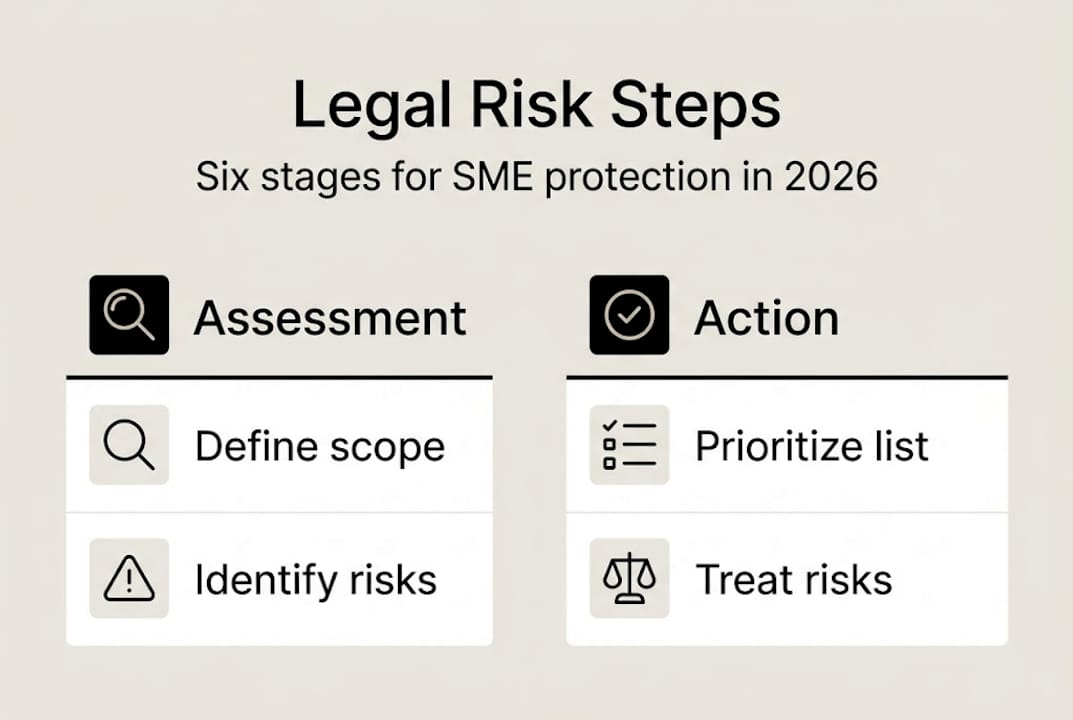
Step 4: Evaluate and prioritize. Rank your risks by severity. High-likelihood and high-impact issues go to the top. This is where you decide what needs immediate action versus what can be monitored.
Step 5: Treat the risks. For each priority risk, choose a response. You can mitigate (fix the root cause), transfer (insurance or contract terms), accept (low-impact items), or avoid (stop the activity). AI tools for legal risk can help draft updated clauses, templates, or policy language at this stage.
Step 6: Monitor and review. Set a review schedule. Document who is responsible for each action. Mark completion dates.
The UNODC Integrity Risk Matrix supports a tiered methodology that scales this process based on your business size:
| Tier | Approach | Who it fits |
|---|---|---|
| Tier 1: Baseline | Simple checklist review | Solo operators, micro-businesses |
| Tier 2: Enhanced | Structured risk register + owner review | SMEs with 10–50 employees |
| Tier 3: Full assessment | Documented review with legal input | SMEs with 50+ employees or high regulatory exposure |
Pro Tip: Document every step you complete, even informally. A dated email thread or shared spreadsheet qualifies. This creates an audit trail that can protect you if a dispute arises later.
Verification and continuous improvement
Running your first assessment is a real achievement. But it's only the beginning. The businesses that consistently avoid legal problems aren't the ones who did a single review three years ago—they're the ones who built ongoing verification into their operations.
Verification means confirming that the controls you put in place are actually working. Here's what that looks like in practice:
- Review your risk register every six months and update it with new information
- Conduct spot checks on high-risk areas like employee contracts or data handling procedures
- Get an independent review annually, whether from a legal advisor or a trusted peer with legal knowledge
- Test your compliance against updated regulations, especially in fast-changing areas like data privacy
Common mistakes SMEs make after their first assessment:
- Setting and forgetting: Running the assessment once and never revisiting it
- No accountability: Identifying risks but assigning no one to fix them
- Vague documentation: Notes so generic they're useless when you need them
- Ignoring regulatory changes: Laws change, and your controls need to change with them
As research on continuous improvement principles makes clear, most SMEs focus on identifying risks but neglect monitoring and enhancement over time.
"Integration, proportionality, and continuous improvement are the cornerstones of ISO 31022—and the principles most often missed by SMEs trying to manage legal risk on their own."
Quick wins you can implement right now: assign a named person to own the risk register, set a calendar reminder for your next review, and add a legal risk agenda item to your quarterly management meetings. These three habits cost nothing and make a measurable difference. For more structured guidance, compliance best practices and a multi-jurisdictional legal guide can help you scale your process as the business grows.
Why most SMEs fall short on legal risk—and how you can do better
Here's an uncomfortable truth: most SMEs treat legal risk assessment as a task rather than a habit. They complete it once, file it away, and move on. Then they're caught off guard when a contract dispute surfaces or a regulatory change creates a gap in their compliance.
The SMEs that handle legal risk well share one trait: they assign ownership. Someone specific is responsible for the risk register, for following up on action items, and for scheduling the next review. It doesn't have to be a lawyer. It just has to be someone accountable.
Legal risk isn't a box you check. It's closer to financial bookkeeping. You wouldn't review your accounts once and assume everything is fine forever. The same logic applies here. The most resilient businesses treat their legal risk register the way they treat their balance sheet: regularly, seriously, and with outside perspective when needed.
We've seen firsthand through helping SMEs navigate complex legal landscapes that the gap between struggling and thriving businesses often comes down to one thing: consistency. Review your legal risk pitfalls regularly, assign clear responsibility, and treat improvement as an ongoing process rather than a finish line.
Use AI tools to simplify and strengthen your legal risk process
If you're ready to make risk assessment less daunting and more reliable, digital tools can be a genuine game-changer for your business.
BXP Legal's AI platform is built specifically to help SMEs tackle legal complexity without a full in-house legal team. You can get instant guidance on contracts, compliance questions, and employment issues, all supported by authoritative citations. Features like document comparison tools help you spot gaps in your agreements before they become disputes. Automated templates save hours of drafting time, and every interaction builds a documented record you can reference later. Whether you're starting your first risk assessment or refining an existing process, BXP Legal gives you the structure and speed to stay ahead of legal risk.
Frequently asked questions
What are the top legal risks facing SMEs in 2026?
The biggest legal risks for SMEs include employment issues, contract disputes, data privacy violations, regulatory compliance failures, and intellectual property challenges. Employment and contract disputes are the most frequent legal threats small businesses face.
How often should a legal risk assessment be done?
SMEs should conduct a legal risk assessment at least once a year or whenever a major business change occurs, such as hiring, entering new markets, or adopting new technology. Regular review and continuous improvement are critical for effective legal risk management.
Are there simple tools for SMEs to assess legal risk?
Yes. SMEs can use accessible frameworks like the UNODC Integrity Risk Matrix or simplified templates based on ISO 31022. Tiered methods and structured tools help SMEs perform proportional reviews without overwhelming complexity.
What is the average cost of a legal dispute for an SME?
Defending a lawsuit costs an SME around $54,000 on average, not counting any settlement or judgment amounts. Average legal defense costs make proactive risk management far more economical than reactive legal battles.
Recommended
- Legal Risk Explained: Protect Your Business in 2026
- Why small businesses need legal guidance: reduce risk
- Legal compliance checklist for SMBs: essential 2026 steps
- Multi-jurisdictional legal guide for SMBs in 2026
- Korp.ph | External audit compliance guide for businesses in 2026
- US LLC Compliance in 2026: What Non-Resident Founders Need to Know (New Rules & Hidden Risks) - MyInc Team LLC