
TL;DR:
- Failure to comply with laws can cost small businesses thousands, lead to lawsuits, or cause shutdowns.
- Building a solid legal foundation and performing regular compliance reviews are essential for ongoing protection.
- Staying updated with changing regulations and seeking expert guidance helps SMBs avoid costly mistakes.
Missing a single compliance step can cost your small business thousands of dollars in fines, trigger a lawsuit, or even force a shutdown. Non-compliance is one of the leading causes of unexpected costs and business closure for SMBs. The good news? Most compliance failures are preventable with the right process. This guide walks you through every critical stage, from understanding what compliance actually means, to building your foundation, executing key tasks, and verifying nothing slips through the cracks. By the end, you'll have clarity on what to do, when to do it, and how to stay protected.
Table of Contents
- What legal compliance really means for SMBs
- Preparation: Building your compliance foundation
- Execution: Completing step-by-step compliance tasks
- Verification: Reviewing compliance and avoiding common pitfalls
- Hard-won lessons: Why compliance is never really 'done' for SMBs
- Get expert help implementing legal compliance
- Frequently asked questions
Key Takeaways
| Point | Details |
|---|---|
| Compliance is critical | Missing legal compliance steps can cost you thousands and threaten your business’s survival. |
| Foundation matters | Start with the right structure, documentation, and registrations to build compliance smoothly. |
| Follow every step | A step-by-step approach helps prevent missed tasks, fines, or legal challenges. |
| Review regularly | Revisit compliance at least yearly and whenever your business changes to stay ahead of risks. |
What legal compliance really means for SMBs
Legal compliance means your business consistently meets all laws, regulations, and standards that apply to how you operate. That sounds simple, but for small and medium-sized businesses, the scope is surprisingly wide. It covers tax obligations, employment law, business licensing, data privacy, contracts, and proper documentation. Each of these areas carries its own set of rules, deadlines, and consequences.
Here's what surprises most new business owners: compliance isn't a one-time task. It's an ongoing operating requirement. And the stakes are real. Compliance failures can result in fines from $50 to over $10,000 per violation and even business closure. A missed payroll tax filing, an expired business license, or a poorly drafted contractor agreement can each trigger serious consequences.
Key compliance areas every SMB must manage:
- Tax compliance: Federal, state, and local tax registrations, filings, and payments
- Employment law: Proper worker classification, wage requirements, I-9 forms, anti-discrimination policies
- Licensing and permits: Industry-specific licenses, local business permits, zoning approvals
- Corporate documentation: Articles of incorporation, bylaws, operating agreements, annual reports
- Data privacy: Customer data handling, breach notification requirements, privacy policies
| Compliance area | Common violation | Typical fine range |
|---|---|---|
| Payroll taxes | Late or missing deposits | $50 to $10,000+ |
| Employment law | Misclassifying workers | $1,000 to $25,000 |
| Business licensing | Operating without a permit | $100 to $5,000 |
| Data privacy | Improper data handling | $2,500 to $7,500 per incident |
A common misconception is that compliance only matters for large companies. In reality, regulators frequently target smaller businesses because they tend to have fewer internal controls. Another myth is that hiring a lawyer once at startup is enough. Laws change, your business evolves, and new obligations appear regularly.
"Compliance is not a legal department problem. It's a business survival problem."
Review the compliance checklist steps that apply specifically to SMBs, and get a clearer picture of what legal compliance explained looks like in practice.
Preparation: Building your compliance foundation
Before you can tackle specific compliance tasks, you need the right foundation in place. Think of this as setting up your legal infrastructure. Without it, every step you take later becomes harder and riskier.
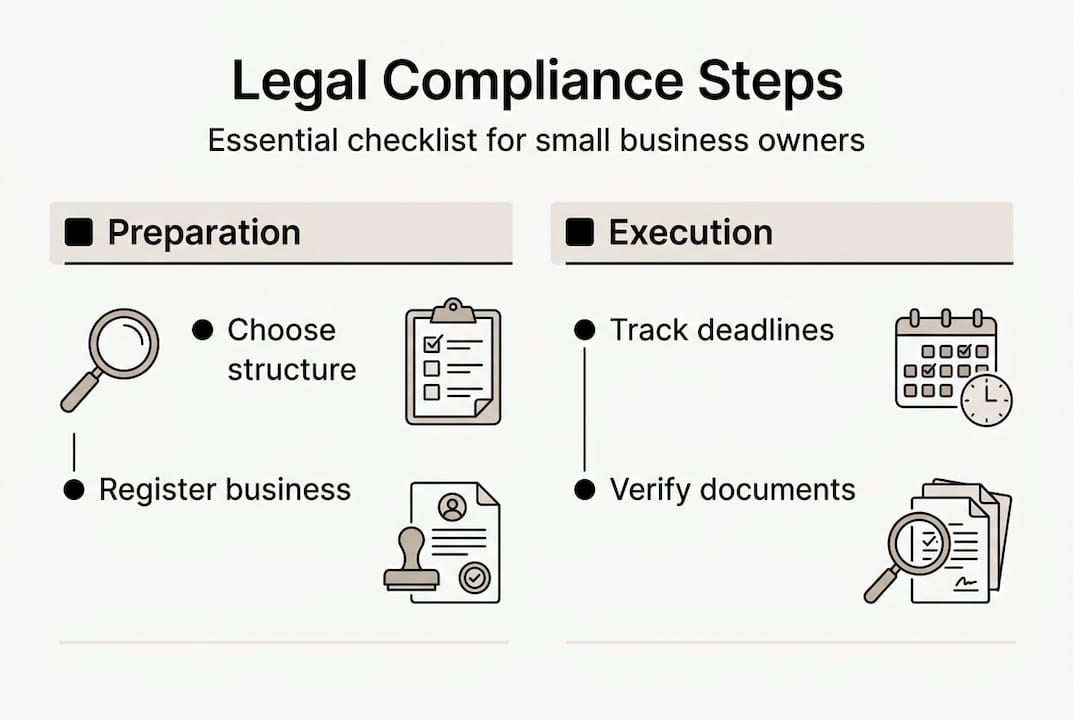
The SBA recommends conducting market research, establishing a legal structure, registering the business, and opening dedicated bank accounts as foundational compliance steps. These aren't optional extras. They're the baseline that every other compliance task builds on.
Foundational steps in order:
- Choose your legal structure (LLC, S-Corp, sole proprietorship, etc.)
- Register your business name with your state
- Obtain your Employer Identification Number (EIN) from the IRS
- Open a dedicated business bank account
- Draft or review your operating agreement or bylaws
- Identify your industry-specific licensing requirements
- Confirm local zoning and permit requirements
Your choice of legal structure matters more than most owners realize. An LLC protects your personal assets from business liabilities. An S-Corp can reduce self-employment taxes. A sole proprietorship offers simplicity but zero liability protection. Each structure triggers different compliance obligations, so the choice has long-term consequences.

| Business structure | Liability protection | Tax treatment | Compliance complexity |
|---|---|---|---|
| Sole proprietorship | None | Pass-through | Low |
| LLC | Strong | Flexible | Moderate |
| S-Corp | Strong | Pass-through | High |
| C-Corp | Strong | Double taxation | Very high |
Location matters too. A restaurant in Texas faces different health, zoning, and liquor licensing rules than one in New York. A contractor in California must comply with strict worker classification laws under AB5. Always verify state and local requirements separately from federal ones.
Pro Tip: Keep a dedicated compliance folder, either physical or digital, with copies of your EIN letter, state registration certificates, licenses, and any signed agreements. This single habit saves enormous time during audits or renewals.
For help organizing the paperwork, explore compliance document drafting resources that walk you through what each document should contain.
Execution: Completing step-by-step compliance tasks
With your foundation in place, it's time to execute. This is where most SMB owners feel overwhelmed, but breaking it into categories makes it manageable.
Tax compliance steps:
- Obtain your EIN from the IRS (free, done online in minutes)
- Register for state tax accounts (income, sales, and payroll where applicable)
- Track your sales tax nexus if you sell across state lines
- Set up monthly reconciliations to catch discrepancies early
- Make quarterly estimated tax payments to avoid underpayment penalties
- Issue W-2 forms to employees and 1099 forms to contractors by January 31
Tax compliance steps include obtaining an EIN, registering for state taxes, tracking sales tax nexus, monthly reconciliations, estimated payments, and issuing forms like W-2s and 1099s. Missing any of these triggers automatic IRS penalties.
Employment compliance essentials:
- Verify every new hire's eligibility with a completed I-9 form
- Post required federal and state labor law notices in your workplace
- Maintain accurate time and payroll records for at least three years
- Provide required benefits disclosures (health coverage options, retirement plans)
- Classify workers correctly as employees or independent contractors
Licensing and permit tasks:
- Apply for your general business license through your city or county
- Obtain industry-specific permits (food handler, contractor, professional license)
- Renew licenses on schedule. Most expire annually or biannually.
- Track permit expiration dates in a calendar with 60-day advance reminders
Pro Tip: Use a compliance calendar that maps every filing deadline, renewal date, and required payment for the full year. Color-code by category (tax, employment, licensing) so nothing gets buried.
For deeper guidance on staying current, review regulatory compliance best practices and understand the compliance document types you'll need on file.
Verification: Reviewing compliance and avoiding common pitfalls
Executing compliance tasks is only half the job. Verifying that everything is accurate, current, and properly documented is where most SMBs fall short.
Start with a self-audit. Go through each compliance category and ask: Is this current? Is it documented? Has anything changed in our business or in the law since we last reviewed this?
Self-audit checklist:
- Confirm all licenses and permits are current and posted where required
- Verify payroll tax deposits are up to date and reconciled
- Review all contractor agreements to confirm proper worker classification
- Check that employee files include signed offer letters, I-9s, and policy acknowledgments
- Confirm your privacy policy reflects current data handling practices
- Review any leases or vendor contracts for compliance-related clauses
Data breaches cost SMBs an average of $3 million, making HR due diligence and annual reviews critical for avoiding hidden compliance risks. That number alone should motivate a thorough annual review.
Edge cases catch many owners off guard. Home-based businesses may need zoning permits, and multi-state operations must navigate sales and use tax nexus rules. If you're acquiring another business, HR compliance during the transition is especially complex.
"The most expensive compliance mistake is the one you didn't know you were making."
Most common SMB compliance mistakes:
- Mixing personal and business finances (destroys liability protection)
- Missing annual report filings with the state (can result in administrative dissolution)
- Ignoring sales tax obligations in states where you have nexus
- Failing to update contracts when business relationships change
- Skipping employment policy updates when new laws take effect
For businesses operating in multiple states, multi-jurisdictional compliance tips provide specific guidance. Also understand why legal notices importance goes beyond formality when disputes arise.
Hard-won lessons: Why compliance is never really 'done' for SMBs
Here's the uncomfortable truth most compliance guides skip: finishing your checklist does not mean you're compliant. It means you were compliant on the day you checked those boxes.
Laws change. Your business changes. Employees are hired and let go. You expand into new states. You add a new product line that triggers a new licensing requirement. Each of these events creates new obligations, and none of them come with an automatic notification.
The businesses that stay out of trouble aren't the ones with the most thorough initial setup. They're the ones that treat compliance as a recurring operational habit, not a one-time project. Quarterly check-ins beat annual scrambles every time.
Here's the contrarian take: over-documenting can actually create liability. If you draft elaborate policies you don't follow, those documents become evidence against you in a dispute. Sometimes a shorter, accurate policy is safer than a long, aspirational one. Good legal documentation reflects what you actually do, not what you wish you did.
Build compliance reviews into your quarterly business rhythm. Assign ownership. Track it like revenue.
Get expert help implementing legal compliance
If working through every compliance layer feels like a full-time job, you're not wrong. The regulations are real, the deadlines are firm, and the consequences of missing something are serious.
BXP Legal gives SMB owners instant AI-powered guidance across contracts, compliance, employment law, privacy, and more, with answers backed by authoritative citations. Whether you need to review an agreement, draft a policy document, or understand a new regulatory requirement, the platform puts legal clarity within reach without the traditional law firm price tag. Use the AI document comparison feature to spot gaps in existing contracts or compliance documents before they become problems. Start with a question and get actionable answers in minutes.
Frequently asked questions
What are the first three steps to legal compliance for a new small business?
Start with choosing a legal structure, registering your business, and obtaining your EIN. The SBA identifies these as the foundational steps every new business must complete before anything else.
How much can non-compliance cost a small business?
Penalties range from $50 to over $10,000 per violation, and data breach costs alone average $3 million for SMBs, making non-compliance one of the most expensive risks a small business can take.
What special compliance steps apply to home-based or multi-state businesses?
Home-based businesses may need local zoning permits, and multi-state businesses must verify sales and use tax nexus in every state where they operate. Edge case compliance needs vary significantly by location and industry.
How often should SMBs review their compliance status?
At minimum, conduct a full compliance review annually, but quarterly check-ins are more effective. Annual reviews and due diligence are critical for catching gaps before they become violations.
Recommended
- Legal compliance explained: essential steps for SMBs
- Legal compliance checklist for SMBs: essential 2026 steps
- Document drafting guide for small businesses: compliance
- Why small businesses need legal guidance: reduce risk
- Business Tax Compliance – Why It Matters for Small Firms
- Korp.ph | Establishing a Business in the Philippines: Step-by-Step Guide