
Missing a legal notice deadline can void your rights entirely, even when you're completely in the right. A formal written notice is a legally required communication that alerts a party to their rights, obligations, disputes, or upcoming legal actions. Many individuals and small business owners treat these documents as routine paperwork, but courts treat them as binding triggers with strict deadlines and format requirements. This article breaks down every major type of legal notice, shows you exactly how they work in real situations, and gives you a practical action plan for sending or responding to one correctly.
Table of Contents
- What is a legal notice?
- Types of legal notices: Actual, constructive, and written
- How legal notices are used: Common scenarios
- Critical compliance: Notice requirements and consequences
- What to do if you receive (or need to send) a legal notice-a-legal-notice)
- How BXP Legal can help you with legal notices
- Frequently asked questions
Key Takeaways
| Point | Details |
|---|---|
| Legal notice meaning | A legal notice is an official communication stating rights, obligations, or upcoming actions. |
| Types and delivery | Notices can be actual, constructive, or written, with different requirements by jurisdiction. |
| Compliance is critical | Failing to follow notice rules can void your rights or contracts, so accuracy matters. |
| Practical steps | Always review, respond promptly, and keep records when sending or receiving legal notices. |
| Professional help | Platforms like BXP Legal AI make drafting, comparing and complying with legal notices easier for individuals and businesses. |
What is a legal notice?
A legal notice is a formal document that puts another party on record that you are aware of, or asserting, a specific legal right or obligation. Think of it as the official starting gun for a legal process. Without it, many legal actions simply cannot proceed.
Legal notices serve three core functions. First, they communicate rights and responsibilities between parties. Second, they give the receiving party a fair opportunity to respond or correct a problem before escalation. Third, they create a documented evidence trail that courts can rely on later.
Who sends and receives legal notices? The list is broader than most people expect:
- Landlords and tenants exchanging eviction or repair notices
- Employers and employees dealing with termination or workplace disputes
- Consumers and businesses handling complaint or refund demands
- Courts and litigants managing case deadlines and hearings
- Government agencies notifying the public of zoning or foreclosure actions
Legal notices appear across a wide range of types of legal documents, from simple demand letters to complex pre-litigation filings. Understanding where they fit in the legal landscape is the first step to handling them correctly.
"Legal notices communicate rights and responsibilities, provide opportunity to exercise rights before action, and include public advertisements for hearings, foreclosures, and liens." — USLegal
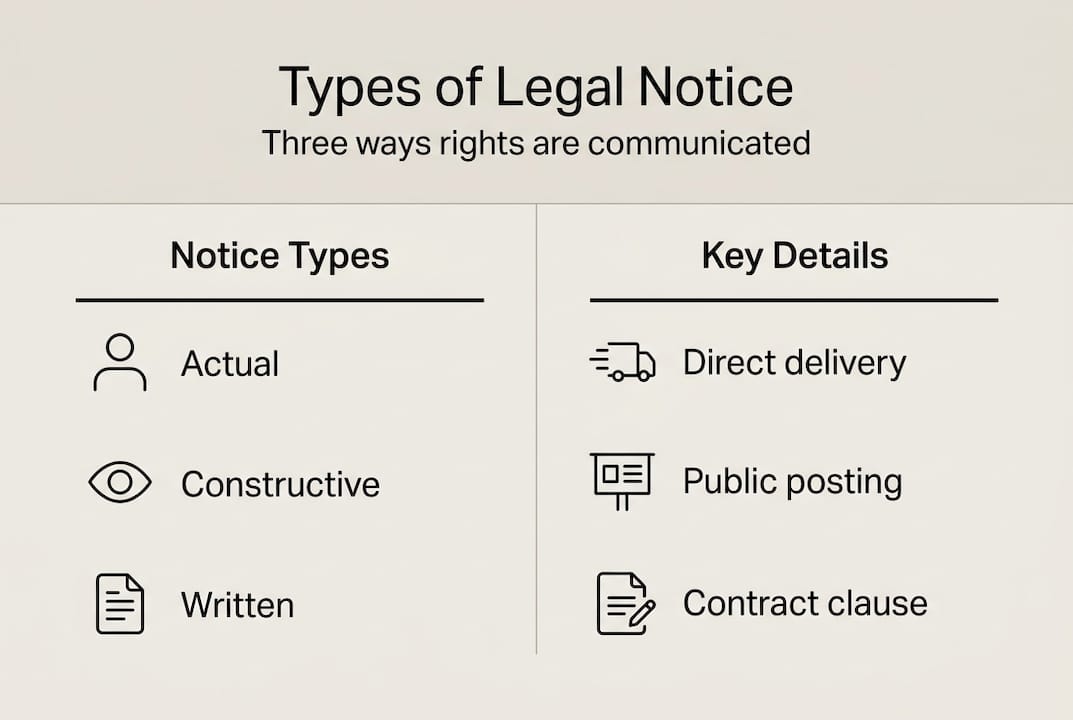
Types of legal notices: Actual, constructive, and written
Not all legal notices work the same way. The type of notice determines how it must be delivered, who is bound by it, and what legal effect it carries. Getting the type wrong is one of the most common and costly mistakes in legal practice.
Here is a side-by-side comparison of the three main types:
| Type | How it works | Who receives it | Legal effect |
|---|---|---|---|
| Actual notice | Direct communication to the party | Named individual or entity | Binding once received |
| Constructive notice | Public posting or legal presumption | General public or implied parties | Binding whether seen or not |
| Written notice | Physical or digital document per local law | Named party per contract or statute | Binding per delivery proof |
Actual notice is the most straightforward. You hand someone a document, send a certified letter, or serve them in person. They know. It is direct and hard to dispute.

Constructive notice is trickier. It assumes that a party should have known about something, even if they never actually saw it. Recording a deed in a public registry, for example, puts the entire world on constructive notice of that property ownership. You cannot claim ignorance of a publicly recorded document.
Written notice requirements vary significantly by state and contract. Virginia law, for instance, requires proof of mailing as a baseline for written notice to be valid. Some contracts specify overnight courier only. Others allow email. The key is that local law and your specific contract clause govern what counts.
- Always read your contract's notice clause before sending anything.
- Match the delivery method exactly to what the contract or statute requires.
- Keep proof of delivery, whether a certified mail receipt, courier confirmation, or email read receipt.
- Note any response deadlines triggered by the notice date.
If you manage contracts across multiple states or countries, a multi-jurisdictional contract checklist can help you track which rules apply where. A thorough contract review checklist will also flag notice clauses before they become a problem.
Pro Tip: Screenshot or print every notice clause in your active contracts and store them in one folder. When a dispute arises, you will know exactly what format and delivery method is required without scrambling through pages of legalese.
How legal notices are used: Common scenarios
Legal notices show up in more situations than most people realize. Knowing the common triggers helps you recognize when you need to act fast and when you need to send one yourself.
| Scenario | Who sends it | Purpose |
|---|---|---|
| Eviction or pay-or-quit | Landlord | Demand rent or vacate |
| Employment termination | Employer or employee | Formal end of contract |
| Consumer complaint demand | Consumer or attorney | Request refund or remedy |
| Litigation hold | Attorney or business | Preserve relevant evidence |
| Foreclosure notice | Lender or court | Alert public of property sale |
| Zoning change | Government agency | Notify affected residents |
For small businesses and individuals, the most frequent encounters with legal notices include:
- Landlord-tenant disputes: A pay-or-quit notice gives a tenant a fixed window, often 3 to 5 days, to pay overdue rent or face eviction proceedings.
- Employment situations: Termination notices, non-compete reminders, and FMLA (Family and Medical Leave Act) notifications all carry specific legal requirements.
- Consumer complaints: A formal demand letter before filing a small claims case is often required and can prompt faster resolution without court involvement.
- Litigation holds: When a lawsuit is anticipated, a litigation hold notice requires all parties to preserve relevant emails, documents, and records immediately.
Public notices follow a different path entirely. Foreclosures, zoning changes, and public bids must be published in approved newspapers for a court-specified duration and circulation. Missing this publication step can invalidate an entire legal proceeding.
Pro Tip: If you receive a notice that triggers a response deadline, mark the deadline in your calendar the same day. Courts rarely grant extensions for missed notice deadlines, even when the reason seems legitimate.
Understanding why legal documentation matters is especially critical for small business owners who may not have in-house legal staff watching these timelines.
Critical compliance: Notice requirements and consequences
This is where legal notices get serious. Courts do not bend the rules for good intentions or honest mistakes. If your notice does not meet the exact requirements set by your contract or local law, it may be treated as if it was never sent at all.
Here is what can go wrong when notice requirements are not followed precisely:
- Wrong delivery method: Sending a notice by email when the contract requires certified mail can void the entire notice.
- Wrong address: Using an old business address instead of the one listed in the contract can invalidate termination rights.
- Missed timing: Sending a 30-day notice 28 days before the deadline may not satisfy the requirement.
- Missing required content: Omitting a required statement or reference to a specific statute can render the notice defective.
Courts strictly enforce contract notice terms, even when the outcome seems harsh. In one documented case, a party's right of first refusal (the right to match an offer before a property is sold to someone else) was voided because the notice was delivered by the wrong method, even though the party clearly knew about the transaction.
"Courts do not override strict notice terms even if the result is unfair. Improper delivery can void a right of first refusal exercise entirely." — Amundsen Davis
The lesson is blunt: notice provision failures cost real money and real rights. Jurisdictional rules add another layer of complexity. A notice valid in Texas may not satisfy requirements in California or New York. Always verify the governing law clause in your contract.
If you are drafting contracts from scratch, building airtight notice clauses is a core skill. Solid contract drafting strategies include specifying delivery method, address, timing, and what constitutes proof of receipt, all in one clear paragraph.
What to do if you receive (or need to send) a legal notice
Receiving a legal notice can feel alarming, but a calm, methodical response protects you far better than panic or silence. Ignoring a notice weakens your position in court and can forfeit rights you would otherwise have.
Here is a step-by-step action plan:
- Read it carefully. Identify the sender, the legal basis cited, the specific demand or action required, and any response deadline.
- Note the deadline immediately. Put it in your calendar with a reminder 48 hours before it expires.
- Gather your documents. Pull the relevant contract, lease, or agreement and compare the notice against its terms.
- Do not ignore it. Even if you believe the notice is invalid, silence is rarely a safe strategy.
- Seek professional guidance. For anything involving significant money, property, or employment rights, consult a qualified attorney before responding.
- Respond in writing. A written response creates your own evidence trail. Use the same delivery method the notice used, or the method your contract specifies.
- Keep copies of everything. Store the original notice, your response, and all delivery confirmations in one secure location.
If you need to send a legal notice, the same principles apply in reverse. Use legal guidance and document drafting tools to ensure your notice meets format and content requirements. Research the applicable legal research techniques for your jurisdiction before drafting. If your situation crosses state or national borders, review multi-jurisdiction legal steps to avoid procedural errors.
Pro Tip: Use legal templates as a starting point for drafting notices, but always customize them to match your specific contract terms and local law. A generic template sent to the wrong address in the wrong format is worse than no notice at all.
Notices that are well-drafted and properly delivered do more than start legal processes. They signal to the other party that you are serious, organized, and prepared to escalate if needed. That alone often prompts faster, more cooperative resolutions.
How BXP Legal can help you with legal notices
Handling legal notices correctly requires knowing the right format, the right delivery method, and the right deadline, all at once. That is a lot to manage without support, especially for individuals and small business owners without a legal team on call.
BXP Legal's AI-powered platform gives you instant access to legal guidance on notice requirements, contract compliance, and document drafting across multiple jurisdictions. You can use document comparison tools to check whether a notice you received matches what your contract actually requires, or whether a notice you are drafting meets the applicable legal standard. The platform's legal templates library provides professionally structured starting points for demand letters, eviction notices, employment notifications, and more. Whether you are responding to a notice or sending one, BXP Legal helps you move forward with confidence and clarity.
Frequently asked questions
Can a legal notice be sent by email?
Some jurisdictions allow email delivery, but you must always check your contract's notice clause and local law first, since many states require proof of mailing or a specific physical delivery method.
What happens if I ignore a legal notice?
Ignoring a legal notice can seriously weaken your legal position, forfeit important rights, and may result in a default judgment or loss of remedies you would otherwise have had.
Do all legal notices have to be published publicly?
No. Only specific notices such as foreclosures, zoning changes, and public bids require newspaper publication. Most legal notices are private communications between named parties.
How do I know if a legal notice is valid?
A valid notice meets the delivery method, format, content, and timing requirements set by your contract and applicable law. Courts strictly enforce these requirements, so even minor deviations can invalidate a notice entirely.