
TL;DR:
- Non-compliance leads to hidden costs like legal fees, lost revenue, and reputational damage.
- Effective compliance relies on ongoing governance, regular reviews, and real staff accountability.
- SMBs should proactively manage edge cases and utilize AI tools to maintain legal and operational integrity.
Compliance rarely gets celebrated at the business strategy table. Most small and medium-sized business owners treat it as background noise, a stack of forms to complete, boxes to check, policies to file away and forget. But that mindset is quietly dangerous. Non-compliance triggers fines, legal repercussions, operational disruptions, reputational damage, and can lead to suspension of operations that few SMBs can absorb. When compliance fails, the damage rarely stops at one penalty. It multiplies across your finances, your operations, and your relationships with customers and partners. This article breaks down exactly why compliance is a business survival tool, not a bureaucratic burden.
Table of Contents
- The hidden costs of non-compliance
- Compliance as the backbone of operational and legal integrity
- The link between compliance, security, and customer trust
- Not-so-obvious compliance pitfalls: Edge cases and 'boundary' risks
- A hard-won lesson: Compliance isn't about paperwork—it's about protecting your future
- Stay compliant effortlessly with BXP Legal AI
- Frequently asked questions
Key Takeaways
| Point | Details |
|---|---|
| Compliance prevents disruption | Proper compliance protects your business from both obvious penalties and hidden operational setbacks. |
| Customer trust depends on compliance | Meeting security and privacy standards builds and preserves client confidence. |
| Paper policies aren’t enough | Regulators and auditors look for real-world, active compliance—not just documentation. |
| Edge cases pose high risks | Ignoring rare business scenarios can still lead to compliance failures and unexpected costs. |
| Continuous improvement is key | Treat compliance as an evolving business process, with regular reviews and ownership assignments. |
The hidden costs of non-compliance
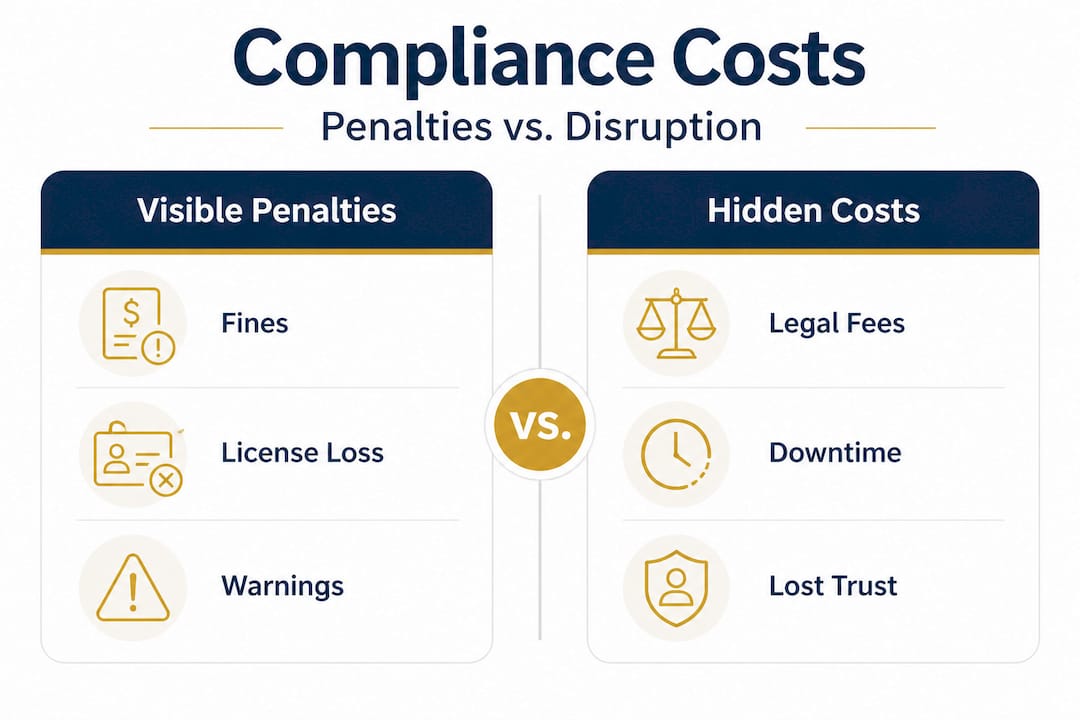
Most business owners think about compliance violations in terms of fines. That's understandable. A penalty notice arrives, you pay it, and you move on. But the real financial damage is far more layered than that single invoice.
Consider what happens after a regulatory agency flags your business. You're suddenly paying legal counsel to respond to the investigation. Your team diverts time and energy from revenue-generating work to manage the audit process. If the violation involves customer data or environmental standards, you face remediation costs. And if the issue becomes public, vendors may pause contracts, clients may look elsewhere, and your pipeline dries up. The hidden costs of non-compliance extend far beyond the fine itself.
The table below separates what most SMBs see from what actually hits the business:
| Visible penalty | Hidden disruption cost |
|---|---|
| Regulatory fine | Legal defense fees |
| License suspension | Lost revenue during investigation |
| Product recall order | Remediation and restocking costs |
| Data breach notification | Customer loss and trust repair |
| Contract breach penalty | Vendor relationship collapse |
| Court judgment | Executive time diverted from operations |
Understanding legal risks for your business requires looking beyond the compliance checklist to the operational fallout that follows a lapse. That's where SMBs consistently underestimate their exposure.
Real SMB scenarios where non-compliance created cascading harm include:
- A retail business ignoring website accessibility legal risks under the Americans with Disabilities Act faced a lawsuit, required site redesign, and lost three months of planned marketing spend to legal costs
- A food service company failing health code compliance triggered a shutdown inspection, forced two weeks of closure, and lost a catering contract worth $40,000
- A small e-commerce store without a proper data handling policy experienced a breach, faced regulatory investigation, and spent over $60,000 in remediation and notification costs
- A consulting firm without up-to-date employment agreements faced an unfair dismissal claim that cost twice the original severance amount in legal fees alone
"Non-compliance is not a one-time setback. It can cascade into legal exposure, remediation costs, lost opportunities, and even business closure."
Getting legal guidance for SMBs at the right time, particularly before a compliance gap becomes a crisis, is the difference between a manageable issue and a business-ending event. Knowing which compliance document types apply to your industry is an important starting point.
Compliance as the backbone of operational and legal integrity
Think of compliance not as a filing task but as the operating system running beneath your business. When it works well, everything else flows smoothly. When it has gaps, processes break down, decisions become legally vulnerable, and stakeholders lose confidence.

Regulators have become more sophisticated in how they evaluate business compliance. As enforcement scrutiny increases, investigators now assess whether governance structures and escalation processes actually function in practice, not just whether policies exist on paper. Having a policy document sitting in a folder is very different from having a compliance system that people use, update, and act on.
This distinction matters enormously for SMBs. Many business owners invest time in creating compliance documents and then move on. But regulators ask harder questions: Was the risk known? Was it escalated? What actions were taken? Without real governance behind the paperwork, even well-intentioned compliance programs can fail under scrutiny.
The comparison below shows the difference between compliance that looks good and compliance that actually holds up:
| Compliance on paper | Compliance in practice |
|---|---|
| Policy manual filed away | Policies reviewed quarterly with team |
| Privacy notice posted on website | Staff trained on data handling procedures |
| Contracts stored in folders | Contracts reviewed before each renewal |
| Safety rules listed in handbook | Safety audits conducted and documented |
| HR policy documented | Incidents logged and consistently escalated |
Business areas significantly shaped by effective compliance include:
- Contracts: Poorly managed contracts expose you to breach claims and unfavorable terms you can't enforce
- Customer trust: Customers research businesses before buying; a compliance failure reported publicly can cost you sales within days
- Vendor relations: Suppliers and partners increasingly require compliance certifications before doing business
- Employment: Labor and wage violations are among the most common and costly compliance failures for growing SMBs
- Data handling: Privacy regulations like GDPR and CCPA impose real obligations, including the requirement to maintain proper privacy policies compliance standards
Following compliance best practices and learning the compliance essentials for your specific business model gives you the foundation to build real operational integrity rather than paper integrity.
Pro Tip: Assign a named person, even if it's you as the owner, as the compliance owner for each key area of your business. Set a quarterly review date on the calendar. Real compliance accountability requires a real name attached to it, not a shared responsibility that everyone assumes someone else is handling.
The link between compliance, security, and customer trust
Data security has become one of the most urgent compliance areas for SMBs. The reason is straightforward: your customers trust you with sensitive information, and regulations now require you to protect it to specific standards. Failing those standards creates legal liability and destroys the customer relationship simultaneously.
Payment security offers one of the clearest examples. PCI DSS, which stands for the Payment Card Industry Data Security Standard, applies to virtually every business that accepts card payments. These aren't optional guidelines. PCI compliance audits verify PCI DSS controls, and noncompliant businesses can face fines of $5,000 to $100,000 per month from card networks and processors. For a small business, even the lower end of that range can be catastrophic.
Beyond the financial penalty, a payment data breach forces you to notify affected customers, cooperate with forensic investigations, and often replace compromised payment infrastructure. The reputational damage from a card data breach tends to outlast the operational recovery by years.
Here are practical steps to strengthen your compliance in security and payments:
- Audit your payment systems annually. Verify that your point-of-sale and online payment tools meet current PCI DSS standards and that any third-party processors you use are also certified compliant
- Map your data flows. Know exactly where customer data is collected, stored, and transmitted within your systems so you can apply the right protections at each point
- Review privacy notices regularly. Regulations like CCPA and state-level privacy laws continue to evolve; your privacy notices should accurately reflect what you collect and why
- Train your team on data handling. Human error is a leading cause of data breaches; staff who understand what to do with sensitive information are your first line of defense
- Use document verification for compliance to confirm that customer-facing agreements and data handling notices meet current legal requirements before they're published or signed
Pro Tip: Use every compliance review as an opportunity to proactively share your security practices with key partners and clients. Telling a major client, "We recently completed our annual PCI audit and updated our data handling policies," signals professionalism and builds the kind of trust that makes relationships stickier and longer lasting.
You can also apply website security compliance tips to protect the digital touchpoints where customers first interact with your business, including your website, login portals, and contact forms.
Not-so-obvious compliance pitfalls: Edge cases and 'boundary' risks
Routine compliance checks cover the obvious territory: annual filings, standard employment practices, recurring vendor contracts. But some of the most damaging compliance failures happen in the gaps, in situations that fall outside your normal workflow and don't trigger your usual review process.
These are called edge cases, and they are exactly where regulators find the most interesting problems. An edge case is a scenario that occurs at the operational boundaries of your business, infrequently enough to fall outside routine checks but consequential enough to create serious exposure when it goes wrong.
As edge case testing in compliance research shows, audit failures often result from inadequate validation of these boundary scenarios, the situations that "probably won't happen" until they do.
"Compliance at the boundaries of your operations is where hidden vulnerabilities tend to cluster. Normal workflow checks won't catch them because, by definition, they don't appear in normal workflows."
Common operational boundary risks that SMBs routinely overlook include:
- New product or service launches: A new product line may trigger different regulatory requirements, industry-specific labeling rules, or additional licensing needs that your existing compliance process never anticipated
- Geographic expansion: Moving into a new state or country brings a different tax regime, employment law framework, and data protection requirement that your current compliance setup may not cover
- Vendor or supplier changes: Swapping a key supplier may affect your supply chain compliance obligations, particularly in food, pharmaceuticals, or electronics where ingredient or component sourcing carries regulatory responsibility
- Rare customer dispute scenarios: An unusual dispute with a customer, such as a refund demand outside normal terms, or a product liability claim on an older product, can expose gaps in your contracts and insurance compliance
- Staff threshold crossings: Crossing employee count thresholds often triggers new obligations under employment law, such as mandatory leave policies, healthcare requirements, or additional reporting duties
- Legacy system use: Running older software that handles payment data or customer records may fall out of compliance with current security standards even if it was compliant when originally deployed
Strategies to identify and close these gaps include reviewing your SMB compliance checklist with edge case scenarios in mind, asking "what if" questions during compliance reviews rather than just verifying standard situations, and documenting the decisions made during unusual events so you have a record of good-faith compliance efforts.
A hard-won lesson: Compliance isn't about paperwork—it's about protecting your future
Here's the uncomfortable truth most compliance articles won't tell you: completing the paperwork is the easy part. The hard part is building a culture where compliance is treated as a living commitment rather than an annual task.
Most SMBs approach compliance reactively. Something goes wrong, or a fine arrives, and suddenly policies get updated. But that reactive cycle means you're always one step behind. The businesses that genuinely protect themselves are the ones that treat compliance as part of how they make decisions every single day, not as a separate administrative function that runs in the background.
From our perspective, working with business owners navigating legal complexity, the biggest gap isn't knowledge. Owners generally know they need contracts, privacy notices, and employment policies. The gap is in verification. They assume that because a policy exists, it's working. They don't check whether staff understand it, whether it's been updated for new regulations, or whether it covers the scenarios that are actually arising in the business.
Effective compliance requires three practical habits. First, track your obligations explicitly. Keep a list of every regulatory requirement that applies to your business and note when each one is due for review. Second, document real decisions, not just policies. When an unusual situation arises, record what happened and what you decided. This documentation becomes your evidence of good governance if a regulator ever asks. Third, verify controls in action by testing them occasionally rather than assuming they work.
If your business is growing across state lines, navigating compliance across regions becomes an added layer of responsibility that requires deliberate planning rather than assumption.
Compliance done well doesn't slow your business down. It gives you a stable foundation from which to grow confidently, take on larger clients, and weather the occasional storm without existential risk.
Stay compliant effortlessly with BXP Legal AI
Keeping up with compliance obligations is genuinely hard when you're running a business at the same time. Regulations change, new requirements emerge, and the documentation needs constant attention.
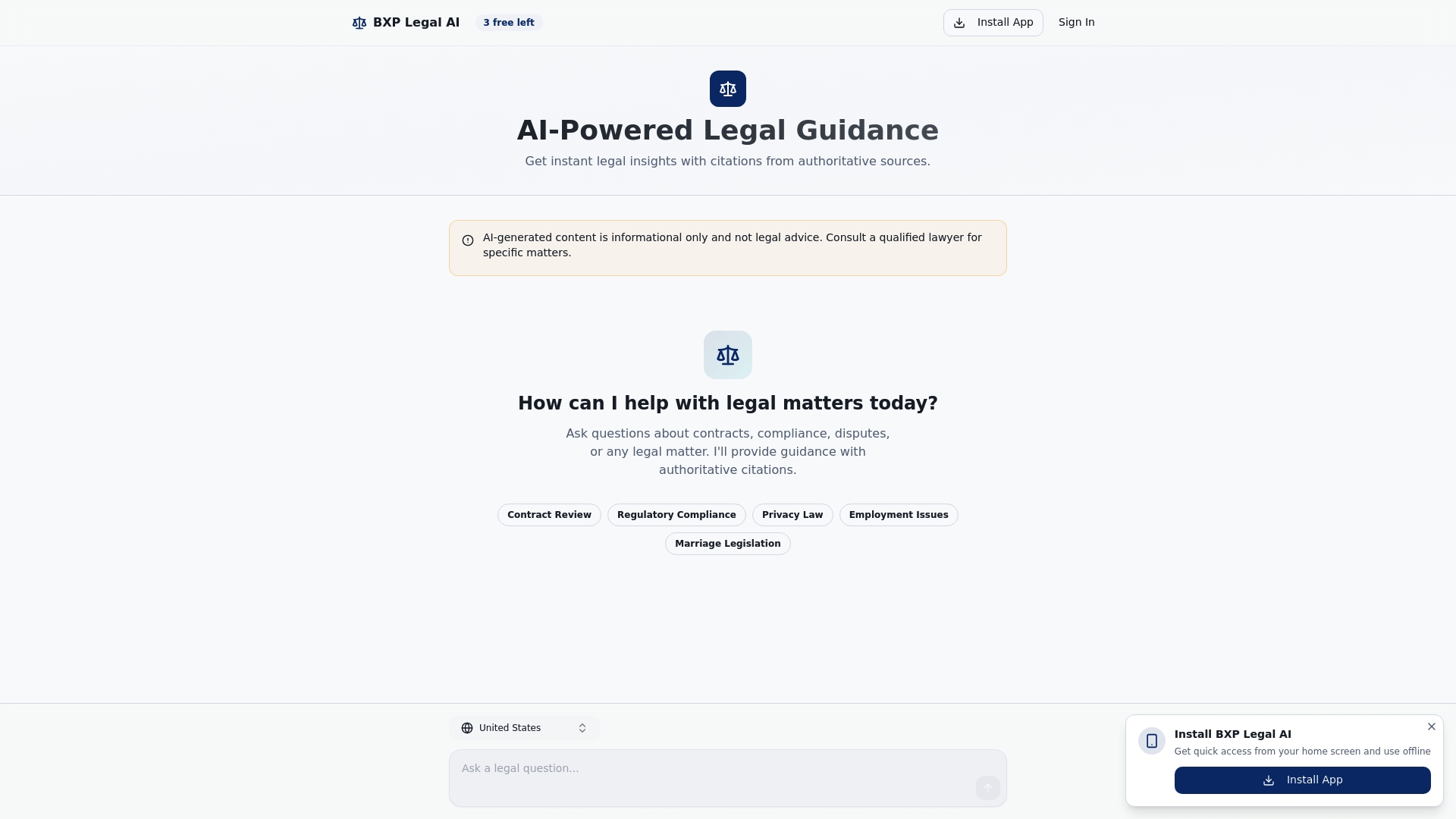
BXP Legal AI is built specifically to help SMBs cut through the complexity. The platform gives you instant AI-powered legal guidance on compliance questions across contracts, privacy law, employment issues, data protection, and more, with every response backed by authoritative citations. You can use BXP Legal AI features to review compliance documents, verify that your policies meet current standards, and flag potential gaps before they become problems. The document comparison tools make it easy to check contracts and compliance documents side by side, saving hours of manual review. For SMBs serious about protecting their operations, BXP Legal AI is practical compliance support available on demand.
Frequently asked questions
What is business compliance and why is it important?
Business compliance means following all laws, regulations, and standards that apply to your company. It's critical because non-compliance triggers fines, legal repercussions, and business closure that can permanently damage your operations.
How can compliance failures affect my reputation with customers?
Compliance failures erode customer trust immediately, especially when they result in data breaches or service disruptions. Because PCI compliance audits verify security controls, failing them signals to customers that their payment data may not be safe.
Do small businesses need dedicated compliance teams?
Most SMBs don't have the budget for dedicated compliance staff, but they should assign specific compliance responsibilities to named individuals and conduct proactive reviews to catch gaps before non-compliance costs multiply into legal and operational crises.
What are 'edge cases' in compliance and why do they matter?
Edge cases are rare or unusual business scenarios that fall outside normal workflows but still carry regulatory risk. Audit failures from edge case gaps are common precisely because businesses only review compliance for situations they expect to encounter.
How does compliance relate to cybersecurity?
Compliance frameworks like PCI DSS establish the security standards that protect customer payment data and reduce breach risk. Businesses that fail these standards face fines of $5,000 to $100,000 per month in addition to the operational and reputational damage from a breach.