
TL;DR:
- Regulatory compliance enhances business growth by building trust and securing contracts.
- Non-compliance costs SMEs five to ten times more than proactive adherence.
- Using tools and advisors makes compliance manageable and turns it into a competitive advantage.
Regulatory compliance gets a bad reputation in the small business world. Most owners see it as a pile of paperwork, a drain on time, and an expense with no clear return. But that framing is backwards. The businesses that treat compliance as a strategic investment rather than a legal obligation routinely outperform competitors, win better contracts, and build stronger customer relationships. For U.S. small and medium-sized enterprises, understanding and following regulatory guidelines isn't just about staying out of trouble. It's one of the most underrated drivers of sustainable growth available to you right now.
Table of Contents
- What are regulatory guidelines, and who do they affect?
- The real costs: Compliance versus non-compliance
- How compliance fuels trust, reputation, and growth
- Balancing the burden: Navigating real-world SME challenges
- From theory to practice: Building compliance into your business
- The uncomfortable truth about regulatory compliance for SMEs
- Get compliance right with smart tools and trusted partners
- Frequently asked questions
Key Takeaways
| Point | Details |
|---|---|
| Compliance minimizes risk | Following guidelines protects your business from costly penalties and damage. |
| Drives trust and growth | Regulatory compliance builds reputation and opens doors to new clients. |
| Proactive is cheaper | Staying ahead on compliance costs far less than facing violations or lawsuits. |
| Smart habits matter | Integrate tracking, documentation, and ongoing learning to keep compliance manageable. |
| Use the right support | Rely on tools and advisors to simplify compliance and reduce your burden. |
What are regulatory guidelines, and who do they affect?
Regulatory guidelines are rules created by government agencies that businesses must follow to operate legally. They exist at the federal, state, and local levels, and they cover nearly every aspect of how a business runs, from how you pay employees to how you store customer data.
These guidelines aren't arbitrary. They're designed to protect workers, consumers, the environment, and fair market competition. Key enforcement agencies include the Occupational Safety and Health Administration (OSHA) for workplace safety, the Internal Revenue Service (IRS) for taxes, the Equal Employment Opportunity Commission (EEOC) for employment discrimination, and state agencies that handle licensing, zoning, and environmental standards.
Where SMEs often get caught off guard is in the sheer variety of regulations that apply simultaneously. A small healthcare practice, for example, might face federal HIPAA rules for patient data, state licensing requirements for practitioners, local zoning rules for the physical location, and employment law obligations for every staff member. Each layer carries its own deadlines and filing requirements.
The SBA mandates staying compliant with federal, state, and local laws through proper filings, tax obligations, and licenses, specifically to help businesses avoid penalties and to support a legal defense or business sale down the road.
Larger corporations often have entire compliance departments to absorb this workload. SMEs rarely have that luxury, which makes understanding essential compliance steps upfront far more valuable. Even something as overlooked as website accessibility laws can trigger liability if your digital presence isn't up to standard.
Here's a quick reference of key regulatory areas and the agencies that oversee them:
| Business area | Key regulation | Enforcement agency |
|---|---|---|
| Employment and payroll | FLSA, FMLA | Department of Labor |
| Workplace safety | OSHA standards | OSHA |
| Data privacy | CCPA, HIPAA | FTC, HHS |
| Tax filing | Federal and state tax codes | IRS, state revenue departments |
| Accessibility | ADA Title III | Department of Justice |
| Environmental | EPA standards | EPA, state agencies |
The businesses that take time to map these obligations early gain an enormous operational advantage. You can't fix what you don't know is broken.
The real costs: Compliance versus non-compliance
Numbers cut through confusion faster than anything else. When SMEs weigh whether to invest in compliance, the math is actually straightforward once you see both sides clearly.
Compliance costs for SMEs typically run 1 to 3 percent of annual revenue. That's a manageable range, especially when treated as part of standard operating costs. Non-compliance, however, costs five to ten times more. HIPAA violations alone can result in fines reaching $1.5 million per violation category. A single data breach at a small medical practice or financial services firm can wipe out years of profit.
The financial burden is also disproportionate. Smaller businesses bear higher compliance costs as a percentage of assets and expenses compared to large enterprises, largely because fixed compliance costs don't scale down with company size.
Here's how the numbers stack up:
| Cost category | Proactive compliance | Non-compliance outcome |
|---|---|---|
| Annual spend | 1 to 3% of revenue | 5 to 10x that figure in fines and fees |
| Data breach response | Preventable | Average $200,000+ remediation cost |
| HIPAA violation fine | Avoided | Up to $1.5 million per category |
| Legal defense | Low (documented processes) | High (reactive legal fees, litigation) |
| Reputational recovery | Not needed | Expensive and often incomplete |
The hidden costs are where SMEs get blindsided. Reputational damage is harder to quantify but arguably more damaging than any fine. Customers who learn a business mishandled their data or violated labor laws don't just leave. They tell others. Lost contracts, difficulty hiring quality talent, and increased scrutiny from regulators are all downstream consequences that compound quickly.
You should use a compliance checklist for SMBs to map your current obligations before the cost of ignoring them shows up on your balance sheet.
Pro Tip: Proactive compliance almost always costs less than reactive fixes. Even a basic compliance audit conducted once a year will identify gaps before they become violations, saving you far more than the cost of the audit itself.
How compliance fuels trust, reputation, and growth
Avoiding a fine is not the same as building a business. That distinction matters, and it's where a lot of compliance conversations go wrong. Regulatory compliance doesn't just protect you from penalties. It actively builds the conditions your business needs to grow.
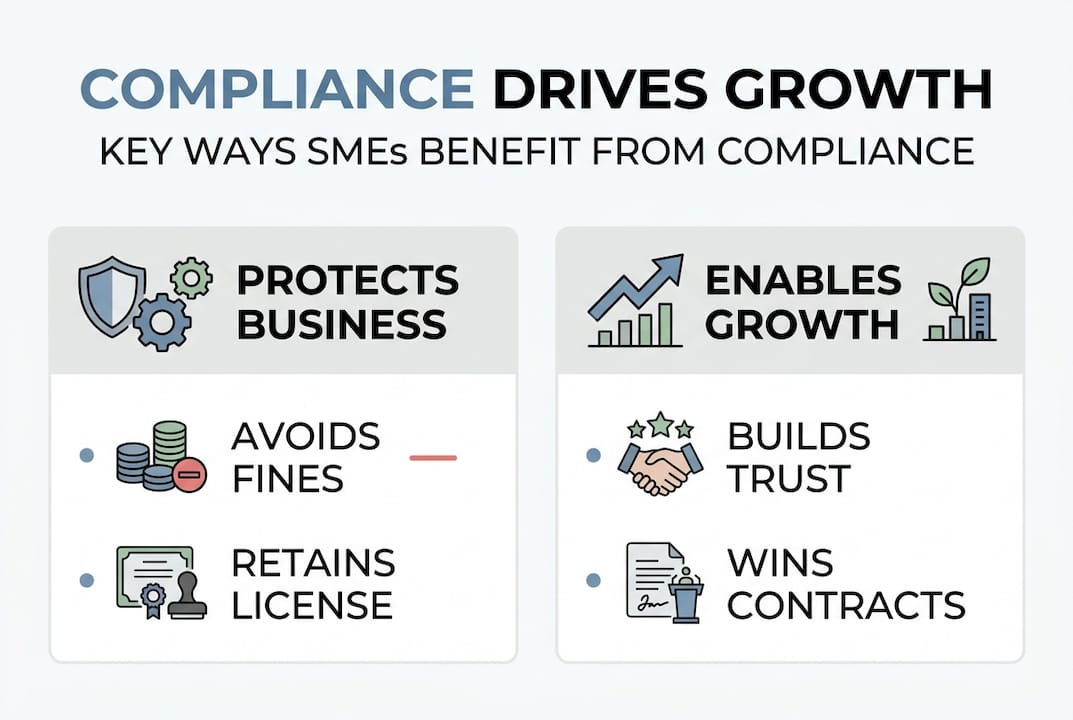
Compliance builds reputation, customer trust, and employee morale, and it opens access to contracts that would otherwise be unavailable, while non-compliance leads to reputational damage and lost opportunities that are difficult and expensive to recover from.

Think about what compliance signals to the market. When a business demonstrates that it follows data privacy rules, handles employment law correctly, and maintains proper licenses, it sends a clear message: this company is trustworthy and professionally managed. That signal matters to customers, especially in B2B relationships. Enterprise clients and government agencies often require proof of compliance before signing contracts. Many RFPs (requests for proposals) include compliance certifications as a baseline requirement.
The legal guidance benefits for SMEs extend well beyond staying out of court. A compliant business is a more attractive acquisition target, a more reliable partner, and a more appealing employer.
Strong privacy compliance and trust practices, for example, directly affect how customers perceive your data handling, especially as privacy concerns grow among consumers across all demographics.
Here are tangible reputation and growth benefits that compliance delivers for SMEs:
- Access to government contracts that require verified compliance status
- Stronger supplier and partner relationships built on demonstrated reliability
- Better financing terms from lenders who see operational discipline as a risk signal
- Higher employee retention because workers feel protected and valued
- Positive online reviews from customers who trust how you handle their data and concerns
- Easier business expansion across state lines or international markets when compliance records are clean
"Treating compliance as a growth driver, not just a legal obligation, changes how every department operates. It becomes a competitive advantage that compounds over time."
The businesses that figure this out early build something rare: a reputation that attracts the right clients, partners, and employees without expensive marketing campaigns. Compliance, done well, is brand equity.
Balancing the burden: Navigating real-world SME challenges
Here's the honest part. Compliance is genuinely hard for small businesses. Regulations change frequently. New rules at the state level often get little media attention until enforcement begins. And for a business owner who is also the operations manager, HR department, and sales team, adding compliance research to the list feels impossible.
Excessive regulations burden SMEs in ways that larger businesses can absorb, partly because prescriptive rules don't adapt to the scale and context of smaller operations. Principles-based regulations that provide flexibility work better for SMEs than rigid, one-size-fits-all mandates.
That said, feeling overwhelmed is not a defense when regulators come knocking. The better approach is prioritization. Not all compliance risks are equal. Some violations carry minor administrative penalties while others can shut your business down. Here's a practical framework for managing compliance without burning out:
- Identify your highest-risk areas based on your industry, size, and the data you handle. Healthcare, finance, and construction have the most regulated environments.
- Start with federal obligations before layering in state and local requirements. Federal compliance creates the foundation.
- Assign internal ownership for compliance tasks, even if that's just one person with a designated checklist and calendar reminders.
- Review compliance best practices specific to your sector at least once a quarter.
- Build a document retention guide into your operations so that records are always available if an audit occurs.
- Use technology to automate deadline tracking, filing reminders, and document storage rather than relying on memory or spreadsheets.
Pro Tip: The goal isn't perfect compliance from day one. It's building systems that catch issues early. A minor violation caught internally and corrected is far less damaging than one discovered by a regulator.
From theory to practice: Building compliance into your business
Sustainable compliance doesn't happen through one-time fixes. It becomes part of how your business operates every day. The difference between businesses that stay compliant and those that drift into violation is usually not knowledge but habit.
Staying compliant with federal, state, and local laws through proper filings, tax obligations, and current licenses protects your ability to defend your business legally and positions it for future sale or expansion.
Knowing what compliance document types your business needs and keeping them current is one of the most cost-effective risk management steps you can take. It's also one of the fastest ways to protect your business from future legal exposure.
Here are the core daily and quarterly habits that keep SMEs on track:
- Track all regulatory deadlines in a shared calendar with assigned owners and buffer reminders two weeks in advance
- Maintain a compliance binder or digital folder that holds licenses, permits, certifications, insurance documents, and HR records
- Review your employment practices at least annually, including onboarding documents, pay practices, and safety training logs
- Monitor industry news for regulatory changes through newsletters from trade associations, legal tech platforms, and government agency updates
- Conduct a simple internal audit once per year to identify gaps, document what you found, and record what corrective actions you took
- Consult advisors proactively, not just in a crisis. An employment attorney reviewed once a year can prevent a costly termination dispute
As your business grows, so does your compliance footprint. Adding employees crosses FMLA thresholds. Expanding to a new state triggers new registration and tax obligations. Accepting payment data adds PCI-DSS requirements. Building compliance review into your growth planning calendar ensures you address these shifts before they become violations.
The uncomfortable truth about regulatory compliance for SMEs
Most compliance advice treats small businesses like miniature versions of corporations. The checklists are too long, the language is too technical, and the frameworks assume resources that most SMEs simply don't have. That's the real problem, and it creates a dangerous gap between what businesses know they should do and what they actually do.
The businesses we've seen navigate compliance successfully don't follow a rigid system. They build a culture where asking legal questions feels normal, where documentation is a habit rather than a punishment, and where outside help is sought early rather than last resort. Compliance isn't a destination. It's an ongoing discipline.
The multi-jurisdictional compliance challenge is a perfect example. Businesses that operate across state lines often underestimate how quickly their obligations multiply. A checklist built for one state fails in another. Adaptability matters more than a perfect manual.
The businesses that thrive don't just check boxes. They cultivate relationships with advisors, stay curious about new rules, and build teams that treat compliance as part of professional identity, not just legal exposure management.
Get compliance right with smart tools and trusted partners
If you're ready to turn compliance from a headache into a competitive edge, here's how BXP Legal AI can help.
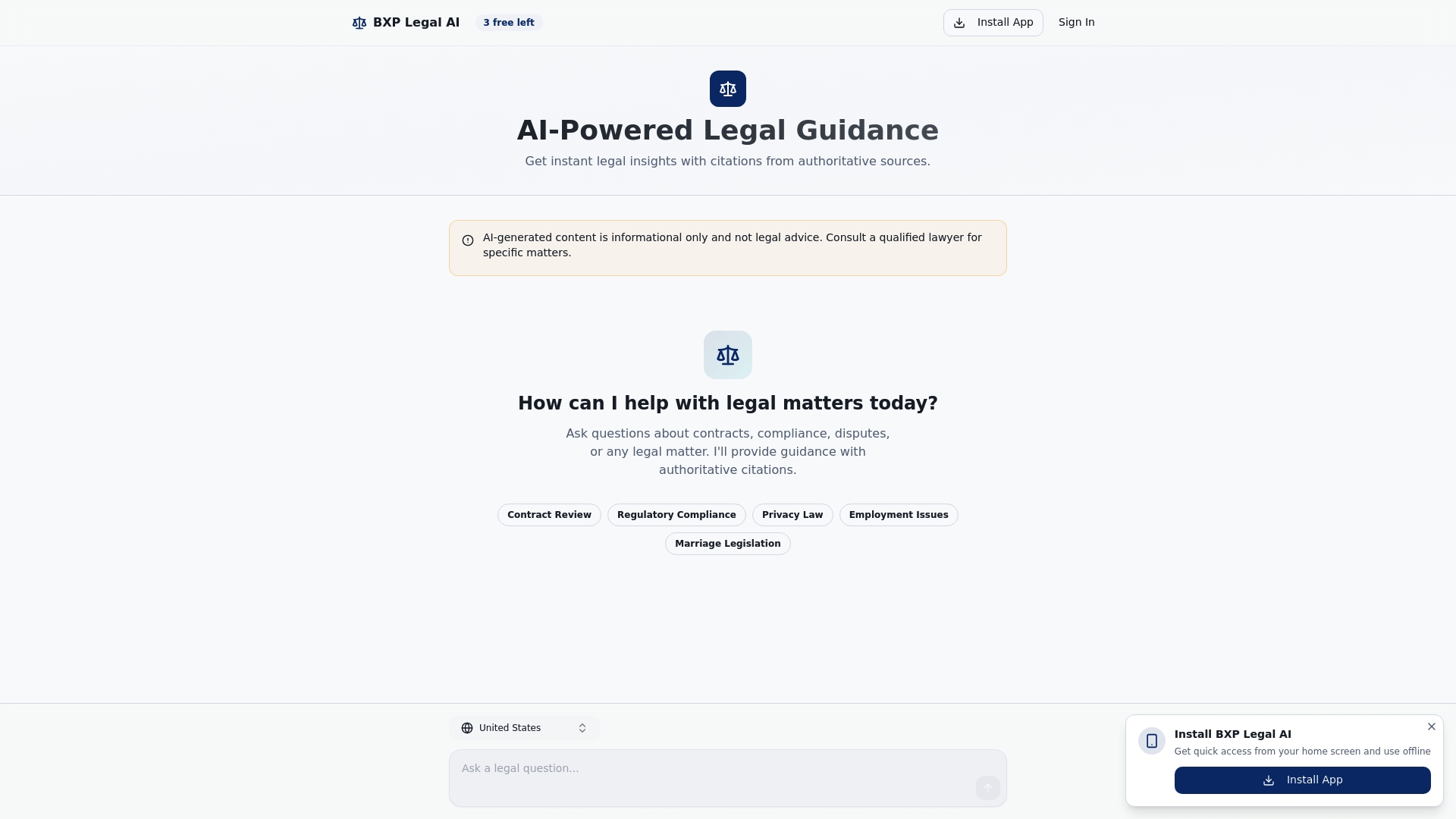
Managing regulatory obligations across employment, contracts, data privacy, and licensing is complex. BXP Legal AI gives SMEs instant access to legal insights across all these domains, with responses backed by authoritative citations. Whether you need to review a contract, research a new regulation, or check your compliance posture before expanding to a new state, the platform's legal AI features are designed for business owners who need clear, fast answers without retaining a law firm for every question. The document comparison tools help you catch inconsistencies and risks before they become costly. It's accessible, efficient, and built for exactly the kind of real-world compliance challenges SMEs face daily.
Frequently asked questions
What are the top penalties for non-compliance?
Top penalties include fines, loss of business licenses, civil lawsuits, and in serious cases, forced business closure. Federal and state laws require proper filings and licensing to maintain legal standing.
How much can compliance cost for an SME annually?
Compliance typically costs SMEs between 1 and 3 percent of annual revenue, which is substantially less than the 5 to 10 times higher cost of non-compliance penalties, breach remediation, and litigation.
Do small businesses really gain new customers through compliance?
Yes. Compliance builds trust and access to contracts and partnerships that would otherwise be unavailable, directly expanding your customer base and revenue opportunities through demonstrated reliability.
How can SMEs keep up with changing regulations?
SMEs should subscribe to trade association updates, work with legal advisors on a recurring basis, and use automated platforms that track regulatory changes and flag relevant updates for their industry and location.
Is it ever OK to cut corners on compliance?
It is never advisable. Even small shortcuts create documented gaps that regulators can act on, and the cost of correcting a discovered violation is almost always far greater than the cost of meeting the requirement from the start.