
TL;DR:
- Proper contract analysis involves thorough preparation, organization, and understanding of key risk areas.
- Use structured review, risk assessment, and technology tools to identify and negotiate problematic clauses.
- Treat contracts as strategic business tools to protect cash flow, reduce liability, and avoid costly disputes.
Picture this: you signed a service agreement six months ago. Business was good, you skimmed the terms, clicked accept. Now your vendor is invoicing you for fees you never expected, citing an automatic renewal clause buried on page nine. Your accountant is on the phone. Your cashflow is bleeding. And your lawyer says fighting it will cost more than just paying up. This scenario plays out for small and medium-sized business owners every single week, and it almost always traces back to one root cause: the contract was never truly analyzed before signing. This guide gives you a practical, repeatable process to change that.
Table of Contents
- What you need before analyzing a contract
- Step 1: Break down the contract structure
- Step 2: Assess key risks and compliance issues
- Step 3: Tools and tech for smarter contract analysis
- Our perspective: Why most SMBs underestimate contract risk
- Take the next step: Get smarter contract analysis
- Frequently asked questions
Key Takeaways
| Point | Details |
|---|---|
| Preparation prevents disputes | Collect all supporting documents and clarify your goals before analyzing contracts to avoid costly mistakes. |
| Structure reveals risks | Breaking down the contract lets you spot hidden risk clauses and compliance gaps. |
| Leverage checklists and AI | Modern tools help streamline contract review, but expert judgment is critical for final decisions. |
| Small details matter most | Even a standard clause can carry huge risks if not reviewed and negotiated carefully. |
What you need before analyzing a contract
Before you read a single clause, you need to set yourself up correctly. Rushing into a contract without the right materials and mindset is like trying to assemble furniture without the instructions or the right tools. You will spend twice as long and still get it wrong.
Gather all related documents first. The contract itself is rarely enough. You need any email correspondence that led to the agreement, previous versions of the contract if this is a renewal, attachments or schedules referenced in the body, and any verbal commitments that were made. Courts and arbitrators often look at the full picture of negotiations, not just the final signed document. Understanding the types of legal documents involved in your agreement helps you know what to collect.
Build your toolkit before you start. Here is what you need on hand:
- A printed or annotated digital copy of the contract with space for notes
- A legal dictionary or online glossary to look up unfamiliar terms immediately
- A contract review checklist tailored to your industry
- A simple spreadsheet or template to log clauses, risk levels, and questions
- Your business objectives written down in plain language
Know your minimum acceptable terms before you start reading. This step is overlooked by almost every SMB owner. Before reviewing a contract, write down the three to five things your business absolutely cannot compromise on. Maybe it is payment timing, intellectual property ownership, or the right to terminate without penalty. Without this clarity, you will read clauses in isolation instead of evaluating them against your actual business needs.
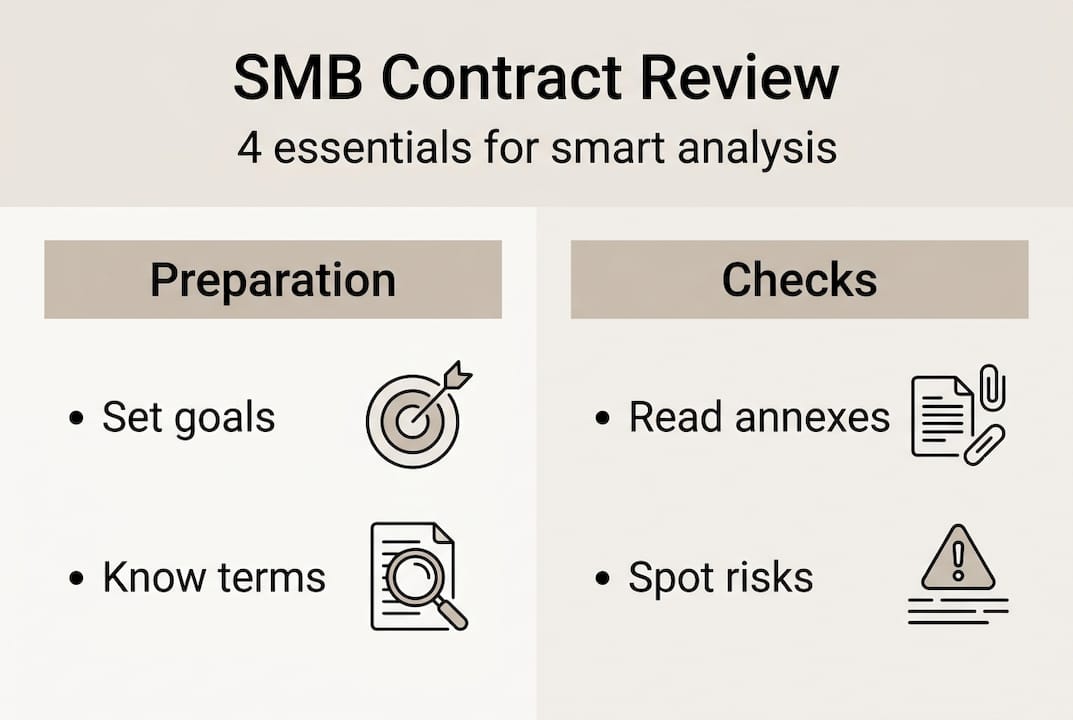
Pro Tip: Never review the main contract body without simultaneously checking its annexes, schedules, and referenced exhibits. These attachments often contain the most commercially important terms, such as pricing, service levels, and limitation amounts, and they are deliberately placed there to reduce scrutiny.
Here is a quick overview of what to organize before your review begins:
| Document type | Why it matters |
|---|---|
| Full contract with all exhibits | Ensures no terms are missed |
| Pre-contract correspondence | Shows intent and any side agreements |
| Industry-standard template | Gives you a baseline for comparison |
| Your business objectives | Keeps your review focused and strategic |
| Prior contract versions | Reveals changes made during negotiation |
B2B disputes average months to resolve and can devastate SMB cashflow, which is exactly why thorough preparation before signing is worth every minute.
Step 1: Break down the contract structure
With your materials gathered, the first task is getting a clear overview of what is inside the contract. Most business owners read contracts linearly, like a novel. That is a mistake. Contracts are reference documents, not narratives. You need to map the structure first, then go deep.
Create a simple section outline. Every well-drafted contract follows a rough structure. Write it out before you read in detail:
- Definitions section: Lists and explains key terms used throughout. Read this first because every other section depends on it.
- Parties and recitals: Confirms who is bound by the contract and why it was formed.
- Obligations of each party: Describes what each side must do, by when, and to what standard.
- Payments and pricing: Covers amounts, schedules, penalty clauses, and adjustment rights.
- Liability and indemnity: Caps, exclusions, and who bears the cost of what goes wrong.
- Termination rights: How either party can exit, under what conditions, and with what notice.
- Dispute resolution: Whether disputes go to court, arbitration, or mediation, and in which jurisdiction.
Use a comparison table to quickly spot risk. Not all contract sections are created equal. Some are standard. Others are genuinely dangerous for SMBs if left unchallenged.
| Contract section | Typical version | High-risk version |
|---|---|---|
| Payment terms | Net 30 days | Net 90 days with right to withhold |
| Liability cap | Capped at contract value | Uncapped or exceeds contract value |
| Termination | 30-day notice for either party | Only vendor can terminate; buyer locked in |
| Renewal | Opt-in renewal required | Auto-renews unless written notice given 90 days prior |
| Dispute resolution | Mutual jurisdiction choice | Fixed to vendor's home jurisdiction only |
| Intellectual property | You retain your IP | All work product assigned to vendor |
Annotate as you go. Use color coding or a simple system. Green means the clause is fine. Yellow means it needs a closer look or a question. Red means it is a problem that needs to be negotiated or escalated. This gives you a visual map of where the real issues are before you spend time drafting questions.

When you encounter unexplained legal jargon, stop immediately. Look it up. Avoiding unclear terminology is especially important in cross-border contracts where terms can have different legal meanings across jurisdictions. Do not assume you know what a term means based on its common usage.
Your review checklist for structure should include a line for every major section so nothing gets skipped, no matter how "standard" it looks.
Pro Tip: Flag every blank field, undefined reference, and section marked "to be agreed." These are not minor oversights. They are open doors to future disputes because both parties can later claim the term meant something different.
Contract disputes average months to resolve, and the ambiguity baked in at signing is usually what makes them last so long.
Step 2: Assess key risks and compliance issues
Once sections are outlined, focus on the clauses that most impact your risk and legal obligations. This is where most SMB owners stop being curious and start assuming everything is fine. That assumption is expensive.
Watch out for these high-risk clause types:
- Automatic renewal clauses: These lock you in for another term, often with a short opt-out window. If you miss the deadline, you are committed regardless of your business circumstances.
- Broad indemnity clauses: These can require you to cover the other party's legal costs and damages for events that are only loosely connected to your obligations.
- Liability exclusions that only protect one side: If the contract limits the vendor's liability but not yours, that is not a balanced agreement.
- Unilateral amendment rights: Some contracts allow the other party to change terms with minimal notice. This is a major red flag.
- Jurisdiction clauses that favor the other party: Being forced to resolve disputes in another state or country can price you out of justice entirely.
Run a compliance check before finalizing your review. Depending on your industry and geography, contracts may need to address:
- Data privacy obligations (such as how customer data is stored and processed)
- Industry-specific regulations (healthcare, finance, construction, and food service all have distinct requirements)
- Required disclosures to consumers or regulators
- Territory restrictions and export controls if you operate across state or national lines
Understanding the broader legal risk pitfalls for your business type makes this step far more targeted. A solid compliance checklist gives you a systematic way to verify nothing important has been missed.
Warning: The hidden cashflow impact of contract disputes is almost always larger than what SMB owners expect. Attorney fees, lost productivity, delayed payments, and damaged vendor relationships compound quickly. Dispute resolution cycles average months even for straightforward cases. A clause reviewed in 20 minutes today could save you six months of stress and thousands of dollars later.
The key is not just identifying which clauses concern you, it is documenting your concerns clearly so you can negotiate with specifics, not just feelings. Write down the clause, the page number, what it means in plain language, and what you want changed. That documentation becomes your negotiation roadmap.
Step 3: Tools and tech for smarter contract analysis
To further streamline analysis and safeguard against human error, consider leveraging modern tech solutions. Contract review is time-consuming, and human attention is finite. Technology does not replace good judgment, but it does extend it.
Here is what modern contract analysis technology actually does:
- AI-powered clause scanning: Identifies non-standard clauses, flags language that deviates from market norms, and highlights terms that carry elevated legal risk.
- Document comparison tools: Instantly compares two versions of a contract to show what changed between drafts. This is invaluable during negotiation rounds.
- Automated checklists: Ensures that every review covers the same ground every time, regardless of who is doing the review.
- E-signature tracking: Records who signed, when, and whether any version changes happened post-execution.
- Clause libraries: Let you compare specific clauses against pre-approved or standard language your business has used before.
Understanding how AI legal tools work helps you choose the right solution for your review process.
| Feature | What it does | Best for |
|---|---|---|
| Clause risk flagging | Highlights non-standard or risky terms | Initial review pass |
| Document comparison | Shows changes between contract versions | Negotiation tracking |
| Automated checklists | Ensures consistent review process | Teams reviewing multiple contracts |
| Jurisdiction detection | Identifies governing law and dispute clauses | Multi-state or international agreements |
| Export and reporting | Creates a risk summary for decision-makers | Internal approval processes |
When technology helps most:
- Reviewing large volumes of contracts quickly
- Checking for consistency across a portfolio of vendor agreements
- Comparing redlined drafts during active negotiations
- Training staff on what to look for in standard agreements
When human review is still essential:
- Negotiating specific terms with commercial and legal implications
- Interpreting how a clause interacts with applicable law in your jurisdiction
- Evaluating whether risks are acceptable given your specific business context
- Signing off on any contract above a meaningful financial threshold
Disputes cost SMBs time and money that most cannot afford to lose, and tools that catch problems earlier in the process pay for themselves quickly.
The smartest approach is to use technology for the scanning and flagging work, then bring focused human attention to the issues that technology surfaces. That combination is faster, cheaper, and more reliable than either approach alone.
Our perspective: Why most SMBs underestimate contract risk
Here is an uncomfortable truth: most SMB owners do not fail at contract analysis because they lack intelligence. They fail because they treat contracts as formalities rather than business tools.
The conventional wisdom is that contracts are legal documents for lawyers. So SMBs sign them, file them away, and forget about them until something goes wrong. By then, the damage is done. The clause that seemed harmless when you signed it is now being used against you, and you have no leverage because you already accepted it.
What we have observed across patterns of SMB disputes is that the riskiest contracts are not the obviously aggressive ones. Those, at least, raise red flags. The riskiest contracts are the ones that look standard but contain one or two clauses that silently shift enormous risk onto the smaller party. An auto-renewal clause with a 90-day notice window. An indemnity clause with no carve-out for the vendor's own negligence. A dispute resolution clause that requires arbitration in a city 2,000 miles away.
Every clause, even the ones labeled "standard" or "boilerplate," was written by someone who had a specific goal in mind. SMBs that invest in legal guidance early in the contracting process consistently fare better when disputes arise, not because they avoided all risk, but because they understood what they were agreeing to.
Our perspective is this: contract review is one of the highest-leverage activities in your business. A two-hour review of a two-year vendor contract can shape your cashflow, your liability exposure, and your operational flexibility for the entire term. Treat it accordingly.
Pro Tip: Use contract review as a negotiation tool, not just a compliance exercise. When you identify a one-sided clause, you have a legitimate basis to request a change. Many vendors will adjust standard terms when asked by a prepared, informed buyer. The worst answer you can get is "no."
B2B dispute cycles average months even after both parties are ready to resolve. Prevention is not just smarter. It is dramatically cheaper.
Take the next step: Get smarter contract analysis
If the steps in this guide feel like a lot to manage on your own, you are not alone. Most SMB owners are not lawyers, and they should not have to become ones just to protect their businesses. That is exactly the gap BXP Legal AI was built to close.
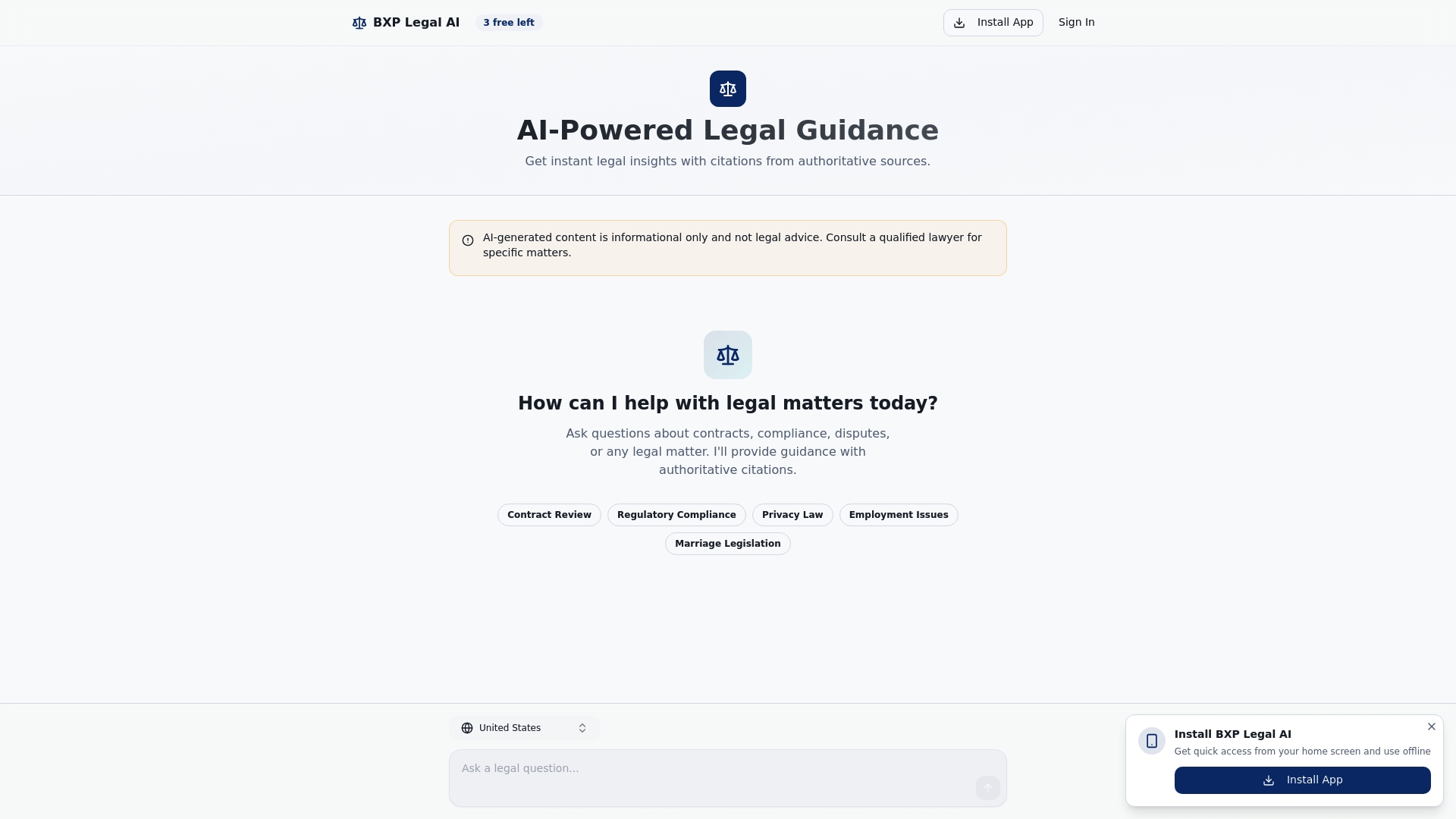
BXP Legal AI gives you access to AI-powered legal features designed specifically for business owners who need fast, reliable contract guidance without the cost of a full legal team. From clause-by-clause risk analysis to document comparison tools that track changes across contract versions, BXP puts professional-grade analysis within reach for any SMB. You get structured checklists, plain-language explanations of complex terms, and AI guidance backed by authoritative legal sources, so you can review contracts with confidence and negotiate from a position of knowledge.
Frequently asked questions
How do I know if a legal contract is fair?
Compare its terms against industry-standard agreements, check that obligations run both ways, and have any clause you do not fully understand reviewed independently before signing.
What is the most important clause to review in a contract?
Liability limitations and termination rights carry the most financial risk for SMBs and deserve the closest attention during any contract review.
Can AI tools fully replace a lawyer for contract analysis?
AI tools are excellent for identifying red flags and flagging non-standard language, but complex contract disputes and high-value agreements still require qualified legal counsel for interpretation and negotiation.
How can I avoid ambiguous language in contracts?
Require definitions for every technical or unusual term, flag any vague phrasing for clarification before signing, and use resources on avoiding terminology errors to keep cross-border agreements precise and enforceable.