
TL;DR:
- Legal informatics combines law and information science to improve legal data organization, retrieval, and analysis using technology. It provides small businesses with accessible, efficient tools for legal research, contract review, and compliance, supported by AI and automation. A hybrid approach that leverages AI's strengths while maintaining human oversight offers the most reliable and effective legal workflows today.
Law has a reputation for being slow, paper-heavy, and impenetrable. But that reputation is increasingly outdated. Legal informatics is the field that sits at the intersection of law and information science, applying technology to how legal information is stored, retrieved, and used. For small business owners and individuals navigating contracts, compliance, or disputes, understanding legal informatics is no longer optional knowledge reserved for law firms. It is the key to working smarter, spending less, and making better decisions with legal information every day.
Table of Contents
- What is legal informatics? Key concepts explained
- How AI and technology power modern legal informatics
- Core methodologies: How legal informatics works under the hood
- Limits and challenges: Bias, privacy, and the boundaries of legal AI
- Benchmarks and practical outcomes: What does legal AI achieve today?
- Why a hybrid approach beats pure AI in legal work
- Take the next step in legal informatics for your business
- Frequently asked questions
Key Takeaways
| Point | Details |
|---|---|
| Legal informatics defined | It means using technology to organize, access, and manage legal information efficiently. |
| AI powers efficiency | AI tools now automate legal research, document drafting, and workflow, saving hours and cutting errors. |
| Human oversight required | Despite automation, expert review remains essential for dealing with nuance and legal ethics. |
| Understand tool limitations | Current AI excels at summarizing and organizing but struggles with complex reasoning or ambiguity. |
| Adopt hybrid solutions | Combining human judgment with AI delivers the most reliable and safe legal outcomes. |
What is legal informatics? Key concepts explained
Let's start with the basics. "Informatics" is the science of organizing and analyzing information using computers and digital systems. When you apply that thinking to the legal world, you get legal informatics.
According to HandWiki, legal informatics is an area within information science that applies informatics to the legal environment, covering the organization, storage, retrieval, and dissemination of legal information using technology in places like law offices, courts, and law schools. That's a formal definition, but here's what it means for you: instead of spending hours digging through binders of case law or guessing at contract language, technology does the heavy lifting.
"Legal informatics connects legal professionals to the digital landscape through technology and AI, improving accessibility to information, efficiency in justice administration, legal databases, and AI-aided decision-making and research."
For small and medium-sized businesses (SMBs), this matters enormously. Legal costs are one of the biggest barriers to getting proper guidance. When technology makes legal information searchable, analyzable, and instantly accessible, businesses can research their own issues, draft initial documents, and flag compliance risks before they become expensive problems.
The core benefits of legal informatics for non-lawyers include:
- Accessibility: Find relevant statutes, case law, or regulatory requirements in minutes rather than days.
- Efficiency: Automate repetitive tasks like contract review, deadline tracking, or document formatting.
- Better research: AI supports legal research by surfacing relevant precedents and summarizing lengthy documents quickly.
- AI decision support: Get structured analysis of contracts or compliance scenarios with data-backed insight.
However, these benefits come with real challenges too. Bias in training data can skew AI recommendations. Cybersecurity risks threaten sensitive legal documents. Privacy concerns emerge when personal or business data is processed by third-party tools. Understanding both the upside and the risks is what separates smart adopters from those who learn the hard way.
How AI and technology power modern legal informatics
Understanding the concepts is just the start. Here's how technology, and especially AI, is transforming how everyday people and businesses interact with the law.
Legal technology tools now support a wide range of functions, from case retrieval and question answering to document management, storage, analysis, summarization, drafting, workflow automation, and eDiscovery. For SMBs, this translates into a practical toolkit that was previously only available to large law firms with dedicated legal departments.
| Task | Traditional method | AI-enabled method |
|---|---|---|
| Legal research | Manual review of databases, hours of reading | Automated case retrieval with ranked relevance scores |
| Contract drafting | Attorney-drafted from scratch | AI-assisted templates with clause suggestions |
| Document review | Line-by-line human review | Bulk AI summarization and flagging of key terms |
| Compliance monitoring | Scheduled manual audits | Real-time regulatory alerts and change tracking |
| eDiscovery | Manual document sorting | AI-powered classification and relevance ranking |
Here's a practical example of how a small business owner could use legal informatics today. Suppose you're renewing a vendor contract and want to understand whether an indemnification clause puts you at unusual risk.
- Upload the contract to an AI-enabled legal tool.
- The AI identifies the indemnification clause, compares it against standard language, and flags deviations.
- The tool provides a plain-English summary explaining the risk.
- You review AI in document drafting resources to understand how to propose alternative language.
- You enter negotiations better informed, potentially saving thousands in attorney fees for routine review.
The same process applies to lease agreements, employment contracts, non-disclosure agreements, and more. And for recurring documents, document automation workflows can systematize the entire process, cutting turnaround from days to minutes.
Pro Tip: Never rely solely on a generic AI-generated template without reviewing it for your specific jurisdiction and situation. Templates are a powerful starting point, but local laws, industry-specific regulations, and the unique facts of your case always require a human check.
Core methodologies: How legal informatics works under the hood
But what actually powers these tools beneath the surface? Here's an easy-to-follow look at how legal informatics really works.
Legal AI tools are built on several core methodologies in legal informatics, including rule-based systems, machine learning, deep learning using transformer models, and natural language processing (NLP) techniques. Each approach has distinct strengths.
Rule-based systems follow explicit "if-then" logic written by legal experts. If a contract contains the phrase "unlimited liability," flag it. These are reliable and explainable, but rigid. They struggle with paraphrasing or novel language.
Machine learning models learn patterns from large datasets of legal text. They can predict outcomes, classify document types, or identify risky clauses without being explicitly programmed to do so. The tradeoff is that they can inherit biases present in their training data.

Natural language processing (NLP) enables computers to read and understand text the way humans do, using techniques like named entity recognition (NER), relationship extraction, and event detection. NER, for example, can automatically identify parties, dates, and monetary amounts within a contract.
Knowledge graphs and ontologies add another layer. Legal ontologies, such as the Legal Knowledge Interchange Format (LKIF), create structured maps of how legal concepts relate to each other, helping AI systems reason about law rather than just match keywords.
| Analysis type | Human strengths | AI strengths |
|---|---|---|
| Ambiguity interpretation | High: contextual judgment | Low: tends to flatten nuance |
| Speed of document review | Low: hours per document | High: seconds per document |
| Consistency across volume | Moderate: fatigue affects accuracy | High: uniform across large datasets |
| Novel legal argument creation | High: creative reasoning | Low: limited to patterns in training data |
| Citation network analysis | Low: time-intensive | High: automated and scalable |
Understanding AI legal tools explained can help you pick the right tool for the right job. Not every AI system uses the same approach, and the methodology matters depending on your use case.
Pro Tip: Hybrid systems that combine rule-based logic with machine learning tend to produce the most reliable results for legal analysis. Pure AI approaches can be creative but inconsistent. Pure rule-based approaches are consistent but brittle. The combination handles both routine and unusual cases better, and it's worth asking any legal AI vendor which approach their tool uses. You should also strengthen your foundation by studying legal research techniques so you can evaluate AI outputs critically.
Limits and challenges: Bias, privacy, and the boundaries of legal AI
While these advancements sound promising, it's important to recognize where legal informatics faces real-world hurdles.
Legal AI is not infallible. One of the most nuanced critiques is that AI struggles with legal uncertainty, particularly with long-distance coreferences in legal documents, metadata versus content analysis (which can introduce hallucinations or break chain of custody), doctrinal ambiguity, and the ethical dimensions of bias and privacy. In other words, AI handles clear-cut rules well but stumbles when the law is deliberately vague, evolving, or contested.
"AI smooths over legal conflicts, fails to detect doctrinal splits, and struggles with vagueness in law resisting formal specification. Human oversight is essential for indeterminate legal situations."
This is not a reason to avoid legal AI tools. It is a reason to use them with your eyes open. Here's a checklist of what to consider before adopting any legal AI platform:
- Data privacy: Does the platform encrypt your documents? Where is your data stored? Who has access?
- Bias transparency: Has the tool been tested for bias across different demographic groups or legal jurisdictions?
- Explainability: Can the tool explain why it flagged something, or does it just give you an answer without reasoning?
- Jurisdiction awareness: Does it account for the specific laws in your state or country, not just federal or general rules?
- Human review provision: Does the provider recommend or require attorney sign-off for high-stakes outputs?
- Update frequency: Legal regulations change constantly. How often is the AI model retrained on updated legal data?
Legal research automation tools that are built transparently and that clearly disclose their limitations are far more valuable than those that promise certainty where none exists. The law rarely offers certainty. Any tool that claims otherwise is overselling itself.
Benchmarks and practical outcomes: What does legal AI achieve today?
With those risks in mind, let's look at the real-world results. What can users actually expect from today's legal informatics tools?
Researchers have developed a set of standardized tests to measure how well legal AI performs across different tasks. Benchmarks like LegalKit, LexEval, and LegalBench test AI models on 23 or more distinct legal tasks using thousands of sample questions drawn from real legal scenarios. The results are revealing.
What AI does well today:
- Document summarization: Top models like GPT-4o score approximately 4.3 out of 5 on summarization tasks. That's genuinely useful for condensing long contracts or regulatory filings.
- Named entity recognition: AI identifies parties, dates, and key terms with high accuracy in standard document formats.
- Classification: Sorting documents into categories (lease vs. purchase agreement, for example) is fast and reliable.
Where AI still falls short:
- Legal retrieval: AI models score as low as 18% on complex case retrieval tasks requiring nuanced reasoning about applicable law.
- Multi-step reasoning: Connecting multiple statutes, precedents, and facts to reach a well-reasoned conclusion remains largely a human strength.
- Detecting jurisdictional splits: When two courts have ruled differently on the same issue, AI often picks one without flagging the conflict.
| Legal task | AI performance level | Practical takeaway |
|---|---|---|
| Document summarization | High (~4.3/5) | Use AI confidently for initial review |
| Named entity recognition | High | Reliable for identifying parties and dates |
| Legal retrieval (complex) | Low (~18%) | Verify manually; do not rely solely on AI |
| Multi-step legal reasoning | Moderate to low | Use AI as a starting point, not a final answer |
| Compliance classification | Moderate to high | Useful with human oversight for edge cases |
The practical advice: use AI to draft legal documents and organize large volumes of information, but bring in a qualified attorney when you face novel legal questions, significant financial stakes, or situations where the law is genuinely unsettled.
Why a hybrid approach beats pure AI in legal work
After looking at all the evidence, the picture is clear: legal informatics is genuinely transformative, but the conversation around it tends to collapse into two camps. One side says AI will replace lawyers entirely and that automation solves everything. The other dismisses legal AI as a gimmick that can't be trusted. Both positions are wrong, and both cost you money.
The contrasting views within legal informatics are well-documented: optimists point to real efficiency gains and broader access to justice, while cautious voices rightly note that AI flattens legal vagueness, can embed systemic bias, and requires human oversight for genuinely indeterminate situations. The evidence-based answer is to prefer hybrid symbolic and statistical methods for reliability.
What does that look like in practice? It means using AI to do what it genuinely does well: scan documents quickly, surface relevant information, and generate first drafts. Then you, or a legal professional, apply the contextual judgment, ethical reasoning, and creative interpretation that AI simply cannot replicate.
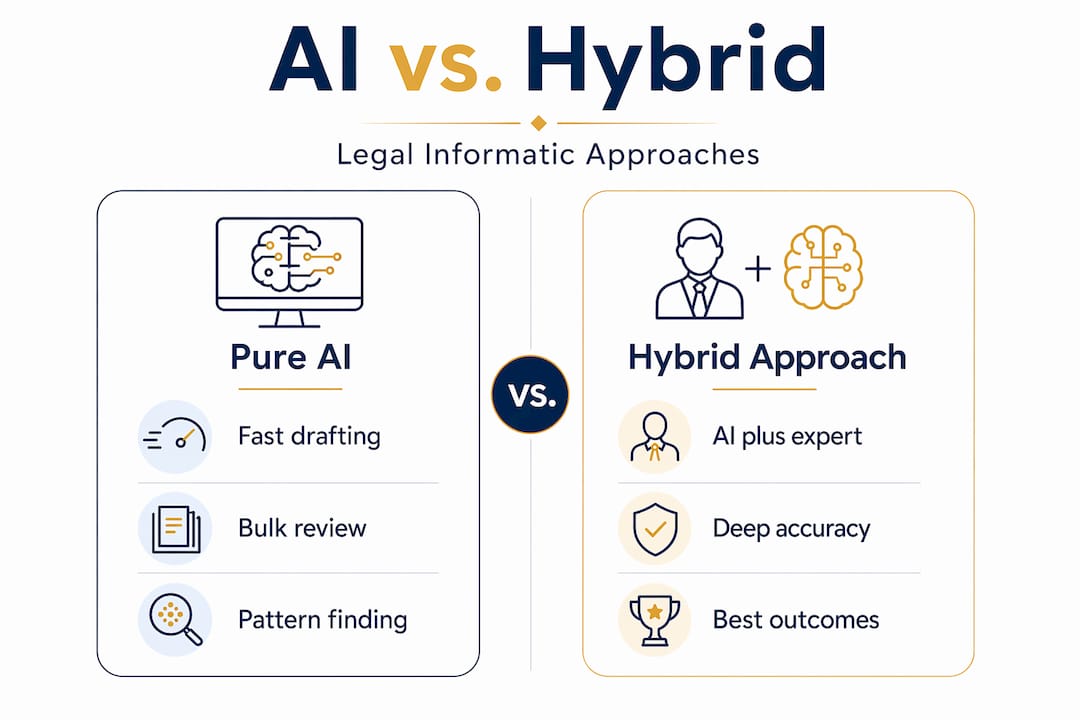
Think of it like a skilled contractor who uses power tools for speed but still applies craftsmanship for precision. The tools don't replace the expertise. They extend it. When you use AI research efficiency tools as a first pass and then review the output with critical thinking, you get better results than either pure human research or pure AI output alone.
The businesses that will get the most out of legal informatics are not the ones that trust AI blindly or reject it outright. They are the ones that build a disciplined practice of using AI for volume and speed, while reserving human judgment for complexity and consequence.
Take the next step in legal informatics for your business
Ready to put these insights into action? Here's how to get started with legal informatics solutions tailored to your needs.
BXP Legal AI is built specifically for individuals and SMBs who need fast, reliable legal guidance without the friction and cost of traditional law firms. Whether you're researching compliance requirements, reviewing a contract, or navigating a dispute, the platform brings AI-powered insights together with authoritative citations so you can act with confidence.
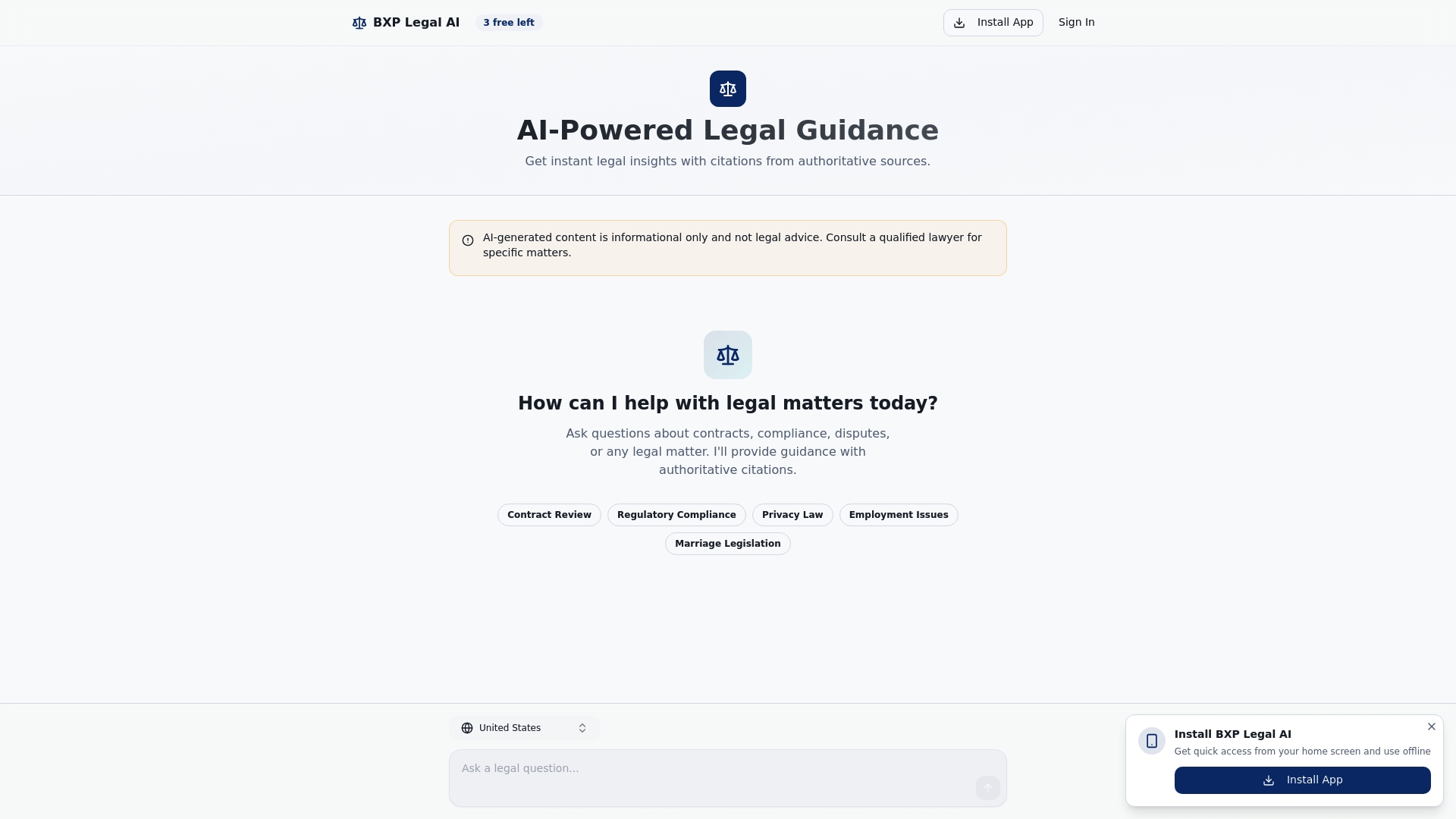
Explore the full suite of BXP Legal AI features, including contract review tools, multi-jurisdictional research, document drafting assistance, and regulatory compliance guidance. Every feature is designed around the hybrid principle this article champions: AI does the heavy lifting, and you stay in control of the decisions that matter. Start a session today and experience how legal informatics works when it is built around your real-world needs.
Frequently asked questions
What is legal informatics in simple terms?
Legal informatics is the use of technology to organize and access legal information, making legal processes more efficient and user-friendly for both professionals and everyday people.
How does legal informatics benefit small businesses?
Small businesses gain faster legal research and drafting capabilities, better document management, and accessible compliance tools that save time and reduce costly errors.
Can AI fully replace lawyers in legal informatics?
No. While AI automates many tasks effectively, human oversight remains essential because AI flattens legal vagueness, embeds bias, and cannot handle genuinely indeterminate legal situations.
Are legal informatics tools secure and private?
They offer strong protections when built responsibly, but users must carefully evaluate each platform for cybersecurity and privacy risks, especially when handling sensitive business or personal information.
What are the best practical uses of legal informatics today?
Document drafting, summarization, and compliance monitoring are the most reliable current applications, with AI tools supporting research and workflow automation for SMBs and individuals alike.