
TL;DR:
- Mediation offers a faster, private, and often more effective alternative to courtroom disputes for small businesses and individuals.
- It involves a neutral mediator facilitating voluntary agreements, with high success rates and significant cost savings.
- Legal agreements from mediation are enforceable, making it a practical and confidential way to resolve conflicts efficiently.
Most people assume that when a legal dispute gets serious, the only path forward is a courtroom. Hiring attorneys, filing motions, waiting months or years for a hearing, and airing private business in a public record. That assumption is costly, and for most disputes, it is simply wrong. Mediation offers a faster, private, and often more effective route to resolution. Whether you are a small business owner dealing with a contract disagreement or an individual navigating a personal conflict, understanding how mediation works in a legal context can save you significant time, money, and stress.
Table of Contents
- What is mediation in law?
- The mediation process: Step-by-step overview
- Success rates, outcomes, and legal enforceability
- Mediation vs. arbitration and litigation: Key differences
- Advanced mediation techniques and why mediation fails
- Our take: The real impact of mediation for small businesses and individuals
- Explore mediation tools and legal support with BXP Legal AI
- Frequently asked questions
Key Takeaways
| Point | Details |
|---|---|
| Mediation is confidential | Communications during mediation are private and protected, ensuring sensitive details don't reach public record. |
| High success rates | Mediation resolves 70-85% of disputes, saving both time and money compared to litigation. |
| Enforceable agreements | Signed mediation settlements are legally binding and can be upheld in court. |
| Faster, lower-cost outcomes | Disputes are resolved in days, not years, and can save thousands in legal fees. |
| Best for preserving relationships | Mediation emphasizes cooperation and privacy, making it ideal for business and personal conflict resolution. |
What is mediation in law?
Mediation is a structured process where a neutral third party, called a mediator, helps disputing parties reach a voluntary agreement. Unlike a judge or arbitrator, the mediator does not decide who wins. The mediator facilitates communication, identifies common ground, and helps both sides work toward a solution they can both accept.
In legal terms, mediation falls under the broader umbrella of alternative dispute resolution, often abbreviated as ADR. It applies across a wide range of dispute types, including:
- Contract disputes between businesses or vendors
- Employment conflicts such as wrongful termination or workplace harassment claims
- Landlord and tenant disagreements
- Partnership disputes among business co-owners
- Family law matters such as divorce settlements or custody arrangements
- Consumer complaints involving product or service failures
One of the most critical advantages of mediation is confidentiality. As JAMS explains, mediation communications are privileged and inadmissible in court, except for issues like fraud. This means what you say during mediation cannot be used against you if the case later goes to court. That protection encourages honest conversation and creative problem-solving that rarely happens in formal legal proceedings.
"Mediation gives parties the freedom to speak candidly without fear that their words will become evidence. That openness is often what makes resolution possible."
For small business owners especially, that privacy is invaluable. A public lawsuit can damage your reputation even if you win. Mediation keeps the dispute, and its resolution, out of the public record. For efficient legal dispute resolution, mediation is frequently the smartest first step.
The mediation process: Step-by-step overview
With a clear picture of mediation's purpose, let's break down its step-by-step process and what actually happens during a session. Knowing what to expect removes a lot of the anxiety people feel about entering a mediation.
According to Harvard's Program on Negotiation, the standard mediation sequence includes these core stages:
- Opening by the mediator. The mediator sets ground rules, explains their neutral role, and outlines the process. This stage establishes trust and structure.
- Opening statements. Each party explains their perspective without interruption. This is not argument; it is storytelling. Each side gets heard.
- Joint discussion. Both parties explore the issues together, often discovering that they share more common ground than they expected.
- Private caucuses. The mediator meets separately with each party to discuss concerns, explore options, and assess flexibility. This is where real negotiation often happens.
- Shuttle diplomacy. The mediator carries offers, counteroffers, and ideas between the parties to move toward an agreement.
- Settlement agreement. If consensus is reached, the parties draft and sign a written agreement, which then becomes legally binding.
Here is a quick comparison of how mediation stacks up against litigation on time and cost:
| Factor | Mediation | Litigation |
|---|---|---|
| Average duration | 1 day to a few weeks | 1 to 2.5 years |
| Average cost | $3,000 to $10,000 | $20,000 to $100,000+ |
| Privacy | Fully confidential | Public record |
| Control over outcome | High (parties decide) | Low (judge decides) |
| Relationship preservation | Strong | Often damaged |
Pro Tip: Before your mediation session, prepare a one-page summary of your key facts, your ideal outcome, and your walk-away position. Review any relevant contracts or communications. If you have done solid legal research ahead of time, you will walk in with confidence rather than confusion. Also consider consulting legal experts before the session to clarify your legal position without committing to full litigation.
Preparation genuinely changes outcomes. Parties who show up organized and realistic about their position reach settlements far more often than those who arrive unprepared or emotionally reactive.
Success rates, outcomes, and legal enforceability
Understanding the process is key, but the numbers show how mediation stacks up against traditional court proceedings. The data here is striking.
Empirical research on mediation shows success rates of 70 to 85% across dispute types. Commercial mediation through the Centre for Effective Dispute Resolution (CEDR) achieves roughly 75% settlement rates. U.S. federal courts report approximately 85% settlement through mediation programs. Community mediation centers average around 80%. These are not marginal improvements; they represent the vast majority of cases resolving without a court decision.
The cost savings are equally compelling. Mediation saves approximately $10,000 per case compared to litigation, and the average commercial dispute resolves in one day versus up to 2.5 years in court. For a small business, 2.5 years of legal uncertainty can be existential.
Practical benefits at a glance:
- Faster resolution protects cash flow and business continuity
- Lower cost means more resources stay in your business
- Confidentiality protects your brand and customer relationships
- Voluntary process means both parties are more committed to the outcome
- Agreements often feel fairer because parties helped design them
Now, what happens after you reach an agreement? This is where many people have misconceptions. A signed mediation agreement is not just a gentleman's handshake. As confirmed by the Washington Legal Services Authority, signed agreements are legally binding contracts enforceable in court. If one party fails to follow through, the other can sue for breach of contract, just like any written agreement. Some jurisdictions also allow mediation agreements to be entered as court orders, giving them even stronger enforcement power.
Using AI legal research tools before and after mediation can help you understand your jurisdiction's specific enforcement rules and ensure your settlement agreement is properly worded.
Mediation vs. arbitration and litigation: Key differences
To make an informed decision, let's see how mediation compares with its alternatives. People often confuse mediation, arbitration, and litigation. They are fundamentally different in structure, outcome, and cost.
| Feature | Mediation | Arbitration | Litigation |
|---|---|---|---|
| Decision maker | The parties themselves | Arbitrator (like a private judge) | Judge or jury |
| Outcome | Voluntary agreement | Binding decision | Court judgment |
| Confidentiality | Yes | Typically yes | No (public record) |
| Speed | Days to weeks | Weeks to months | Months to years |
| Cost | Lowest | Moderate | Highest |
| Party control | Highest | Low | Lowest |
| Relationship impact | Preserving | Neutral | Often damaging |
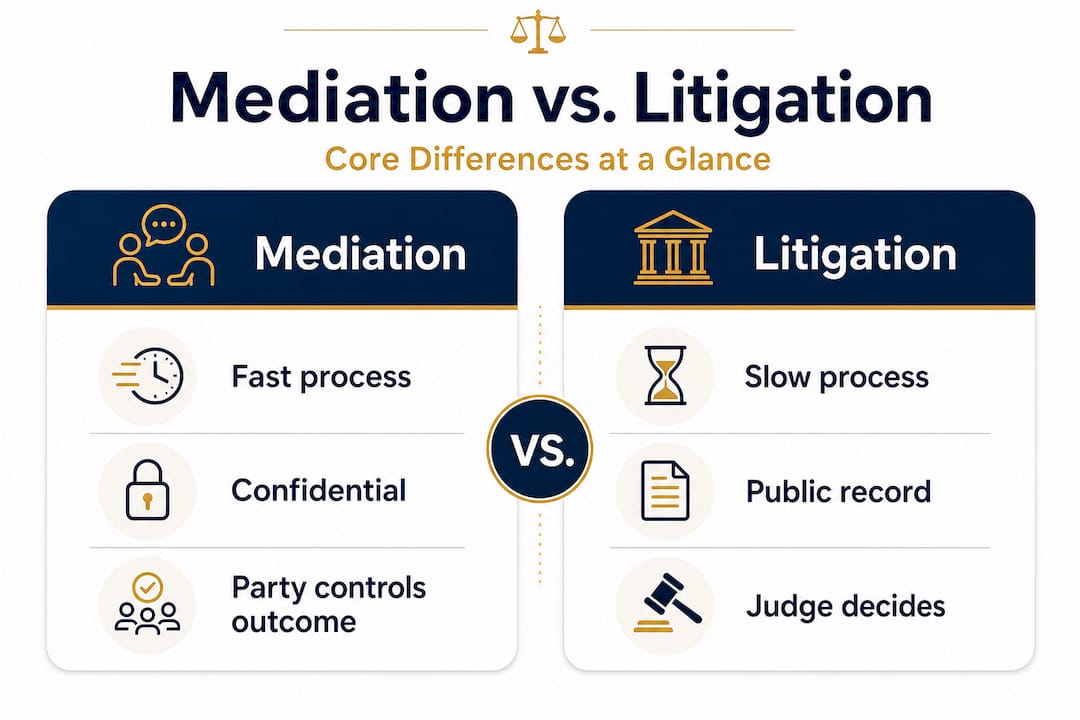
As Mondaq's analysis makes clear, mediation best preserves relationships in business disputes by requiring cooperation and keeping control with the parties. Arbitration is faster and cheaper than litigation but still produces a binding decision you may not like. Litigation is the most formal and adversarial option, and once you file suit, costs escalate quickly.
For small business owners, the relationship angle matters enormously. If your dispute involves a supplier, a landlord, or a long-term customer, burning that relationship in court may cost you far more than the dispute itself. Mediation lets both sides feel heard and often produces creative solutions, like revised payment terms or adjusted contracts, that a judge simply cannot order.
If you are weighing arbitration and mediation alternatives or need to review your contracts before entering any dispute process, a solid contract checklist can surface issues you might otherwise miss.
Advanced mediation techniques and why mediation fails
Even the best approaches can sometimes fall short; here are advanced techniques and what to do if mediation is not successful. Most guides stop at the basics. But knowing the advanced strategies and failure points separates parties who reach deals from those who walk away empty-handed.
Advanced techniques worth knowing:
- Bracketing. This involves each side proposing a range of acceptable outcomes rather than fixed numbers. According to ADR Systems, bracketing helps parties move past positional bargaining and identify overlapping ranges where a deal can happen.
- Pre-mediation memos. Submitting a written brief to the mediator before the session lets you frame your strongest arguments privately, without tipping your hand to the other side.
- Objective case evaluation. Ask the mediator to provide a frank assessment of each side's strengths and weaknesses. This reality check often shifts unrealistic expectations.
- Issue reframing. Skilled mediators help parties restate problems in terms of interests rather than positions. Instead of "I want $50,000," it becomes "I need my business losses covered." That shift opens more options.
- Sequencing agreements. Break the dispute into smaller pieces and agree on each one separately. Building small wins creates momentum toward a full settlement.
Pro Tip: If you are entering a high-stakes commercial mediation, send a pre-mediation memo to the mediator 48 hours in advance. Lay out your key facts, your legal position, and what a realistic outcome looks like for you. This primes the mediator to understand your perspective without prejudging the case.
Why mediation fails:
Mediation does not always work, and understanding why helps you avoid those traps. According to Lawsuit.com's analysis, common failure causes include:
- High hostility. When emotions dominate logic, rational negotiation breaks down.
- Lack of authority. If the person at the table cannot approve a deal, nothing gets settled.
- Poor timing. Starting mediation before both sides have gathered enough information, or after positions have hardened, reduces success chances significantly.
- Bad faith participation. One party using mediation simply to gather information for later litigation.
- Unrealistic expectations. Believing you will get everything and offering nothing.
If mediation fails, your options include adjourning and returning with better preparation, attempting re-mediation with a different mediator, escalating to arbitration, or proceeding to litigation. Understanding your multi-jurisdiction legal steps matters here, especially if your dispute crosses state or national lines. Legal technology tools can help you map those steps efficiently and cost-effectively.
Our take: The real impact of mediation for small businesses and individuals
Here is something most legal guides will not tell you: mediation is not just a cheaper version of court. It is a fundamentally different kind of process, one that shifts power back to the people actually affected by the dispute.

In a courtroom, a judge controls the outcome. In mediation, you do. That distinction sounds simple, but its implications are enormous. When you design your own resolution, you are far more likely to follow through on it. You also understand it. You agreed to it. Compliance rates after mediation are consistently higher than after court-imposed judgments precisely because the parties had ownership of the result.
There is also a reputational dimension that rarely gets discussed. For small business owners, a public lawsuit can become a Google search result. It can scare away customers, partners, and investors before you even get to trial. Mediation happens behind closed doors. Whatever is said, whatever is agreed to, stays between the parties. That protection alone can be worth far more than the cost of the process.
We also think people underestimate the emotional relief mediation provides. Litigation drags disputes out for years. That weight, the uncertainty, the legal bills, the distraction from your actual business, compounds over time. Mediation closes the loop. Even when the settlement is imperfect, the certainty it provides has real value.
Before entering mediation, ask yourself honestly: What do I actually need here? Not what do I want to win, but what outcome would let me move forward? That clarity, more than anything else, is what makes mediation work. If you approach mediation as a problem-solving exercise rather than a battle, you dramatically increase your chances of success.
For further reading on putting this into practice, explore strategies for efficient legal dispute resolution with technology tools designed for exactly this kind of situation.
Explore mediation tools and legal support with BXP Legal AI
If you are ready to put this knowledge into action, here are resources that can help streamline your dispute resolution strategy.
Navigating a dispute is stressful enough without also feeling lost on the legal side. BXP Legal AI is built to give you instant, citation-backed guidance on conflict resolution, contract review, and dispute preparation, without the delays and costs of a traditional law firm consultation.
Whether you need to understand your rights before entering mediation, draft a settlement agreement, or explore your options across multiple jurisdictions, the legal AI features at BXP Legal AI put authoritative answers at your fingertips. Visit BXP Legal to start asking questions tailored to your situation. If your dispute touches different states or countries, the multi-jurisdiction support tools can map the legal landscape for you quickly and clearly.
Frequently asked questions
Is mediation legally binding, and can agreements be enforced in court?
Yes, once signed, mediation agreements are legally binding contracts enforceable by courts, giving the same legal force as any written contract between parties.
How long does the mediation process usually take compared to court litigation?
Mediation typically resolves disputes in one day, versus up to 2.5 years for litigation, making it dramatically faster for both individuals and businesses.
Are all communications during mediation confidential?
Yes, mediation communications are confidential and generally inadmissible in court, with limited exceptions for situations involving fraud or criminal conduct.
What are the main reasons mediation fails?
Mediation most often fails due to high hostility, lack of decision-maker authority, poor timing, bad faith participation, or unrealistic expectations from one or both parties.
Can mediation help preserve business or personal relationships?
Yes, because mediation is cooperative and private, it preserves relationships far better than adversarial court proceedings, which is especially valuable in ongoing business partnerships.