
TL;DR:
- Compliance frameworks are essential for SMBs to organize policies and internal controls, reducing legal and regulatory risks. Building a simple, adaptable, and behavior-driven framework enables consistent compliance and avoids costly gaps caused by informal processes. Regular updates, clear ownership, and automation are key for effective implementation and ongoing risk management.
Compliance frameworks are not reserved for Fortune 500 companies with legal departments the size of a small city. A 2022 case involving a mid-sized healthcare staffing firm illustrates this painfully well: without documented policies or assigned oversight, the company failed to catch recurring HIPAA violations until federal investigators knocked. The resulting fines and remediation costs ran into the hundreds of thousands. That outcome wasn't inevitable. It was the product of treating compliance as an afterthought rather than a structured system. This article breaks down what compliance frameworks are, why they matter urgently for SMBs, and how to build one that actually works in the real world.
Table of Contents
- What is a compliance framework?
- Why compliance frameworks are essential for SMBs
- Operationalizing your compliance framework: From policies to practice
- Choosing and combining frameworks: Alignment, mapping, and smart scaling
- A practical take: Why less can be more in compliance for SMBs
- Empower your compliance journey with BXP Legal AI
- Frequently asked questions
Key Takeaways
| Point | Details |
|---|---|
| Not just for large companies | Compliance frameworks help SMBs reduce legal risks and work more efficiently. |
| Tailored and practical | Effective frameworks match your business size and operations for real-world impact. |
| Update and integrate | Review frameworks regularly and embed compliance into daily workflows. |
| Alignment matters | Mapping multiple frameworks avoids duplicated work and compliance gaps. |
| Simplicity wins | Lean frameworks are likelier to be followed and keep your team engaged. |
What is a compliance framework?
Now that we've set the stage for why frameworks aren't just for the big players, let's get clear on what a compliance framework actually is.
A compliance framework is a structured approach to organizing your business's policies, procedures, and internal controls so that legal and regulatory obligations are met consistently. Think of it as the operating manual for staying on the right side of the law. Without one, compliance becomes a series of reactive decisions made under pressure, often too late.
Understanding compliance risk basics is the starting point, because a framework is only as strong as the risks it's designed to address. A well-built framework typically includes the following components:
- Documented policies: Written rules that govern employee behavior, data handling, vendor relationships, and financial reporting.
- Assigned responsibilities: Specific people (or roles) who own each compliance area and are accountable for outcomes.
- Training programs: Structured onboarding and ongoing education to ensure the whole team understands their obligations.
- Monitoring and testing systems: Regular internal audits, checks, and automated alerts that catch problems before they escalate.
- Reporting mechanisms: Clear channels for employees to raise concerns, report violations, or seek guidance without fear of retaliation.
None of these elements work in isolation. A policy document with no owner is just a PDF gathering digital dust. Monitoring without documented procedures leaves investigators with nothing to point to as evidence of good faith.
"Compliance expectations are not one-size-fits-all. Effectiveness criteria are evaluated with sensitivity to organizational size, complexity, and risk profile, and programs must be tailored and periodically updated." — U.S. Department of Justice, Revised Corporate Enforcement Policy (2025)
That last point is critical. A framework built for your business today may not be adequate in two years if you've added employees, entered new markets, or changed your data practices. Regulatory environments shift, too. What worked in 2023 may leave dangerous gaps by 2026.
Why compliance frameworks are essential for SMBs
With a clear definition in hand, it's time to focus on why following a compliance framework matters so much, especially for small and medium-sized businesses.
Many SMB owners assume frameworks are bureaucratic tools designed for publicly traded companies with compliance officers and legal budgets to match. That thinking is costly. In reality, smaller organizations often face more acute risk per incident precisely because they lack the financial cushion to absorb fines, litigation costs, or reputational damage.
The essential legal compliance steps for SMBs are not dramatically different from those of larger enterprises. The scale is different, but the obligations are just as real. Data privacy laws, employment regulations, contractual liability, and anti-fraud requirements apply regardless of headcount.
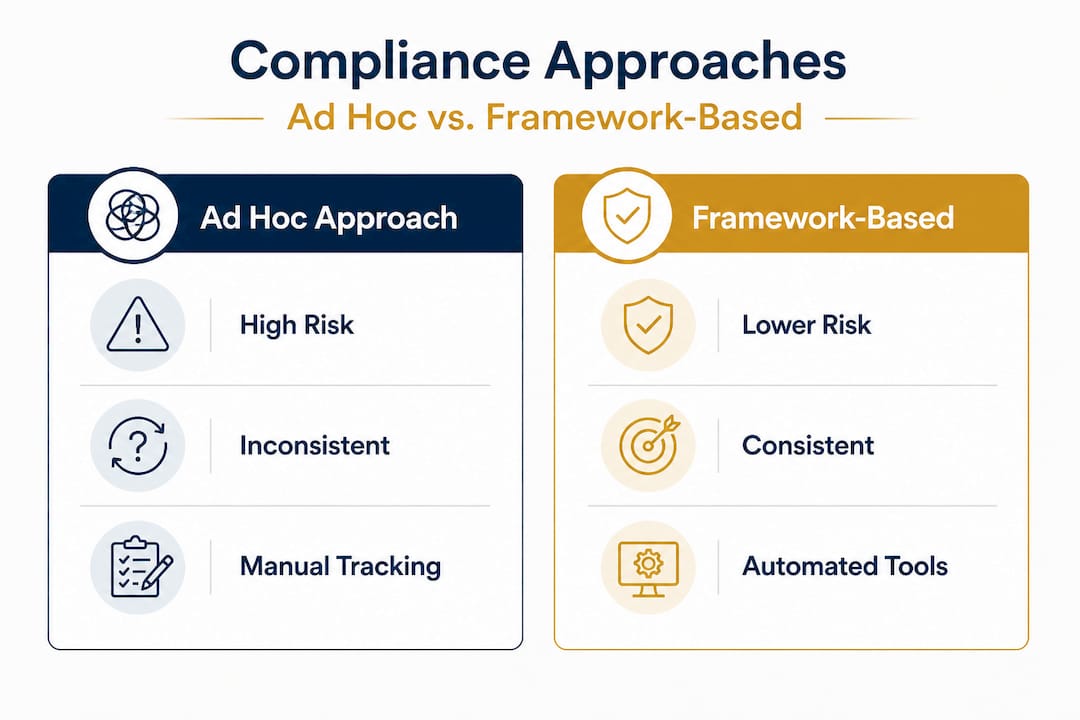
Here's a practical comparison between ad hoc and framework-based compliance:
| Compliance area | Ad hoc approach | Framework-based approach |
|---|---|---|
| Penalties and fines | Higher risk, harder to contest | Lower risk, documented defenses available |
| Audit findings | Fragmented, inconsistent evidence | Organized, traceable documentation |
| Employee confusion | Frequent, costly errors | Clear policies reduce incidents |
| Operational efficiency | Reactive, duplicated effort | Proactive, streamlined processes |
| Regulatory updates | Often missed | Captured through scheduled reviews |
Businesses that operate without a formal framework tend to rely on individual memory and informal norms. That works fine until the person who "knows how everything works" leaves, retires, or gets sick. Then institutional knowledge evaporates, and compliance gaps widen fast.

The U.S. Department of Justice's tailored program expectations reinforce that regulators do not expect SMBs to replicate enterprise-level systems. They do expect businesses to be thoughtful, proportionate, and genuinely committed to compliance. A lean framework that is actively used beats a sophisticated one that no one follows.
Following regulatory best practices for your industry also signals to customers, partners, and investors that your business takes its obligations seriously. That reputational value is hard to quantify but very real.
Pro Tip: Start by identifying your top three compliance risks (employment law, data privacy, and contracts are common starting points for most SMBs), then build simple, practical controls around those before expanding. Incremental progress beats a sprawling framework nobody uses.
Operationalizing your compliance framework: From policies to practice
Understanding that frameworks must be more than documents, let's talk about what it means to put a compliance framework into practice.
This is where many SMBs fall short. They invest time creating written policies, perhaps even hiring a consultant to format them professionally, and then file them away. Six months later, employees don't know the policies exist, and the business is no closer to genuine compliance than before. The document is not the framework. The behavior it drives is the framework.
The difference between structural compliance (having policies) and operational compliance (living those policies daily) is enormous in practice. Consider this comparison:
| Compliance type | What it looks like | Outcome |
|---|---|---|
| Structural (framework-focused) | Policy documents, org charts, assigned roles | Good foundation, but incomplete |
| Operational (workflow-focused) | Daily checklists, automated reminders, integrated training | Consistent, auditable compliance behavior |
To bridge the gap, you need to integrate compliance into how your business actually runs. Here is a practical sequence for doing that:
- Assign clear owners. Every policy needs a named person who is accountable for its implementation and monitoring, not just a department. Accountability without a name attached rarely sticks.
- Embed compliance in onboarding. New employees should encounter your compliance framework on day one, not six months in. Build policy acknowledgment and role-specific training into your onboarding checklist.
- Create standing review cycles. Set calendar reminders for quarterly checks on high-risk areas and annual reviews of the full framework. Reviews should be meetings with documented outcomes, not silent self-assessments.
- Automate recurring tasks. Contract renewal reminders, certification expiration alerts, and data retention schedules are all candidates for automation. Manual tracking fails at scale.
- Build feedback loops. Encourage employees to flag ambiguities or practical obstacles in policies. A framework that people actively engage with improves over time.
Investing early in compliance technology for SMBs dramatically reduces the manual burden of maintaining operational compliance as your team grows. Tools that automate reminders, track training completion, and centralize documentation can turn a labor-intensive process into a manageable routine.
As one practitioner framework guide notes, frameworks sized for SMEs should balance formal structural elements with operational mechanics that make compliance actually work day to day. Over-engineering the structural side without addressing the operational side is one of the most common and expensive mistakes SMBs make.
A step-by-step compliance guide tailored to your business size and industry can make this process much less intimidating and far more effective.
Pro Tip: Automate at least one recurring compliance task in your first 30 days of framework implementation. Even a simple email reminder for contract renewals demonstrates value quickly and builds momentum for broader adoption.
Choosing and combining frameworks: Alignment, mapping, and smart scaling
Once you understand how to put a framework into action, the next step is ensuring you don't overcomplicate things, especially if multiple frameworks apply.
Most SMBs in 2026 operate under more than one regulatory regime. A retail business handling customer payment data must consider both general commercial law and payment card industry security standards. A healthcare adjacent startup may need to navigate HIPAA, state-level privacy laws, and potentially AI governance guidelines simultaneously. The temptation is to treat each framework as a separate silo, which creates exactly the kind of fragmented, duplicated effort you're trying to avoid.
Key steps for selecting, aligning, and scaling across multiple frameworks:
- Inventory your obligations first. Before choosing any framework, map out every regulatory regime your business operates under. This prevents the common mistake of selecting a framework that covers some but not all of your exposures.
- Identify overlaps. Most frameworks share common requirements around access controls, documentation, incident response, and training. A single set of policies can often satisfy multiple frameworks if written with that alignment in mind.
- Prioritize by risk and consequence. Not all regulatory requirements carry equal weight. Structure your framework to address high-consequence obligations first, then layer in lower-risk requirements as capacity allows.
- Use a master control document. Map each framework requirement to a single control or policy. This prevents redundant evidence collection and makes audits far more efficient.
- Build for scale. Your framework should accommodate new requirements without requiring a complete rebuild. Modular designs allow you to add regulatory coverage as your business expands.
"When selecting or combining frameworks, mapping and alignment across requirements is often required; otherwise teams duplicate work and evidence becomes fragmented."
That insight is especially relevant for SMBs handling cross-border or multi-jurisdictional compliance strategies, where local laws may intersect with federal standards and international requirements like GDPR. Misalignment in those scenarios doesn't just waste time; it creates genuine legal exposure.
Smart scaling means accepting that your framework today is not your framework forever. Build a mechanism to review and extend it as your business grows, enters new markets, or adopts new technology. A framework that was right-sized for 10 employees needs revisiting at 50.
A practical take: Why less can be more in compliance for SMBs
The conventional advice tells SMBs to "build a robust compliance framework." That phrasing, though well-intentioned, often leads business owners to conclude they need something impossibly elaborate before they can claim their compliance is legitimate. We disagree with that framing, strongly.
The real danger for most SMBs is not too little structure. It's too much bureaucracy that nobody follows. We've seen businesses spend thousands of dollars producing multi-hundred-page compliance manuals that employees cannot navigate and managers never reference. Those documents provide legal theater, not legal protection. When regulators look under the hood, they want to see evidence of genuine behavior change, not impressive PDFs.
The businesses that handle compliance best tend to share a few traits. Their frameworks are simple enough that every employee can understand their role within them. Their policies are connected to real workflows rather than living in isolation. And they review and update those frameworks regularly, treating compliance as a living practice rather than a one-time project.
Here are practical steps for right-sizing your compliance framework without sacrificing effectiveness:
- Start with risk, not regulation. Identify the three to five issues most likely to cause your business serious harm, then build controls around those first.
- Rely on workflows over policies. A daily checklist that embeds compliance into normal work is worth ten policy documents nobody reads.
- Assign real owners. Every control needs a person who will be asked about it in an audit. Vague ownership produces vague compliance.
- Review annually at a minimum. Set a fixed date each year to walk through the full framework and update anything that no longer reflects reality.
- Treat gaps as intelligence, not failure. When audits or incidents reveal gaps, use those findings to improve the framework rather than to assign blame.
The SMB compliance essentials that matter most are not the most complex ones. They are the ones your team actually follows, every single day. A lean, living framework beats an elaborate document that sits untouched between annual audits.
Simple frameworks also encourage the one thing that documentation cannot manufacture: genuine engagement. When employees understand why a policy exists and see how it connects to their daily work, they become active participants in your compliance culture rather than passive recipients of a rule set.
Empower your compliance journey with BXP Legal AI
Incorporating effective compliance doesn't have to be daunting, especially with the right support.
Building and maintaining a compliance framework takes real effort, but that effort multiplies fast when you have tools working alongside you. BXP Legal AI is designed specifically for businesses like yours, offering guided workflows, smart templates, and multi-jurisdiction support that adapt as your regulatory obligations evolve.
Whether you need to draft policies from scratch, identify compliance gaps across business units, or stay current with shifting regulations, BXP Legal's AI features give you a practical starting point rather than a blank page. Explore ready-to-use legal document templates that are built to align with common compliance frameworks and save hours of drafting time. For SMBs that want structure without the overhead of a full legal department, BXP Legal AI is the accessible, always-available alternative.
Frequently asked questions
What is the main purpose of a compliance framework?
A compliance framework helps businesses organize controls and procedures to meet legal and regulatory standards efficiently, with the depth and formality of each program scaled to organizational size and risk profile.
How often should an SMB update its compliance framework?
Review your framework at least once a year and after any major regulatory change, business expansion, or significant incident, since programs must be periodically updated to reflect evolving risk profiles.
Can compliance frameworks be applied to different industries?
Yes, frameworks can and should be tailored across industries. When multiple regulatory regimes apply, mapping requirements across frameworks prevents duplicated effort and evidence gaps.
What is the risk of not having a compliance framework?
Without a framework, businesses are far more likely to miss critical obligations, face regulatory fines, and struggle to demonstrate good faith to investigators or auditors when problems arise.