
TL;DR:
- Many small businesses underestimate the cost of non-compliance, which can be 2 to 10 times higher than legal guidance.
- Proactive legal advice helps SMEs reduce risks, improve reputation, and avoid costly disputes by establishing strong legal foundations early.
Most small business owners assume legal help is something they can put off until things go wrong. That assumption is expensive. Compliance costs for small businesses typically run 1 to 3% of annual revenue, but the price of non-compliance can be 2 to 10 times higher. For a small company operating on tight margins, a single regulatory misstep, a poorly worded contract, or an overlooked employment obligation can wipe out months of profit. This guide covers the practical legal terrain every SME needs to understand: where your real risks are, what compliance actually costs, and how to build smarter legal habits before problems find you.
Table of Contents
- Why SMEs need specialized legal guidance
- The financial impact: Compliance costs vs. non-compliance
- Key legal areas where SMEs need support
- From reactive to preventive: The proactive advantage of legal guidance
- What most SMEs get wrong about legal support and how to get it right
- Accessible legal guidance for SMEs—get practical help
- Frequently asked questions
Key Takeaways
| Point | Details |
|---|---|
| Legal risks are real | SMEs face unique legal vulnerabilities that can threaten business survival if ignored. |
| Prevention saves money | Compliance costs are minor compared to the major repercussions of legal problems and non-compliance. |
| Invest in expertise | External legal advisors offer SME-focused guidance without the cost of an in-house attorney. |
| Start with core frameworks | Foundational tools like SOPs, risk assessments, and compliance calendars help keep your SME protected. |
| Be proactive, not reactive | Ongoing, preventive legal strategies let SMEs focus on growth instead of costly fire-fighting. |
Why SMEs need specialized legal guidance
Small and medium-sized businesses face a paradox. They operate in the same legal environment as large corporations, with similar obligations around contracts, employment, data privacy, and tax, but without the resources those corporations rely on. A Fortune 500 company has an in-house legal team. You have a busy calendar and a lawyer you call when something breaks.
SMEs often lack resources for in-house counsel, which means they depend on external advisors for specialist knowledge, independent advice, and the kind of assurance that prevents costly mistakes from compounding. That external relationship, when it's structured well, provides something even better than a staff lawyer: a specialist who sees problems across many industries and brings hard-won pattern recognition to your situation.
The core risk areas where SMEs most often stumble include:
- Contracts: Vague terms, missing clauses, or poorly defined payment conditions create disputes that drag on for months.
- Compliance: Keeping pace with regulatory changes across employment law, tax, and sector-specific rules is a full-time task on its own.
- Intellectual property: Many SMEs don't register trademarks or lock down IP ownership in founder or contractor agreements until it's too late.
- Employment law: Misclassifying workers, missing leave entitlements, or handling terminations incorrectly exposes SMEs to tribunal claims and fines.
"Legal guidance helps SMEs mitigate risks in contracts, compliance, IP, and employment, preventing costly litigation and penalties."
Understanding why SMEs need legal guidance isn't just about knowing the risks in theory. It's about recognizing that every week you operate without a clear legal foundation is a week you're absorbing unnecessary exposure. The good news is that you don't need a large budget to start fixing that.
The financial impact: Compliance costs vs. non-compliance
Numbers tell a clearer story than warnings. When you look at the actual data on compliance spending versus the cost of getting it wrong, the investment in legal guidance stops looking like an expense and starts looking like insurance with a guaranteed payout.
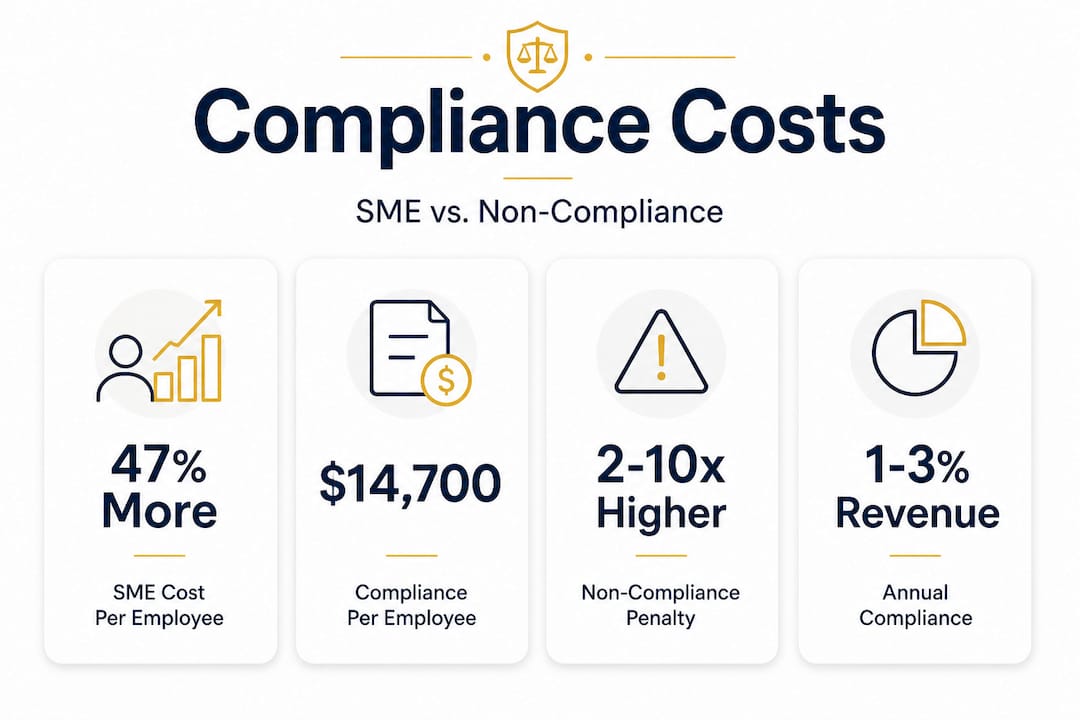
Small firms pay 47% more per employee on compliance than large companies, averaging around $14,700 per employee compared to $10,000 for their larger counterparts. That's a structural disadvantage, but it also underscores why strategic spending matters. Getting the most out of every compliance dollar is not optional for an SME. It's survival math.
Here's a direct comparison of what compliance looks like against the realistic cost of ignoring it:
| Scenario | Estimated cost range | Business impact |
|---|---|---|
| Annual compliance investment | 1 to 3% of revenue | Predictable, manageable, protects operations |
| Regulatory fine (minor violation) | $5,000 to $50,000 | Disruptive, often paired with audits |
| Employment tribunal claim | $20,000 to $100,000+ | Reputational and operational damage |
| Data breach (GDPR or CCPA non-compliance) | $50,000 to $500,000+ | Business threatening at SME scale |
| Contract dispute with litigation | $30,000 to $250,000 | Drains cash and management attention |
The pattern is consistent. The compliance cost for SMEs is real, but the cost of non-compliance multiplies it by a factor of 2 to 10. At the higher end of that range, a single incident can match or exceed an entire year's revenue for a smaller business.
The benefits of SME legal compliance extend well beyond avoiding fines. Businesses with strong compliance records find it easier to secure financing, win enterprise clients, and maintain team morale. A reputation for operating cleanly is a genuine competitive advantage, especially when larger customers conduct due diligence on their supply chain.

Pro Tip: Set a compliance line item in your annual budget before anything goes wrong. Even a modest monthly retainer with a legal advisor, combined with a basic compliance calendar, creates a predictable cost structure instead of emergency spending. Understanding legal compliance basics is the first step toward building that structure.
One underappreciated factor is the role of intermediaries in SME compliance performance. External legal advisors, compliance consultants, and legal tech tools aren't just cost centers. They directly influence business outcomes by catching issues early, freeing up management focus, and reducing the cognitive load of staying current with regulatory changes. Knowing how to protect your SMB from risk starts with understanding that human capital in legal guidance, whether a retained advisor or a smart platform, is one of the highest-return investments a small business can make.
Key legal areas where SMEs need support
Once you accept the financial argument, the practical question becomes: where do you actually focus? Not every legal issue carries the same weight. Some areas generate recurring low-level risk. Others have the potential to shut your business down overnight.
The SBA guidance on staying legally compliant identifies a core set of methodologies that give SMEs a workable foundation: data mapping, Records of Processing Activities (ROPA), standard operating procedures (SOPs), compliance calendars, risk assessments, staff training, and data processing agreements (DPAs). These aren't bureaucratic exercises. They are the scaffolding that keeps a business standing when regulators come knocking or a client demands evidence of due diligence.
Here's how traditional and tech-enabled compliance approaches compare in practice:
| Approach | Traditional | Tech-enabled |
|---|---|---|
| Contract management | Manual drafting and review | Automated templates, clause libraries, AI review |
| Compliance tracking | Spreadsheets, calendar reminders | Real-time regulatory monitoring tools |
| Data protection | Periodic audits | Continuous data mapping and automated alerts |
| Employment compliance | Reactive HR processes | Policy libraries, jurisdiction-aware guidance |
| Cost profile | High hourly fees, unpredictable | Subscription-based, scalable |
The gap between these two approaches closes every year as legal tech for SMEs becomes more accessible. Businesses that once needed a law firm's billing hours to manage regulatory requirements can now access AI-powered tools that provide instant, citation-backed answers and flag emerging issues in real time.
Setting up your compliance foundation doesn't have to be overwhelming. Here's a straightforward sequence to follow:
- Audit your current contracts. Review all supplier, client, and employment agreements for missing terms, outdated clauses, or ambiguous liability provisions.
- Build a compliance calendar. Map out your key regulatory deadlines: tax filings, license renewals, employment law updates, and data protection review dates.
- Conduct a data mapping exercise. Know exactly what personal data you hold, where it's stored, and who can access it. This is the starting point for GDPR and AI Act readiness.
- Draft or review your SOPs. Document how your team handles contracts, complaints, data access requests, and terminations.
- Establish DPAs with vendors. Any third party that handles personal data on your behalf needs a signed data processing agreement.
- Schedule a legal risk review. At least once a year, sit down with an advisor or use a structured tool to assess where your exposure has changed.
Pro Tip: Start with data mapping, even if you're not operating in Europe. As AI Act obligations begin applying to businesses using AI-driven tools, a solid data map gives you a head start on compliance across multiple overlapping frameworks. Adopting best compliance practices early means fewer surprises as regulations evolve.
Employment law deserves special attention in this list. Misclassifying a contractor as an employee, or vice versa, triggers tax liabilities, social security obligations, and potential back pay claims. The rules differ by jurisdiction and change frequently. Staying current without dedicated support is genuinely difficult, which is exactly why this area generates so many expensive disputes for SMEs.
From reactive to preventive: The proactive advantage of legal guidance
Most SMEs operate in legal firefighting mode. Something goes wrong, and then they call a lawyer. A contract dispute surfaces, and suddenly you're spending $400 an hour on crisis management instead of $200 a month on prevention. That gap represents the core financial argument for shifting your approach.
Legal guidance shifts SMEs from reactive fixes to preventive strategies, giving you the bandwidth to focus on growth rather than damage control. Retained counsel, meaning an ongoing advisory relationship rather than a one-off engagement, also means your advisor monitors regulatory changes and flags relevant updates before they become your problem.
"Prevention isn't just cheaper than litigation. It's the difference between running your business and being run by your legal problems."
The practical benefits of preventive legal strategy play out in several concrete ways. Businesses with well-drafted contracts spend less time in payment disputes. Companies with clear employment policies face fewer tribunal claims. Brands that register their intellectual property early avoid costly rebrandings. These aren't abstract outcomes. They're the direct result of putting the right structures in place before pressure arrives.
A legal risk assessment for SMEs is one of the most practical tools available, and it doesn't require a large budget. A structured review of your highest-exposure areas, conducted annually, gives you a prioritized action list rather than a vague sense of unease.
Here are the proactive legal moves every SME should be making right now:
- Conduct a contract audit and update outdated agreements
- Establish a retained or subscription-based relationship with a legal advisor or legal tech platform
- Create and maintain a compliance calendar for all regulatory deadlines
- Register trademarks and protect IP before going to market, not after
- Put a data protection policy in place and communicate it to staff
- Review employment agreements to ensure classification and terms are current
- Build a dispute resolution clause into every client contract
Treating legal compliance as a growth engine for your SME rather than a cost center changes the way you invest in it. Compliant businesses attract better clients, close deals faster, and scale with fewer obstacles. If you want a practical starting point, a step-by-step compliance guide will help you sequence your efforts without getting overwhelmed.
What most SMEs get wrong about legal support and how to get it right
Here's the uncomfortable truth: most SMEs don't underinvest in legal guidance because they can't afford it. They underinvest because they've categorized legal support as reactive spend rather than strategic infrastructure. That mental model is the root cause of most avoidable legal crises.
Conventional wisdom says legal costs are a burden to minimize. The data says the exact opposite. Non-compliance costs 2 to 10 times more than compliance. Employment disputes cost far more than good HR policies. A trademark dispute costs more than registration. Every "money saved" on legal preparation has a corresponding risk multiplier attached to it.
Many SMEs also wait for an external trigger, a dispute, a fine, an audit, before establishing an ongoing advisory relationship. By that point, the conversation is about damage limitation, not strategic positioning. The businesses that grow fastest with the fewest disruptions tend to have legal advisors who function as regular sounding boards, not emergency contacts.
The overlooked value of legal counsel isn't in crisis management. It's in the quiet, preventive work that never makes headlines because nothing went wrong. That's the value you're not seeing when you look at your legal spend as a line item to cut.
Getting this right requires a mindset shift. Your legal partner should be in the room, or at least accessible on demand, when you're negotiating a new supplier agreement, hiring your first employee, expanding into a new market, or launching a product that uses customer data. Not after any of those events have created a problem, but before.
The businesses that win over the long term treat legal guidance the way they treat accounting: as ongoing infrastructure, not emergency repair.
Accessible legal guidance for SMEs—get practical help
If the steps above feel like a lot to tackle alone, that's exactly the problem BXP Legal was built to solve. Shifting from reactive legal firefighting to a preventive, compliance-first approach is dramatically easier when you have immediate access to reliable, AI-powered legal guidance.
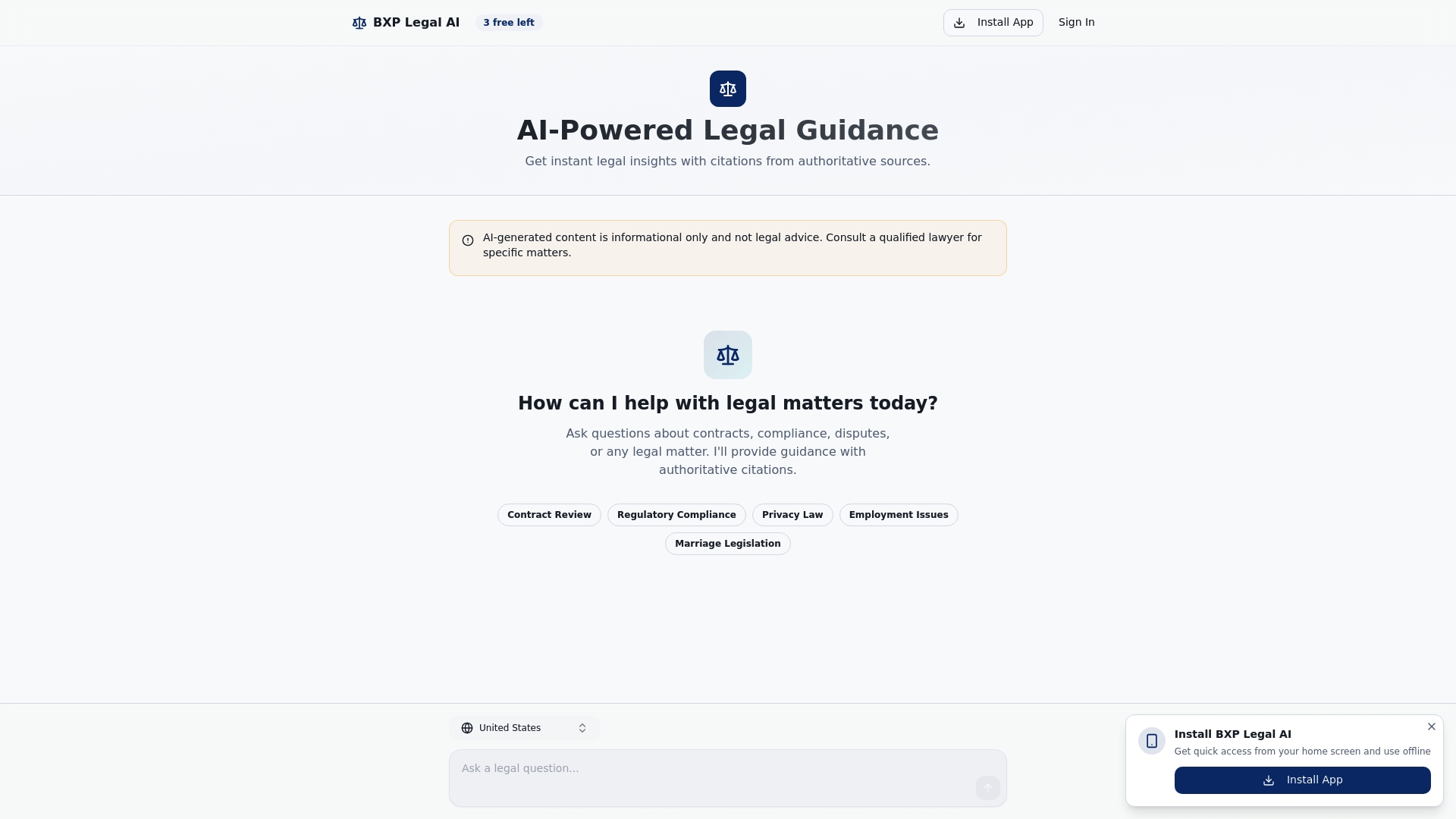
BXP Legal gives SMEs instant answers on contracts, compliance, employment, data privacy, and more, backed by authoritative citations so you always understand the basis for the guidance. Whether you're reviewing a supplier agreement at 10 PM or trying to understand your obligations under a new regulation, the BXP Legal AI features put expert-level legal insight within reach without the hourly billing surprises. For SMEs that want to operate with confidence and grow without unnecessary legal exposure, accessible, affordable, and always-on legal support isn't a luxury. It's the foundation.
Frequently asked questions
What are the main legal risks for SMEs?
Key risks include poor contract management, IP infringement, employment law violations, and non-compliance with regulations. Legal guidance helps address each of these before they escalate into costly disputes or penalties.
How much should an SME budget for legal compliance?
Expect to spend 1 to 3% of annual revenue on compliance. The cost of non-compliance can be 2 to 10 times higher, making proactive investment the more economical choice in virtually every scenario.
What's the difference between preventive and reactive legal strategies?
Preventive strategies address risks before issues arise, while reactive approaches fix problems after damage is done, usually at significantly higher cost. Retained legal counsel is the primary mechanism for staying in preventive mode.
Can small businesses get affordable legal support without hiring in-house counsel?
Yes. Most SMEs rely on external legal advisors for affordable, specialist help without the fixed overhead of a staff lawyer, often supplemented by legal tech platforms for day-to-day guidance.
What practical steps can SMEs take to improve legal compliance?
Adopt SOPs and compliance calendars, conduct regular risk assessments, start with data mapping for privacy obligations, and use legal tech tools to monitor regulatory changes continuously.