
TL;DR:
- Legal technology now offers affordable contract analysis and compliance tools for small and medium-sized enterprises.
- AI-powered platforms streamline routine legal tasks, reducing costs and saving time for SMEs.
- Trust, transparency, and regular updates are key factors for SME adoption of legal tech solutions.
Legal technology is no longer the exclusive territory of large corporations with six-figure legal budgets. Preventive legal technology now extends affordable contract risk analysis, plain-language explanations, and compliance alerts to small businesses that previously had no practical access to legal support. If you run a small or medium-sized enterprise and have been watching legal tech from the sidelines, this guide cuts through the noise and shows you exactly where to start, what to look for, and how to apply it in your daily operations.
Table of Contents
- Why legal tech matters for SMEs
- Key features of modern legal tech for SMEs
- Overcoming adoption barriers: What SMEs need to know
- From theory to practice: Real-world SME legal tech use cases
- Why SME legal tech adoption is still harder than it should be
- Explore BXP Legal AI solutions for your SME
- Frequently asked questions
Key Takeaways
| Point | Details |
|---|---|
| Legal tech empowers SMEs | Modern legal tech makes contract management and compliance affordable for smaller businesses. |
| AI tools offer practical support | Features like risk analysis, plain-language summaries, and compliance alerts tackle real-world SME pain points. |
| Adoption barriers exist | Cost, uncertainty, and fear of obsolescence are real concerns but can be managed with thoughtful tool selection. |
| Combine tech and human insight | For best results, pair legal tech solutions with human review for sensitive or complex scenarios. |
Why legal tech matters for SMEs
Running a small business means wearing many hats, and the legal one rarely fits comfortably. You need supplier contracts reviewed, employment agreements drafted, data privacy policies updated, and regulatory filings tracked, often all at once, and usually without a dedicated legal team. Traditional law firm retainers can run thousands of dollars per month. Even a one-off contract review can cost hundreds of dollars per hour. For most SMEs, that math simply does not work.
This is where legal tech steps in. Platforms powered by artificial intelligence (AI) can automate many of the repetitive, time-consuming tasks that previously demanded a lawyer. Think contract clause identification, regulatory deadline tracking, and plain-language rewriting of dense legal text. These tools do not replace legal judgment in complex disputes, but they handle the routine work efficiently, freeing up your time and reducing your legal spend significantly.
The data here is revealing. According to research from the Solicitors Regulation Authority, 82% agreed technology helps provide better value, yet only 4% of respondents felt there were no barriers to adoption. That gap between recognition and action tells you something important: SME owners understand the value, but they are uncertain how to move forward. That uncertainty is exactly what this article addresses.
The most common legal pain points for SMEs include:
- Contract risks: Unfavorable clauses buried in supplier or client agreements
- Compliance gaps: Missed regulatory deadlines or outdated policies
- Employment issues: Misclassification of workers or incomplete onboarding documentation
- Data privacy obligations: Requirements under laws like GDPR or state-level privacy statutes
- Cost overruns: Hourly legal fees that eat into already thin margins
Getting access to online legal guidance has become one of the fastest ways for SMEs to bridge the knowledge gap without committing to expensive retainer arrangements. And understanding the compliance steps for SMBs is the foundation before any technology layer can add real value.
Pro Tip: Start with one specific legal pain point, like contract review or compliance tracking, rather than trying to overhaul your entire legal process overnight. Small wins build confidence and prove ROI quickly.
Key features of modern legal tech for SMEs
Not all legal tech is created equal. Some tools cater to enterprise-level legal departments and come loaded with features you will never use. What matters for SMEs is a focused set of capabilities that directly address your most common legal challenges.
Modern AI-driven platforms perform contract risk analysis, generate plain-language summaries, suggest alternative clauses, and trigger compliance alerts with human validation layers built in for accuracy. That last point matters: the best tools do not pretend AI is infallible. They include a "human-in-the-loop" mechanism where flagged issues can be escalated for review by qualified professionals.
Here is what a well-rounded legal tech platform should offer:
- Contract risk ranking: Automatically categorizes clauses by risk level, so you focus attention where it matters most
- Plain-language summaries: Converts legal jargon into clear, readable explanations without losing meaning
- Alternative clause suggestions: Proposes safer or more favorable language when a clause is flagged as risky
- Compliance alert systems: Tracks regulatory deadlines and sends proactive notifications before penalties apply
- Document drafting tools: Generates first-draft agreements, NDAs, and policies based on your inputs
- Multi-jurisdictional support: Identifies which laws apply based on your business location and customer base
"The goal is not to turn every business owner into a lawyer. It is to give them enough context and clarity that they can make informed decisions faster and bring specialists in only when genuinely needed."
Here is how the traditional approach compares to modern AI-powered legal tech:
| Feature | Traditional lawyer-led | AI legal tech platform |
|---|---|---|
| Contract review turnaround | Days to weeks | Minutes to hours |
| Cost per document review | $200 to $800+ | Flat subscription or per-use fee |
| Compliance tracking | Manual, reactive | Automated, proactive alerts |
| Plain-language explanations | Available on request | Built into every output |
| Availability | Office hours only | 24/7 access |
| Human review option | Always | Available for complex matters |
| Scalability | Limited by attorney time | Scales with your business instantly |
Getting familiar with a solid legal technology guide helps you understand the landscape before committing to any single platform. Once you know the basics, exploring how AI legal tools specifically tackle contracts and compliance will help you make a smarter purchasing decision.

Overcoming adoption barriers: What SMEs need to know
Knowing that legal tech exists and understanding why it is useful does not automatically translate into adoption. The barriers are real, and dismissing them would be doing you a disservice.
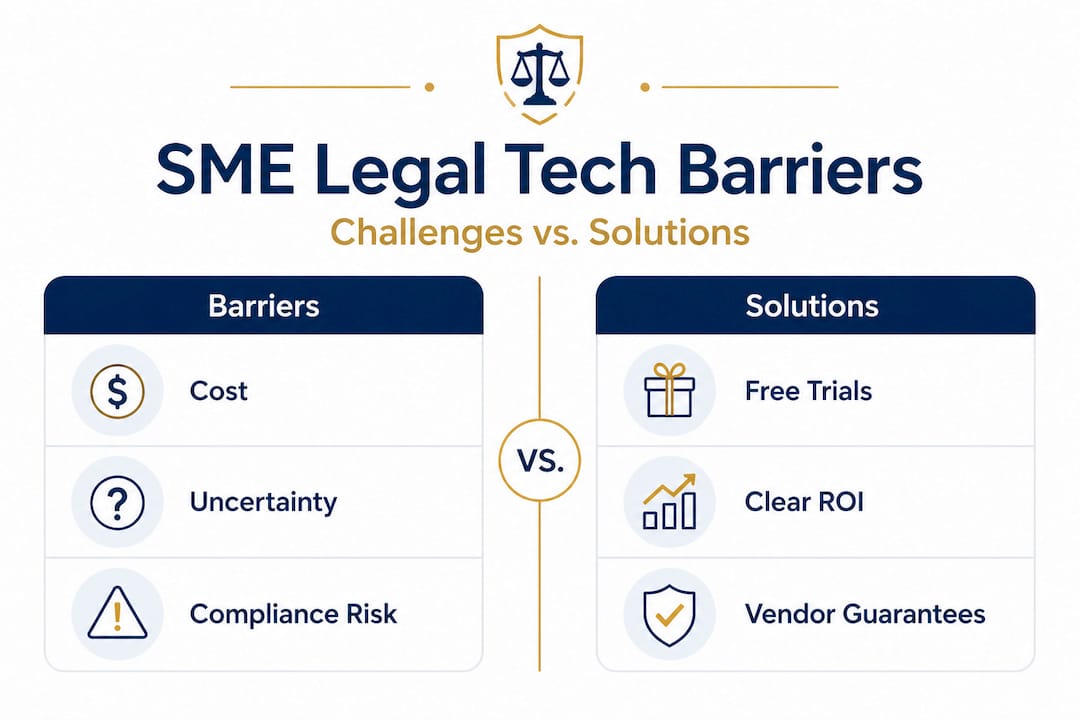
Research consistently shows that cost, uncertainty, and reluctance to invest in technology that might become non-compliant or outdated are the primary reasons SMEs stall on adoption. These concerns are legitimate. Regulatory environments shift. Vendors sometimes overpromise. Budget constraints are real. And no business owner wants to invest in a platform that becomes obsolete in 18 months.
Here is a practical framework for working through each barrier:
| Barrier | Root concern | Practical solution |
|---|---|---|
| Cost | ROI uncertainty | Start with free trials, measure hours saved |
| Uncertainty about tools | Too many options, unclear differences | Use demo periods, request references from similar businesses |
| Fear of obsolescence | Regulations changing quickly | Choose vendors with documented compliance update schedules |
The most important thing you can do before selecting a tool is ask vendors direct questions about their update process. How often are compliance databases refreshed? What happens when a major regulation changes? Is there a support team that monitors legal developments? If a vendor cannot answer those questions clearly, move on.
Practical steps to move forward without getting overwhelmed:
- Audit your current legal workload: List the top five legal tasks that consume your time or budget each month
- Prioritize by pain: Address the costliest or riskiest issue first, not the easiest
- Request demos from at least three vendors: Compare user experience, not just feature lists
- Start modular: Choose tools that solve one problem well rather than platforms promising everything
- Build in a review cycle: Schedule a 90-day check to assess whether the tool is actually reducing your legal risk or spend
Using a structured legal compliance checklist gives you a clear baseline before you introduce any new technology. It helps you identify exactly where gaps exist so you are shopping for solutions to real problems, not imaginary ones. Once you are ready to build documents, understanding AI in document drafting can save you significant time on routine paperwork.
Pro Tip: Always negotiate a free pilot period or money-back guarantee with legal tech vendors. A 30-day trial on live business documents tells you far more than a polished sales demo ever will.
From theory to practice: Real-world SME legal tech use cases
Let's get specific. Here are three concrete scenarios where legal tech directly changes outcomes for SME owners.
Use case 1: Vendor contract review
A small marketing agency receives a 40-page services agreement from a new enterprise client. Without legal tech, the owner either spends hours reading it, pays a lawyer to review it at $400 per hour, or signs it without understanding the liability and indemnity clauses buried inside. With an AI-powered contract tool, the platform flags the three highest-risk clauses within minutes, explains each one in plain language, and suggests alternative wording. The owner then sends those specific sections to a lawyer for 30 minutes of targeted review rather than full-document billing. The savings are immediate and the risk exposure is dramatically reduced.
Use case 2: Regulatory compliance deadline
A mid-sized e-commerce business selling in multiple states needs to track sales tax nexus rules, data privacy notification requirements, and employment law changes across four jurisdictions. Manually tracking all of this is a full-time job. An AI provides first-pass risk analysis and compliance alerts tailored to the business's specific operational footprint, giving the owner advance warning before deadlines hit rather than reactive scrambling after a violation notice arrives.
Use case 3: Day-to-day legal inquiries
An HR manager at a 35-person software company needs to quickly understand whether a new remote work policy creates any classification risks under current labor law. Instead of emailing a lawyer and waiting two days, she asks an AI legal platform and receives a plain-language explanation with citations in minutes. She has enough context to make a preliminary decision and knows exactly which points to raise if she does decide to loop in outside counsel.
These are not edge cases. They represent the daily reality of running an SME in a regulatory environment that grows more complex each year.
- Identify your highest-frequency legal task
- Test at least one AI tool against it using a real document or question
- Measure time saved and compare to your previous cost
- Decide whether to expand use based on measured results
Use a contract review checklist to standardize how your team approaches agreements so the AI tool is working within a consistent process. And if you want to build a repeatable workflow around AI guidance, a clear AI legal guidance workflow gives you a practical structure to follow.
Pro Tip: Pair every AI contract output with a 15-minute human review for any agreement above $10,000 in value or involving IP rights. The AI handles the heavy lifting; human judgment handles the edge cases.
Why SME legal tech adoption is still harder than it should be
Here is an honest take that most vendor-led content will not give you: the barriers to legal tech adoption for SMEs go deeper than cost and feature awareness. The real friction is emotional and strategic, rooted in trust.
Think about what you are being asked to do. You are running a business that you built, often with personal financial risk attached. You are being asked to hand part of your legal decision-making process to a software platform you found online, built by a company you may never meet. That is not irrational hesitation. That is reasonable caution.
Vendor messaging alone may not overcome adoption friction because the underlying uncertainties and compliance worries run deeper than any marketing campaign can address. The research is clear on this. And yet most vendors respond with more feature announcements rather than addressing the trust gap directly.
What actually moves the needle is transparency. SMEs want to know who built the tool, what legal framework it operates within, how errors are handled, and what recourse exists if the AI gives bad guidance. Vendors who answer those questions openly and build those guardrails visibly into the product will win long-term trust. Vendors who lead with speed and cost savings without addressing liability and accuracy will create churn.
There is also a sector-specificity problem that gets underestimated. A one-size-fits-all contract review tool may work reasonably well for standard commercial agreements but fall short for construction subcontracts, healthcare service agreements, or software licensing deals that carry industry-specific regulatory weight. SME owners in specialized sectors need platforms that either cover their vertical or are honest about their limitations.
The path forward is not more automation. It is better alignment between what the technology does well and what the SME owner needs to feel confident using it. Explore AI solutions for everyone to see how platforms are working to bridge that confidence gap with transparent, guided experiences.
Explore BXP Legal AI solutions for your SME
If you've read this far, you already understand the value of smarter legal tools for your business. The question is not whether legal tech is worth exploring. It is which platform deserves your attention.
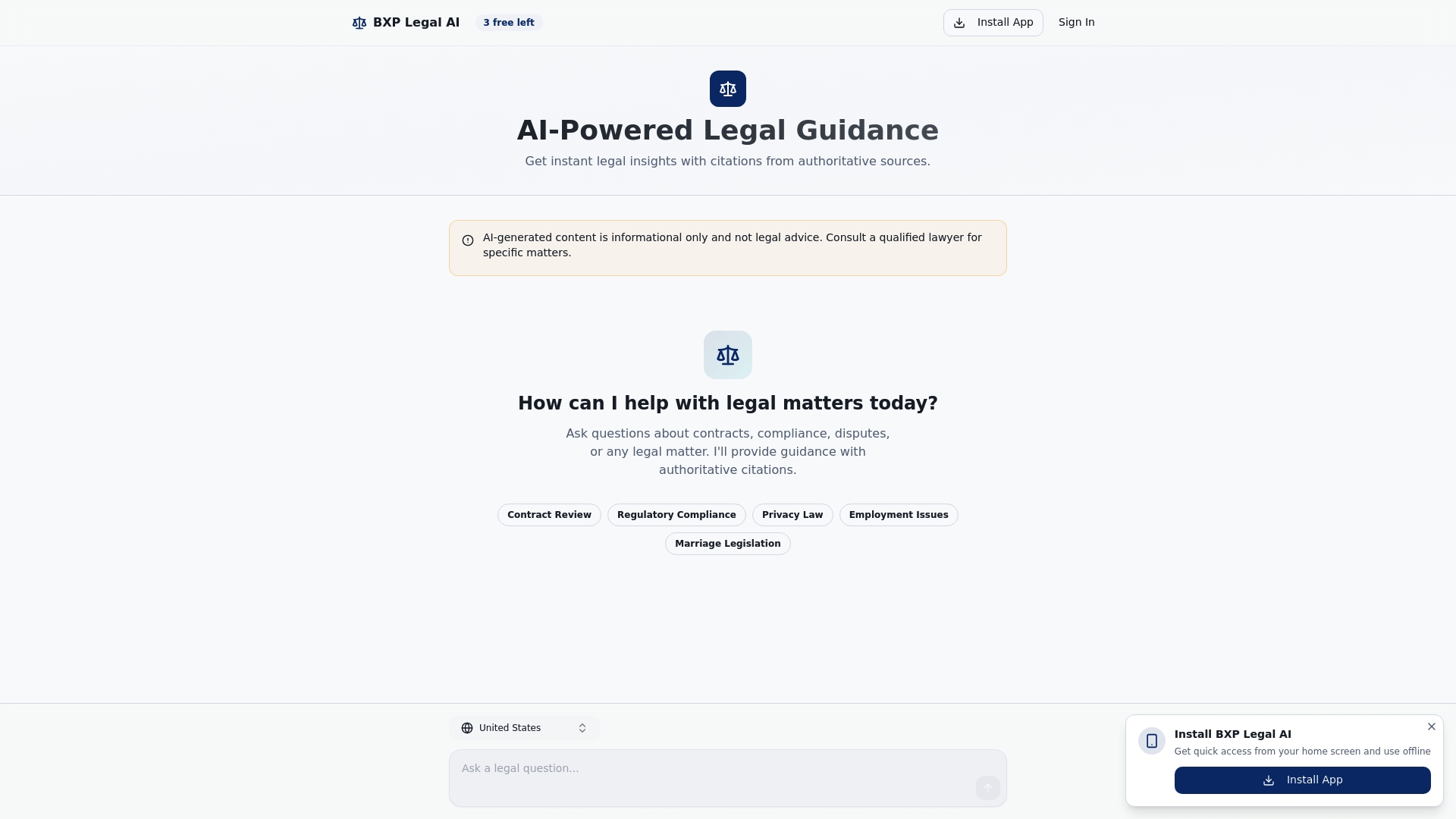
BXP Legal AI is built specifically for businesses like yours. Whether you need instant answers to compliance questions, a first pass on a vendor contract, or help drafting an employment policy, BXPLegal.com gives you AI-powered legal guidance backed by authoritative citations across contracts, privacy law, employment issues, and more. The platform supports document drafting, multi-jurisdictional research, and day-to-day legal inquiries without routing every question through a law firm. Start by exploring the features, run a test on a real document or legal question you are currently facing, and see the difference immediate, cited, plain-language guidance makes for your daily operations.
Frequently asked questions
What's the main advantage of legal tech for SMEs?
Legal tech gives SMEs affordable access to compliance checks, contract analysis, and legal guidance without hiring a full-time lawyer, with platforms that extend legal assistance to businesses that previously could not afford attorney support at all.
Can AI legal tools fully replace a lawyer for my SME?
AI tools handle contract reviews and compliance alerts well, but complex or high-stakes matters still benefit from human expert review, particularly since AI legal tech includes human-in-the-loop validation precisely for ethical and liability edge cases.
How do I know which legal tech tool is right for my business?
Look for tools with transparent pricing, compliance update features, and trial options to test real-world fit before committing, since SME adoption is most constrained by cost uncertainty and concerns about future-proofing rather than a lack of interest.
What are the biggest risks with adopting legal tech?
The main risks involve rapid regulatory changes and tools becoming outdated, so choosing providers with documented compliance update schedules is essential since many SMEs fear systems quickly become non-compliant or functionally obsolete as laws evolve.