
TL;DR:
- Most people accept terms without reading, risking unintended legal and financial consequences.
- Proper acceptance methods like clickwrap agreements ensure enforceability of T&Cs.
- Critical clauses include dispute resolution, liability limits, auto-renewals, and data use, requiring careful review.
Most people click "I agree" without reading a single word. In fact, 91% of users accept terms and conditions without reading them, spending an average of just 73 seconds skimming a document that averages 2,657 words. That gap between what you agree to and what you actually know you agreed to can cost you real money, rights, and business opportunities. This guide cuts through the legal fog to show you exactly what terms and conditions mean, what to watch for, and how to protect yourself whether you are an individual consumer or a small business owner navigating vendor contracts.
Table of Contents
- What are terms and conditions and why do they matter?
- Key components of typical terms and conditions
- Unfair terms: How legal protections apply to individuals and small businesses
- Practical tips for reviewing and negotiating terms and conditions
- A fresh perspective: What most people miss about terms and conditions
- How BXP Legal AI can help you navigate terms and conditions
- Frequently asked questions
Key Takeaways
| Point | Details |
|---|---|
| Enforceability depends on acceptance | How you accept terms (clickwrap vs. browsewrap) determines their legal strength. |
| Watch for unfair terms | Small businesses and individuals have legal protections against terms that cause significant imbalance and detriment. |
| Most people don’t read T&Cs | 91% of users accept terms without reading them, risking exposure to unfavorable clauses. |
| Consult experts when unclear | Seek guidance if terms are unclear or negotiation is needed—legal advice can prevent costly mistakes. |
| Leverage tech tools | AI-powered solutions simplify reviewing, understanding, and negotiating terms and conditions. |
What are terms and conditions and why do they matter?
Terms and conditions, often called T&Cs, are legally binding agreements that govern the relationship between a service provider and the person using that service. They spell out each party's rights and responsibilities, set the rules for how disputes get handled, and define what happens if either side breaks the agreement. Most people treat them as a formality. They are anything but.
Here is what makes T&Cs especially powerful from a legal standpoint: once you accept them, you are generally bound by every clause inside, even if you never read it. Courts in the United States consistently uphold T&Cs when they are properly presented. That brings us to one of the most important distinctions in contract law.
Clickwrap vs. browsewrap: why the difference matters
The method by which you "accept" a T&C determines how enforceable it is. Clickwrap vs. browsewrap enforceability is a well-documented legal issue. Clickwrap requires you to actively click a button or check a box that says "I agree." Courts view this as a clear, affirmative act of consent, making clickwrap agreements highly enforceable. Browsewrap, on the other hand, assumes consent simply because you used the website. These agreements often fail in court because there is no proof the user was ever aware of the terms.
For small businesses writing their own T&Cs, this is critical. If your agreement uses browsewrap and a dispute arises, a court may throw out the whole thing. For individuals, knowing this distinction helps you understand when you are genuinely bound and when you may have an argument.
Common misconceptions that get people into trouble:
- "It's just boilerplate, it doesn't really apply to me." Every clause applies unless specifically excluded.
- "I can get out of it if the terms are unfair." Not automatically. You typically need to challenge it formally.
- "A company can't enforce something I didn't read." Courts disagree. Lack of reading is not a valid defense.
- "Small print doesn't have legal weight." Courts treat the entire document equally, regardless of font size.
Pro Tip: If you are a small business owner drafting your own T&Cs, always use a clickwrap mechanism. It creates a documented, time-stamped record of consent that holds up in disputes.
"A contract is not less enforceable simply because one party failed to read it. The obligation to read what you sign has been a bedrock principle of American contract law for over a century."
For anyone who wants clear legal guidance on what specific clauses in a T&C actually mean, starting with a reliable resource can save you from agreeing to terms that actively work against you. It also helps to understand how T&Cs interact with other legal documents like privacy policies explained, since both are often bundled together and affect your data and financial rights simultaneously.
Key components of typical terms and conditions
Now that you know why T&Cs matter, let's break down their key parts so you can spot what matters most when you are reading one.

Most T&Cs are long, dense, and written in language designed more for liability protection than readability. The average T&C document is 2,657 words long, and 42% of shopping sites contain unfavorable financial terms buried inside them. Knowing which sections to focus on gives you a real advantage.
The core sections to look for:
- Payment and billing terms. How and when you will be charged. Watch for auto-renewal clauses that lock you into another billing cycle with little warning.
- Limitation of liability. This caps how much the company owes you if something goes wrong. Some clauses limit liability to the amount you paid, which could be just a few dollars even if you suffered significant harm.
- Dispute resolution. This section tells you where and how disagreements are handled. Mandatory arbitration clauses are common and can strip you of your right to sue in court or join a class action lawsuit.
- Termination clauses. Under what conditions can the company cancel your account? Can they do it without notice? Can you get a refund?
- Intellectual property. Who owns the content you upload or create? Some platforms claim a broad license to use your work commercially.
- Privacy and data use. How your personal data is collected, stored, and shared with third parties.
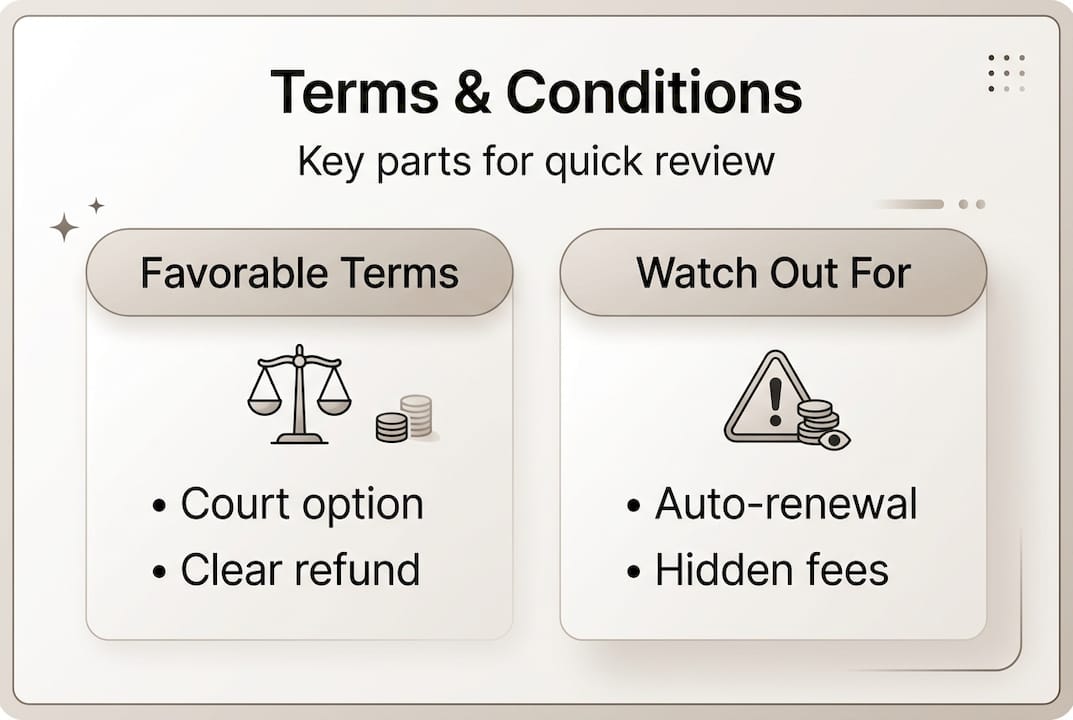
Favorable vs. unfavorable clauses at a glance:
| Clause type | Favorable to you | Unfavorable to you |
|---|---|---|
| Dispute resolution | Option to sue in court | Mandatory binding arbitration only |
| Liability limit | Actual damages covered | Capped at purchase price |
| Cancellation | Cancel anytime, full refund | Long notice period, no refund |
| Data use | Data not shared without consent | Data sold or shared broadly |
| Auto-renewal | Advance notice required | Automatic renewal with no warning |
| Governing law | Your home state or jurisdiction | Company's preferred jurisdiction |
Use this table as a quick-reference checklist when you open a T&C document. A useful contract review checklist can further structure your review so nothing slips through the cracks.
Pro Tip: Jump straight to the "Dispute Resolution" and "Limitation of Liability" sections first. These two clauses have the biggest impact on what recourse you actually have if something goes wrong.
Small businesses entering vendor agreements, software licenses, or supplier contracts face extra complexity here. Knowing the difference between standard and negotiable language is key. Resources on contract drafting strategies can help you understand which terms are typically boilerplate and which ones vendors will actually move on.
Unfair terms: How legal protections apply to individuals and small businesses
Understanding T&C components highlights the need to watch for unfair terms, especially for individuals and small business owners who often have less negotiating power than large corporations.
A term is generally considered "unfair" when it creates a significant imbalance in the parties' rights and obligations. Legal frameworks around the world address this. For example, unfair contract terms protections make such terms void if they cause a significant imbalance in rights, are not reasonably necessary to protect legitimate business interests, and cause detriment to the other party. Notably, these protections extend to small businesses with fewer than 100 employees or under a certain annual turnover threshold.
In the United States, consumer protection laws at both the federal and state level address similar concerns. The Federal Trade Commission Act prohibits unfair or deceptive business practices. Many states have their own consumer protection statutes that go further.
Examples of potentially unfair terms:
- A clause stating the company can change prices mid-contract without notice
- A term that holds you liable for the company's own negligence
- A unilateral modification clause that lets the company change any term at any time without your consent
- A dispute clause that requires you to file in a court located thousands of miles away from you
How to assess whether a term is unfair:
| Factor | What to look for |
|---|---|
| Significant imbalance | Does the clause give the company rights without matching obligations? |
| Legitimate necessity | Is the clause genuinely needed to protect a real business interest? |
| Detriment to you | Would this clause cost you money, rights, or options if enforced? |
| Transparency | Was the clause clearly disclosed before you accepted? |
Knowing your legal obligations in contracts and those of the other party helps you spot terms that overstep legitimate bounds.
For small businesses specifically, the stakes are higher because you may be signing vendor agreements, software as a service contracts, or supplier terms that your whole operation depends on. Getting small business legal guidance before signing high-value agreements is not overcaution, it is smart risk management.
How to challenge or negotiate unfair terms:
- Write to the company before signing and request amendments in writing
- Ask for the clause to be removed or replaced with a mutual obligation
- If they refuse, consider whether the service is worth the risk
- Document all communications in case you need to show you objected
Pro Tip: If you are a small business and the vendor refuses to negotiate any term in a standard form contract, that itself is a legal signal. Courts may consider a company's unwillingness to modify terms when assessing fairness.
Practical tips for reviewing and negotiating terms and conditions
Now that you know your rights and protections, here is how to apply them when reviewing or negotiating T&Cs. Having a structured approach makes the difference between glossing over something costly and catching it before you are committed.
A step-by-step review process:
- Start with the dispute resolution clause. If it contains mandatory arbitration, you should know immediately, because it affects every other right you hold under the contract.
- Read the liability limitation section. Understand exactly what the company will owe you if their product or service fails.
- Check for automatic renewals and cancellation policies. Know how to exit before you enter.
- Review the data and privacy section. What data they collect, what they do with it, and who they share it with directly affects you.
- Look for unilateral modification rights. Can they change the terms without your consent? If yes, you have very little certainty.
- Check the governing law and jurisdiction clause. A dispute clause requiring litigation in another state can be prohibitively expensive.
- Flag any clause you do not understand. Write it down and get it clarified before you sign or click agree.
One critical point: T&Cs cannot override statutory rights you hold under law. Statutory consumer guarantees such as cooling-off periods exist whether or not a company includes them in its T&Cs. If a company's terms purport to eliminate your statutory rights, those specific clauses are generally unenforceable.
"A contract clause cannot legally strip you of rights the government has decided you must always have, no matter what you agree to in writing."
Non-EU providers are often less compliant with consumer protection requirements than their European counterparts, so extra caution is warranted when signing up with international platforms.
Pro Tip: If you are reviewing a complex T&C for a business contract, use a multijurisdictional contract checklist to catch jurisdiction-specific obligations that a generic review might miss.
When should you get a lawyer involved?
Not every T&C needs a lawyer's review. But you should consult one when you are signing a multi-year agreement, when large sums of money are at stake, when the contract involves intellectual property you created, or when you are being asked to waive significant legal rights. The cost of a one-hour legal review is almost always less than the cost of a dispute you could have avoided.
A fresh perspective: What most people miss about terms and conditions
Here is something most guides will not tell you: skimming is almost as dangerous as not reading at all. When people skim T&Cs, they tend to notice familiar words like "agreement," "payment," and "cancel," while completely missing the structural clauses that actually determine outcomes. Arbitration clauses, indemnification provisions, and unilateral modification rights rarely use alarming language. They are written to sound routine, because that is how companies ensure they get accepted without friction.
There is also a false sense of security that comes from using AI tools to summarize T&Cs. AI summaries are helpful starting points, but they can miss nuance, fail to flag jurisdiction-specific risks, or oversimplify clauses that need professional interpretation. Relying solely on a summary without reading the flagged sections yourself introduces a different kind of risk.
What years of observing legal disputes reveal is that most T&C problems are not about dramatic, obviously unfair clauses. They are about ordinary clauses that become problematic in specific situations nobody anticipated when signing. A standard "no refunds after 30 days" clause seems fine until your subscription fails on day 29 and the company takes no responsibility.
The smartest approach is to consult legal experts when context demands it, use AI tools to surface the right questions, and always read at least the three or four sections that matter most for your specific situation. Treating every T&C as a formality is a choice, but it is an informed risk only when you actually understand what you are accepting.
How BXP Legal AI can help you navigate terms and conditions
Reviewing T&Cs does not have to mean hours of confusion or expensive legal consultations for every agreement you encounter.
BXP Legal AI is built to help individuals and small business owners cut through complex legal language quickly. Whether you need to understand a specific clause, check whether a term is potentially unfair, or get instant guidance on dispute resolution provisions, the BXP Legal AI features platform delivers answers backed by authoritative citations. You can ask plain-language questions and get reliable, structured responses across contract law, consumer rights, privacy law, and more. Visit BXP Legal to explore how AI-powered legal tools can make your next T&C review faster, clearer, and far more informed.
Frequently asked questions
Are terms and conditions always legally binding?
Terms and conditions become legally binding when properly accepted by the user, but enforceability depends heavily on how acceptance is captured. Clickwrap agreements with an affirmative "I agree" click are the strongest, while browsewrap agreements often fail in court due to insufficient notice.
What should small businesses check first in T&Cs?
Small businesses should prioritize checking for unfair terms, limitation of liability clauses, payment and auto-renewal terms, and dispute resolution provisions. Unfair terms in standard form contracts that cause significant imbalance can be void, giving small businesses a legal basis to challenge or avoid them.
Can terms and conditions override consumer guarantees?
No, T&Cs cannot override statutory consumer guarantees. Statutory cooling-off periods and other legislated rights exist independently of whatever the contract says, and any clause attempting to eliminate them is generally unenforceable.
How long are typical terms and conditions?
The average T&C document is approximately 2,657 words long, and most users only spend about 73 seconds skimming it before accepting, which leaves most of the content unreviewed.