
TL;DR:
- Legal research involves a structured, step-by-step process focusing on preparation and jurisdiction.
- Small businesses should prioritize free, official sources and verify legal sources with citators.
- Maintaining an open, skeptical mindset ensures reliable results and reduces legal risks.
Missing a single clause in a contract or overlooking one compliance requirement can cost a small business thousands of dollars in penalties, disputes, or wasted legal fees. Legal research is the process of finding and analyzing the law that applies to your specific situation, and it is something non-lawyers can absolutely do with the right framework. This guide walks you through every stage, from organizing your facts to verifying your sources, so you can approach contracts and compliance with confidence rather than guesswork. You do not need a law degree to follow these steps — you need a clear process and the discipline to see it through.
Table of Contents
- What you need before you start: preparation and mindset
- Step-by-step legal research process explained
- Choosing the right sources: free tools vs. paid databases
- Verifying your research: citators and avoiding common pitfalls
- Analyzing and applying your findings for contracts and compliance
- Our perspective: Why legal research is about mindset, not just method
- Take the next step: Simplify your legal research with BXP Legal AI
- Frequently asked questions
Key Takeaways
| Point | Details |
|---|---|
| Start with clear facts | Accurately defining your issue and jurisdiction is the foundation for effective legal research. |
| Follow structured steps | Use a proven, step-by-step method but expect to revisit steps as your understanding grows. |
| Prioritize free sources | Begin with official and reputable free tools before considering paid databases. |
| Always verify authority | Ensure laws and cases are current using citators to avoid acting on outdated information. |
| Apply and review regularly | Turn research into actionable steps and routinely check for updates in legal requirements. |
What you need before you start: preparation and mindset
Before you search a single database or open a government website, get clear on two things: exactly what your legal question is, and which jurisdiction (the geographic or governmental authority whose laws apply to your situation) governs it. These two elements shape everything that follows. Skipping them leads to the common legal research mistakes that trip up even experienced researchers.
Legal research follows a structured, step-by-step process that emphasizes preparation and jurisdiction before anything else. That means you need to understand whether your issue is governed by federal law, state law, local ordinances, or some combination of all three. A contract dispute between two businesses in different states, for example, may trigger very different rules than a local employment matter.
Here is what to gather before you start researching:
- Your legal question, written out in plain language (e.g., "Does this non-compete clause in my contractor agreement comply with Texas law?")
- All relevant documents, including contracts, emails, invoices, and prior correspondence
- The parties involved and their locations
- Key dates, because statutes of limitation (legal deadlines for taking action) are jurisdiction-specific
- Any prior legal advice you have received on this matter
Research is iterative. You will often start with one question and discover three more along the way. That is normal. The clear legal research steps used by professionals allow for this looping back, so do not treat a change in direction as a failure.
| Factor | What to identify |
|---|---|
| Jurisdiction | Federal, state, or local |
| Type of law | Contract, regulatory, employment |
| Governing clause | Choice of law provision in contract |
| Applicable timeline | Filing deadlines, renewal dates |
Small businesses especially benefit from upfront clarity. Review our resource on legal guidance for small businesses if you are unsure where your issue fits.
Pro Tip: Write your facts and legal questions in a simple document before you open any search tool. This single habit saves hours of unfocused searching later.
Step-by-step legal research process explained
With your problem and facts mapped, follow this structured workflow. The structured legal research process covers six core stages, and each one builds on the last.
- Analyze the issue. Break your problem into specific legal sub-questions. What area of law applies? What facts are legally significant?
- Consult secondary sources. Secondary sources (legal encyclopedias, practice guides, law review articles) explain the law in context. They are not binding authority, but they point you toward the right statutes and cases.
- Locate statutes and regulations. Find the primary law (actual legislation or regulatory rules) on official government websites. For federal issues, start with congress.gov or the Code of Federal Regulations (CFR).
- Find relevant case law. Courts interpret statutes. Case law shows how judges have applied the law in real disputes, which is critical for understanding how a contract clause or compliance issue will be evaluated.
- Run a citator check. A citator (such as Shepard's or KeyCite) tells you whether a statute or case is still valid, has been amended, or was overturned. This step is non-negotiable.
- Organize your results. Document what you found, where you found it, and how it applies to your facts. This record becomes your reference for drafting or compliance decisions.
The research process is iterative, meaning step 4 might send you back to step 2. Embrace that. For independent legal research steps that go deeper into each stage, it helps to pair your research with a solid approach to drafting compliant legal documents.

| Step | Action | Free tool |
|---|---|---|
| 1. Analyze | Define legal sub-questions | Pen and paper, notes app |
| 2. Secondary sources | Read guides and encyclopedias | Google, law library portals |
| 3. Statutes | Find governing legislation | congress.gov, state legislature sites |
| 4. Case law | Find court decisions | Google Scholar, CourtListener |
| 5. Citator | Verify source currency | Free citator on Fastcase |
| 6. Organize | Document findings | Spreadsheet, Google Docs |
Review our guide on steps for SMB compliance to see how this process maps to real business scenarios.
Pro Tip: Always start with free official resources before paying for anything. Government websites and Google Scholar cover the majority of what most small businesses need.
Choosing the right sources: free tools vs. paid databases
Not all legal research requires a paid subscription. Small businesses should prioritize free resources — including state and federal government websites, Google Scholar, and legal encyclopedias — before turning to paid tools.
Here are the most reliable free options:
- Government websites (.gov): Find statutes, regulations, and agency guidance directly from the source.
- Google Scholar: Search published court opinions across federal and state courts at no cost.
- CourtListener (via Free Law Project): Excellent for federal case law and some state decisions.
- Legal encyclopedias and guides: Resources like Cornell Law School's Legal Information Institute (LII) offer plain-English overviews of most legal topics.
- Public law libraries: Many jurisdictions offer free public access to professional databases on-site.
Paid tools become valuable when your issue is complex, spans multiple jurisdictions, or requires advanced citation analysis. Platforms like Westlaw and LexisNexis offer powerful search capabilities and reliable citator tools. However, these cost hundreds of dollars per month and are rarely necessary for routine small business research.
For help understanding how to find relevant cases within these databases, the University of Oregon's legal research resource is a practical reference.
| Feature | Free tools | Paid databases |
|---|---|---|
| Cost | $0 | $100 to $500+ per month |
| Accessibility | Open to anyone | Subscription required |
| Citator quality | Limited (Fastcase basic) | Full Shepard's or KeyCite |
| Search precision | Basic keyword | Advanced Boolean, filters |
| Reliability | High for official .gov | Very high, updated daily |
If you are working on a contract review, pair your research with a contract review checklist to ensure nothing slips through. For an overview of how AI can support the process, explore AI legal tools for contracts.
Verifying your research: citators and avoiding common pitfalls
Finding a statute or court case is only half the job. You must also confirm it is still good law. A citator is a tool that tracks the history and treatment of a legal authority — showing whether a case was affirmed, overturned, or distinguished, and whether a statute has been amended.
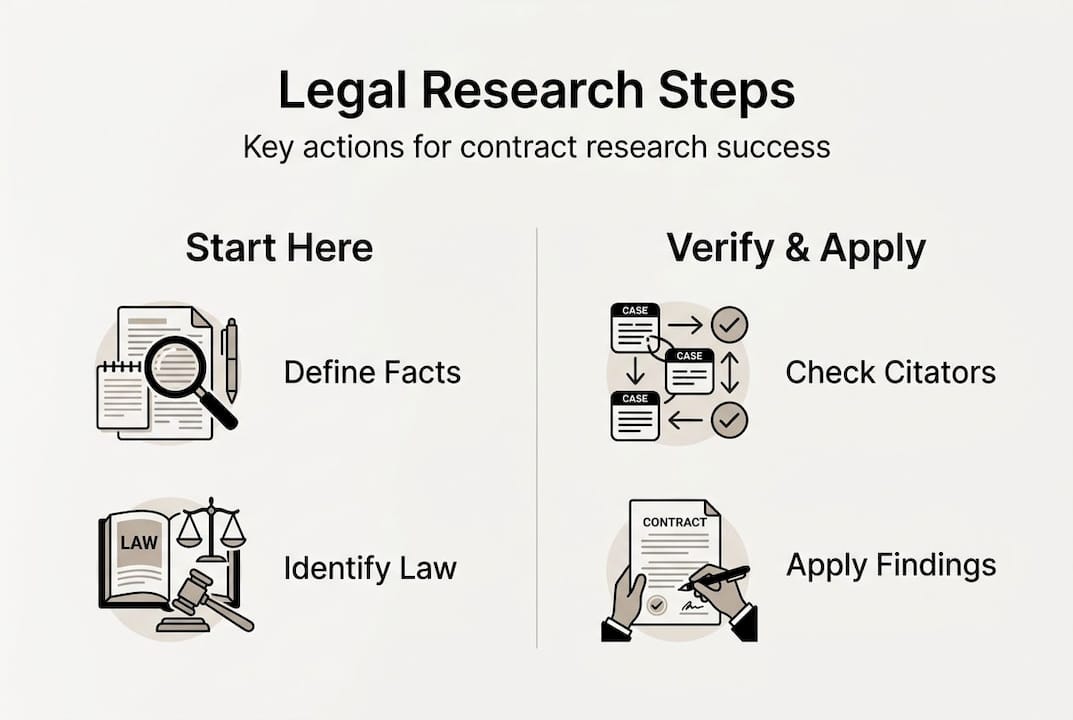
The two most widely used citators are Shepard's (on LexisNexis) and KeyCite (on Westlaw). Fastcase, which is free through many state bar associations, also offers basic citator functionality.
Common pitfalls that trip up non-professional researchers include:
- Wrong jurisdiction: Using a federal statute for a state-level issue, or vice versa
- Outdated sources: Relying on a regulation that was amended six months ago
- Overreliance on secondary sources: Treating a law review article as binding legal authority
- Skipping citator checks: Assuming the case or statute you found is still valid without verifying
- Missing local variations: Overlooking city or county ordinances that modify state law
"Citators should verify the status of every case and statute you rely on; the most frequent errors involve missed jurisdiction, outdated sources, and faulty citations."
The numbers reinforce this: according to research methodology mistakes documented in legal library research, a significant share of non-lawyer errors involve sources that were no longer current at the time of use. One missed citator check can mean building a contract clause around a rule that no longer applies.
For a deeper look at how legal citation accuracy affects real-world outcomes, and to sharpen your verification habits, review these legal research techniques used by experienced practitioners.
Analyzing and applying your findings for contracts and compliance
With reliable sources verified, you are ready to turn your research into practical business decisions. This stage is where the work becomes real. Legal research is not complete without organizing, analyzing, and rechecking findings, especially when the stakes involve contracts or compliance obligations.
Follow this process to make your findings actionable:
- Summarize the applicable law in plain language. Write one or two sentences explaining what the statute or ruling actually requires.
- Apply it to your specific facts. Does your contract clause or business practice meet the requirement? Where are the gaps?
- Document your reasoning. Record not just the conclusion but why you reached it. This matters enormously if you are ever audited or face a dispute.
- Draft or revise your document. Use your findings to adjust contract language or update your compliance policy. The SMB compliance checklist is a practical tool for this step.
- Schedule a review date. Laws change. Build a reminder to recheck your research every six to twelve months, or immediately after any significant regulatory announcement.
For guidance on analyzing research results at a deeper level, the University of Oregon's open legal research textbook offers excellent structured guidance.
Pro Tip: When you save your research, save the reasoning alongside the conclusion. If your business is ever reviewed or challenged, an audit trail showing your good-faith research process is a powerful protection.
Our perspective: Why legal research is about mindset, not just method
Here is something most legal guides will not tell you: the steps are the easy part. The real challenge is maintaining an open, skeptical mindset as you go. It is remarkably easy to find a statute, confirm it looks relevant, and stop. The discipline to ask "Is this the current version? Does a local ordinance change this? Has a court interpreted this differently in my jurisdiction?" is what separates genuinely useful research from research that just feels complete.
We have seen this pattern repeatedly. Even experienced researchers fall into the trap of treating a statutory citation as final. They find the rule, note the citation, and move on — never running that one extra citator check that would have revealed a 2025 amendment. For small businesses, that mistake is not academic. It shows up in contract disputes and compliance penalties.
The iterative nature of legal research is not a flaw in the process. It is the process. Every loop back, every re-checked assumption, every revised question makes your final answer more reliable. Treat the legal research techniques as a mindset framework rather than a linear checklist, and your results will be far more trustworthy.
Take the next step: Simplify your legal research with BXP Legal AI
Now that you have a clear, step-by-step framework, the right tools can dramatically reduce the time and effort required. BXP Legal AI is built for exactly this situation.
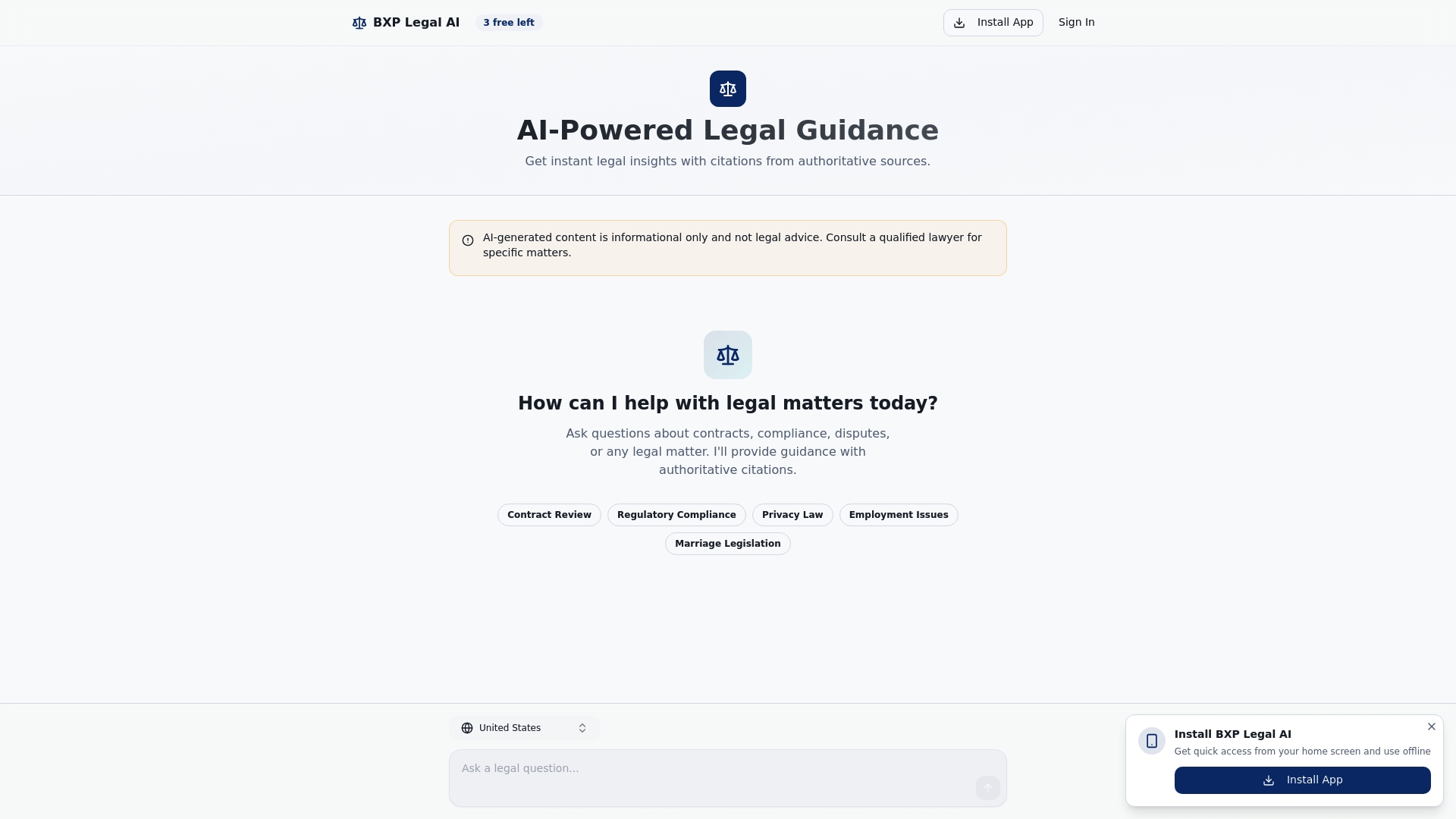
AI-powered legal research on BXP Legal gives you instant access to authoritative legal guidance across contract law, compliance, employment issues, and more — all backed by citations so you can verify every answer. You can draft, review, and refine documents faster, and track compliance requirements without combing through dense regulatory text. Explore ready-to-use legal templates to put your research into practice immediately. The platform is designed for individuals and small business owners who want to move faster and smarter without replacing qualified legal counsel.
Frequently asked questions
What is the first step in legal research for small business contracts?
Start by analyzing the facts of your situation and clearly identifying the legal issue and relevant jurisdiction before searching any database or source.
What reliable free resources can I use for legal research?
Free public resources like government (.gov) websites, Google Scholar, and Cornell Law's Legal Information Institute cover the majority of what small businesses need before considering paid tools.
How do I verify if a legal source is still good law?
Citators verify the current validity of statutes and cases — use Shepard's, KeyCite, or the free citator on Fastcase to confirm nothing has been overturned or amended.
What are the most common mistakes in legal research?
Most frequent errors involve using the wrong jurisdiction, relying on outdated statutes or cases, and skipping the citator verification step entirely.
How can AI tools help with legal research?
AI legal research tools used by a growing share of firms can suggest relevant statutes and cases quickly, but every result still requires careful human verification before you rely on it.