
TL;DR:
- Small retail businesses must honor their privacy promises or face enforcement actions from regulators.
- To create a compliant privacy policy, businesses need a comprehensive understanding of their data flows and legal obligations beforehand.
- Maintaining an accurate, clear, and regularly updated policy is essential for ongoing compliance and customer trust.
A small retail business receives a cease-and-desist letter from the FTC because its website promises "we never sell your data" while a third-party marketing vendor was quietly receiving customer email lists. That scenario plays out more often than you'd think, and the FTC warns that businesses must honor every privacy promise they make or face enforcement action. For small and medium-sized business owners, a privacy policy isn't just legal fine print. It's a binding commitment to your customers, and getting it wrong can cost you far more than getting it right.
Table of Contents
- What you need before you start
- Step-by-step guide to drafting your privacy policy
- Making your privacy policy clear, accessible, and compliant
- Common pitfalls, special cases, and keeping your policy current
- The hard truth: Privacy policy compliance is an ongoing process
- How BXP Legal can help simplify privacy compliance
- Frequently asked questions
Key Takeaways
| Point | Details |
|---|---|
| Start with data mapping | You can’t draft an honest policy without first understanding your actual data flows and sharing. |
| Use required sections | Include contact info, data types, usage, recipients, retention, rights, and complaints to cover compliance basics. |
| Plain and prominent presentation | A clear, accessible policy placed where users expect it builds trust and helps meet legal standards. |
| Updates protect you | Review and update your policy regularly, especially as laws or practices change, to avoid risk. |
| No copying—stay accurate | Using others’ text often results in legal and reputational danger; reflect your actual practices every time. |
What you need before you start
With the stakes established, let's focus on what you need in hand before you write a single word of your policy.
The most common mistake SMB owners make is opening a blank document and starting to type. Or worse, copying a policy from a competitor's website and swapping out the company name. Both approaches leave you legally exposed because they skip the most important step: understanding your own data flows before you describe them to anyone else.
According to the ICO's guidance on privacy notices, you need to gather specific information before you draft anything, including contact details, types of personal data collected, sources of that data when it doesn't come directly from the user, purposes for use, the lawful basis for processing, recipients who receive the data, and retention periods. That's a substantial list, and each item requires you to look inward at your actual operations.
Here's a simple table to organize what you need and why each item matters:
| Information to gather | Why it matters |
|---|---|
| Business contact details | Users need to know who to contact with privacy concerns |
| Types of personal data collected | Defines the scope of your legal obligations |
| Source of data (if indirect) | Required disclosure when data comes from third parties |
| Purpose of data collection | Justifies why you hold the data at all |
| Lawful basis for processing | GDPR and similar laws require a stated legal ground |
| Who you share data with | Identifies third-party risk and vendor relationships |
| Data retention periods | Shows you don't hold data longer than needed |
| User rights and complaint process | Required by most modern privacy laws |
Think of this as your "data map." Mapping your data flows means writing down every touchpoint where your business collects, stores, uses, or passes along personal information. That includes your contact form, checkout page, newsletter signup, analytics tools, CRM system, and even your social media plugins. Our compliance drafting checklist walks you through this mapping process in detail, and the SMB compliance checklist covers the broader regulatory landscape you'll need to factor in.
Pro Tip: Don't overlook special cases. If your website uses cookies, retargeting pixels, or session replay tools, those are data collection practices that need explicit disclosure. If any part of your service could appeal to children under 13, children's privacy rules apply to you automatically, even if you didn't intend to target that group.
Step-by-step guide to drafting your privacy policy
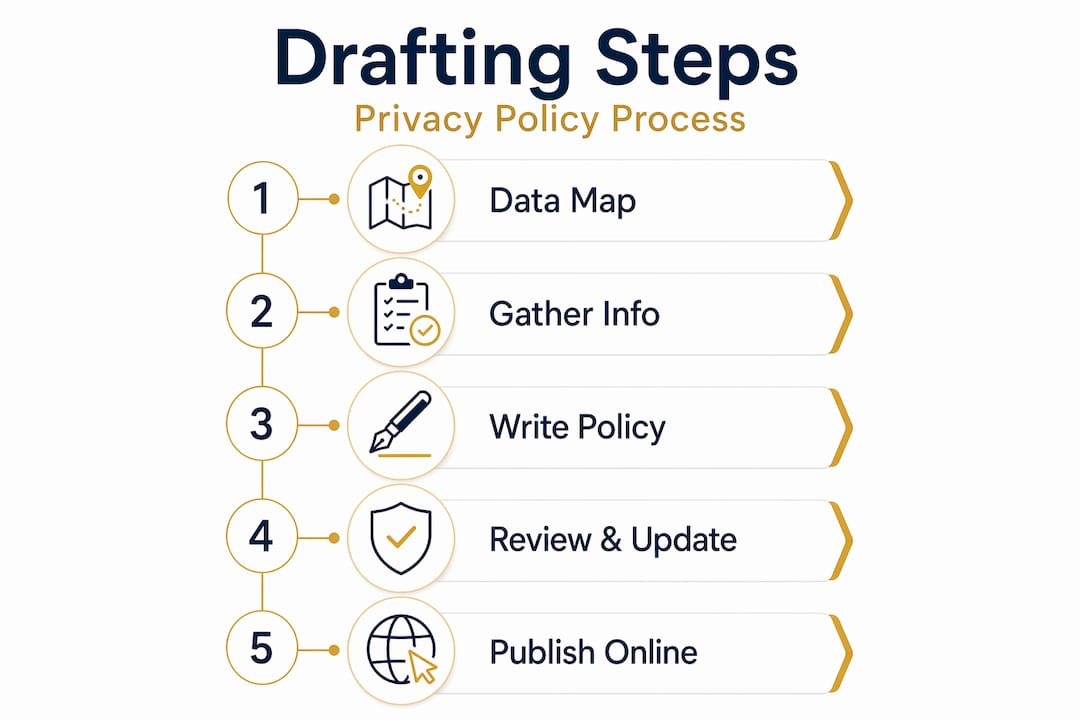
Once your materials are gathered, it's time to write. Here's a proven step-by-step method that mirrors how professional privacy attorneys approach the work.
A practical data flow mapping approach starts by documenting what data you collect and why, then identifies which privacy laws and platform rules apply to your situation, then moves into drafting clear, purpose-based disclosure sections before addressing technical elements like cookies and trackers. Following a logical sequence like this keeps your policy internally consistent and reduces the risk of contradictions.
Here's the full 12-step framework:
- Complete your data map before writing anything.
- Identify applicable laws (GDPR, CCPA, COPPA, state-specific rules).
- List every vendor and third party that touches your customer data.
- Choose a structure and plain-language tone appropriate for your audience.
- Open with your identity and contact information so users know who is responsible.
- Define what data you collect and how with concrete specifics, not vague language.
- State the purpose of each data type and the lawful basis where required.
- Disclose all third-party sharing including analytics, advertising, and payment processors.
- Address cookies and tracking technologies in a separate, clearly labeled section.
- Describe your data retention periods for each data category.
- Outline user rights and provide a simple way to exercise them.
- Include your update and governance process so users know the policy is actively maintained.
For businesses that serve European customers or operate platforms with international reach, a layered approach to GDPR privacy notices helps avoid overwhelming users. The first layer is a short, clear summary. The second layer provides the full legal detail for users who need it. This structure works well for SMBs because it respects both reader attention and regulatory requirements.
A comparison of approaches is useful here:
| Drafting approach | Best for | Risk level |
|---|---|---|
| Copy from competitor | Businesses trying to save time | Very high: likely mismatch with real practices |
| Generic template (unedited) | No real use case | High: false sense of compliance |
| Template with customization | Businesses with simple data flows | Moderate: needs careful review |
| Custom draft from data map | Any business with a real compliance goal | Low: reflects operational reality |
The essential compliance steps for SMBs always include policy documentation, and understanding legal notice basics helps you see where a privacy policy fits within your broader set of obligations. You can also explore the types of compliance documents every growing business needs.
Pro Tip: Use your actual vendor list when drafting. Don't say "we may share data with advertising partners." Say "we share data with Google Analytics and Meta Pixel for advertising measurement purposes." Specificity protects you because vague language invites interpretation, and that interpretation might not go your way in an enforcement action.
Making your privacy policy clear, accessible, and compliant
After your content is drafted, presentation and ongoing accuracy make the difference between window dressing and real compliance.

A privacy policy that lives only in a hard-to-find corner of your website does not serve its legal or ethical purpose. The ICO emphasizes that your policy must explain individuals' rights and how to complain, and it must use simple, understandable language. That second point trips up a lot of SMB owners who assume legalistic language makes their policy stronger. It doesn't. It just makes it unreadable, and regulators take accessibility seriously.
BBB guidance for small businesses stresses four pillars: operational accuracy, plain language, prominent placement, and keeping the policy current. These aren't suggestions. They're the criteria regulators and courts use to evaluate whether a business was acting in good faith.
Here's where your policy should appear:
- Website footer on every page, as a permanent link
- Homepage with a visible reference or summary notice
- At every data-collection point: checkout forms, contact forms, newsletter signups, and account creation pages
- In any app if your business has a mobile presence
- In onboarding emails when users create accounts or subscribe
On language: replace "we process personal data for operational efficiency" with "we use your name and email address to send you order updates." Replace "third-party data processors" with "companies we hire to help run our website, like our email service provider." Short sentences, active verbs, and everyday words make your policy both more readable and more legally credible.
Keep it real. Never copy generic text that doesn't reflect what you actually do. If your policy says you don't sell data but your analytics vendor monetizes user behavior, you have a problem. Accuracy is your first line of defense, not perfect phrasing.
Understanding why compliance matters for small businesses and the value of compliance frameworks can help you see this as a business asset rather than a legal burden.
Common pitfalls, special cases, and keeping your policy current
The real test of a privacy policy is how it holds up as your business changes. Here's how to keep pace.
The three most common mistakes SMBs make are:
-
Stale policies: A policy written in 2021 that hasn't been touched since is almost certainly outdated. Data practices evolve fast, new vendors get added, and the law changes. The FTC actively enforces against businesses whose practices don't match their stated policies, and a stale policy is an open invitation for mismatches.
-
Mismatched claims: Your policy says you don't collect sensitive data, but your checkout form asks for birth date and health conditions. Your policy says you don't use third-party advertising, but you installed a social media retargeting pixel six months ago and forgot about it. These mismatches are where enforcement cases start.
-
Missing special-case disclosures: Cookies, session replay tools, and children's data each require their own clear disclosures. Many SMBs address the general data picture but skip the technical details that regulators specifically look for.
On children's privacy: if your business, product, or content could reasonably attract children under 13, COPPA applies. That means your policy must explain what data you collect from children, how you use it, and how parents can review, delete, or restrict it. It also means you need verifiable parental consent before collecting any personal information from that age group. This is not optional, and the FTC has levied multi-million-dollar fines against businesses that ignored it.
State privacy law is expanding rapidly. Practical guidance for navigating US state law requirements shows that states like California, Colorado, Virginia, Texas, and others now require prescriptive disclosures that go well beyond generic data practices language. If you sell to customers in multiple states, you may need to address state-specific rights directly in your policy or in a supplemental state law addendum.
Pro Tip: Put a recurring privacy policy review on your calendar right now. Set it for the same date every year, and build a short internal checklist: have any new vendors been added? Have data collection practices changed? Have new state or federal rules taken effect? Assign one person on your team to own this review process. The legal compliance guide for small businesses can serve as a reference for structuring that review.
The hard truth: Privacy policy compliance is an ongoing process
Now that you know how to get it right, let's talk about what really drives sustainable privacy compliance.
Most SMB owners treat drafting a privacy policy as a one-time event. They write it, post it, and move on. That approach works fine until the business adds a new email automation tool, starts running paid ads with audience tracking, or expands into a new state with its own consumer data law. At that point, the policy becomes a liability rather than a protection.
The uncomfortable reality is that enforcement rarely hinges on whether your legal language was perfectly worded. It hinges on whether your actual practices matched what you told your customers you were doing. A business with a beautifully written policy that doesn't reflect its real operations is far more exposed than a business with a plain-language policy that's scrupulously accurate.
What works in the long run is treating your data map as a living document rather than a one-time exercise. When you onboard a new vendor that touches customer data, update the map. When you change how long you store transaction records, update the map. When your map changes, your policy follows. That discipline, more than any other single practice, keeps you on the right side of regulators.
We also encourage you to build a culture of accuracy over a culture of fear. Privacy compliance isn't about finding perfect legal language to shield you from liability. It's about building systems that actually protect your customers' data and being honest about how those systems work. Businesses that approach it that way earn customer trust as a side benefit. Understanding why small businesses need legal guidance at the right stages of growth can help you decide when to bring in a professional versus when solid internal processes are enough.
How BXP Legal can help simplify privacy compliance
Reliable compliance solutions can help put these best practices on autopilot while you focus on growth.
Drafting a privacy policy that accurately reflects your data practices, stays current with evolving laws, and reads clearly to your customers is a significant undertaking for any SMB owner juggling operations, sales, and customer service at the same time.
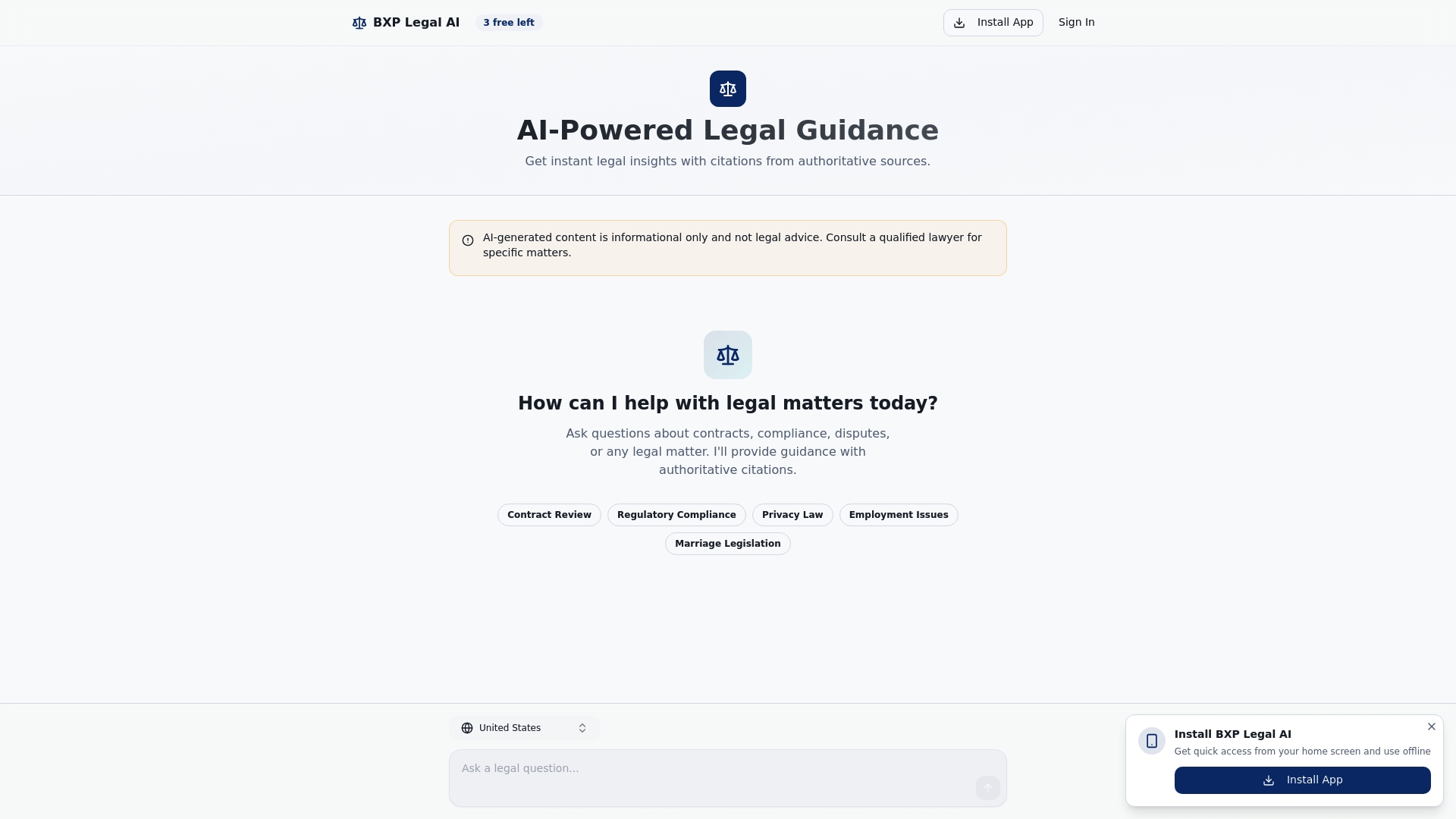
That's where the BXP Legal platform comes in. BXP Legal gives small and medium-sized business owners instant access to AI-powered legal guidance across privacy law, compliance, contract drafting, and more. You can ask specific questions about your privacy policy obligations, get answers backed by authoritative citations, and use the platform's AI legal drafting features to generate and review policy language that reflects your actual data practices. Whether you're starting from scratch or updating an existing policy to address new state laws, BXP Legal reduces the time and uncertainty that typically pushes SMB owners toward risky copy-paste shortcuts.
Frequently asked questions
What information does a privacy policy need to include for compliance?
A privacy policy must list your contact details, the types of personal data you collect, sources of that data, purposes for use, sharing arrangements, retention periods, user rights, and how to file a complaint, as required by major privacy frameworks.
Do privacy policies need to be updated regularly?
Yes, you should update your policy whenever your data practices change and conduct a full review at minimum once a year to catch any gaps between stated practices and operational reality.
How should privacy policies for children's websites differ?
They must comply with COPPA's parental consent requirements, clearly explain what information is collected from children under 13, and provide parents with the ability to review and delete that data.
What risks come from copying another company's privacy policy?
Copying creates a mismatch between your stated promises and your actual data practices, which opens businesses to FTC and state-level enforcement action whenever those promises aren't honored.
Should my privacy policy mention cookies and data trackers?
Yes, if you use cookies, pixels, or session replay tools, your policy must clearly explain their use and give users meaningful control options, particularly for non-essential tracking.